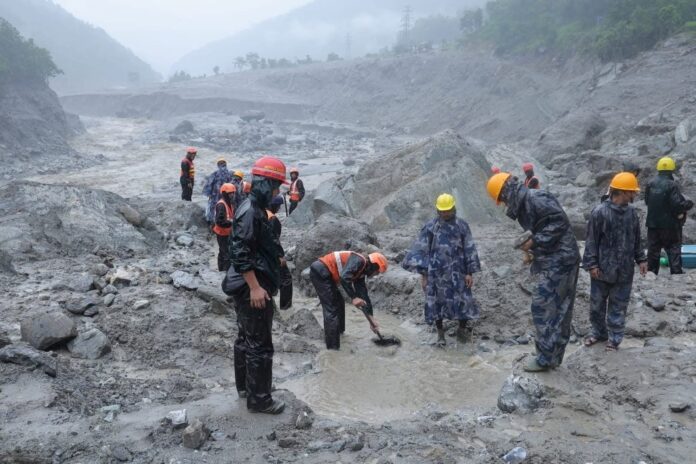
Rescue teams in Nepal and Tibet are racing against time to locate thousands of people still missing after a devastating surge of water and debris swept through villages along the Himalayan border. At least 768 deaths have been confirmed, while authorities continue searching through thick mud and unstable terrain for survivors and bodies.
Highlights
- At least 768 deaths have been confirmed.
- More than 3,000 people remain missing or unaccounted for.
- Over 3,700 people have been rescued in Nepal.
- More than 100 hydropower workers are believed trapped in tunnels.
- Authorities are warning of another potential rise in floodwaters.
Main Story
Search continues after deadly Himalayan disaster
Rescuers in Nepal and Tibet are facing difficult conditions as they search for people missing after a massive wall of water tore through communities along the Himalayan border.
The latest figures put the number of missing people at 3,048, including hundreds of foreign nationals.
Authorities have confirmed 768 deaths, while some bodies are believed to have been carried downstream, potentially reaching areas in India.
The disaster struck early Wednesday after a glacial collapse triggered a huge surge of water, mud and debris. The US Geological Survey identified the collapse as the cause of the destructive event.
Nepal begins identifying victims
Nepalese authorities have started burying some of the recovered bodies as the search continues.
Before burial, officials are collecting DNA samples to help identify the victims and allow families to recover their remains later.
The approach is particularly important in Nepal, where families traditionally carry out specific funeral rites following the identification of their loved ones.
Nepal’s Foreign Minister Shisir Khanal has also used the disaster to highlight the country’s vulnerability to climate change.
He argued that Nepal contributes only a tiny fraction of global greenhouse gas emissions but continues to experience severe consequences linked to a changing climate.
Hundreds of hydropower workers missing
More than 3,700 people have so far been rescued in Nepal.
Across the border in Tibet, Chinese authorities reported 16 deaths and 546 people missing. Among those missing are hundreds of foreign nationals, including citizens from Nepal, India, Latvia, the United States and the United Kingdom.
One of the most urgent rescue operations is taking place at the Trishuli 3A hydroelectric project in Nepal.
The army managed to insert a pipe into a tunnel where more than 100 workers are believed to be trapped.
Home Minister Sudan Gurung said rescuers had begun pumping air through the opening and planned to excavate the area before sending teams into the tunnel.
The workers are among 933 hydropower employees listed as missing by Nepal’s disaster authorities.
Rescue teams are concentrating on the Trishuli 3A and 3B facilities as they try to determine whether workers trapped underground can still be reached alive.
Authorities warn of more flooding
Even as rescue operations continue, officials are dealing with another potential threat.
Nepal’s disaster management authority has warned that water levels in the Bhotekoshi River in Rasuwa have risen further.
Rescue teams have consequently been urged to remain cautious as they work in areas that could be affected by additional flooding.
The combination of unstable terrain, rising rivers and difficult access is making the search increasingly dangerous.
Climate crisis puts Nepal in the spotlight
Nepal’s government has called for stronger international action on climate change, arguing that Himalayan communities are facing consequences they did little to cause.
The disaster has once again highlighted the risks faced by communities living near glaciers, rivers and hydropower projects in mountainous regions.
As rescue workers continue digging through mud and debris, families are left waiting for news of relatives whose whereabouts remain unknown.
For thousands of families still waiting for answers, every hour matters and amid the mud, debris and rising waters, rescuers continue to race against time to bring hope to those who may still be alive.

