
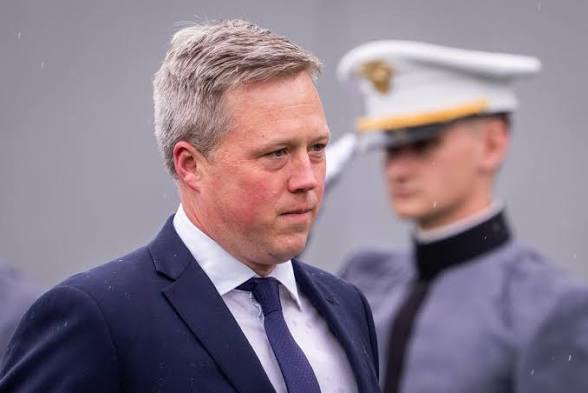
US Army Secretary Dan Driscoll has resigned from his position after roughly 18 months in office, becoming the latest senior military figure to leave the Pentagon amid reported tensions with Defence Secretary Pete Hegseth. Driscoll, who became known as Donald Trump’s “drone guy”, leaves behind a tenure marked by military technology initiatives, diplomacy over the Russia-Ukraine war and a prominent role in the administration’s domestic security operations.
Highlights
- Dan Driscoll has resigned as US Army Secretary after about 18 months.
- His departure follows reported tensions with Defence Secretary Pete Hegseth.
- Driscoll was the youngest person to serve as Army Secretary.
- He became known for promoting drone and emerging battlefield technologies.
- His exit adds to a growing list of senior US military officials who have recently left their positions.
Main Story
Driscoll Leaves Army Leadership
Dan Driscoll has stepped down as Secretary of the US Army, ending a relatively short but high-profile period at the top of the service.
His resignation was reported by CBS, which cited months of disagreements between Driscoll and Defence Secretary Pete Hegseth.
The White House, however, praised his record, describing him as an effective leader who advanced President Donald Trump’s defence agenda and provided strong leadership during military operations.
Driscoll, 41, made history as the youngest person to serve as Army Secretary.
The ‘Drone Guy’ in Trump’s Administration
Driscoll developed a reputation within the administration for his interest in drones and other emerging military technologies.
His approach focused heavily on adapting the Army to modern battlefields, where unmanned systems and rapidly developing technology are increasingly influencing military operations.
That earned him the nickname Trump’s “drone guy”.
His tenure also extended beyond traditional Army responsibilities. Last year, Driscoll became involved in diplomatic efforts surrounding the Russia-Ukraine conflict, travelling overseas and holding discussions with Ukrainian President Volodymyr Zelensky.
Reported Pentagon Tensions
The circumstances surrounding Driscoll’s resignation remain unclear, but reports point to a strained relationship with Hegseth.
CBS reported that the tensions had been building for months.
Driscoll was also reportedly close to former Army Chief of Staff Randy George. George was among the senior military leaders whose position came under pressure during Hegseth’s tenure.
Driscoll’s departure therefore comes at a time of significant turnover among senior US military officials.
Other recent exits have included Navy Secretary John Phelan, Army Chief of Staff Randy George, Army General David Hodne and Major General William Green.
Hegseth has also removed or overseen the departure of numerous senior officers since taking charge at the Pentagon, including the Navy’s top officer and the Air Force’s vice-chief of staff.
From Iraq Deployment to the Pentagon
Driscoll is a former Army officer who began his military career in 2007.
He later commanded a cavalry platoon and served in Iraq in 2009 before moving into other professional and political roles.
His friendship with Vice-President JD Vance also became an important part of his political network. The two met while studying at Yale Law School and later became close allies.
That relationship helped position Driscoll within Trump’s broader political circle.
A Wider Role in Trump’s Security Agenda
As Army Secretary, Driscoll became involved in several major initiatives under the Trump administration.
He played a role in the deployment of National Guard forces to American cities, placing him at the centre of politically sensitive debates over the use of military personnel domestically.
He also briefly took on responsibilities as acting director of the Bureau of Alcohol, Tobacco, Firearms and Explosives.
The Army Secretary is the senior civilian leader of the US Army and oversees the service’s active-duty personnel, National Guard and reserve components.
Another Major Departure
Driscoll’s resignation adds to a period of significant change at the Pentagon.
The repeated departures of senior military figures have raised attention around Hegseth’s management of the Defence Department and the administration’s approach to reshaping the US military leadership.
While the White House has portrayed Driscoll’s tenure positively, the reported disagreements with Hegseth have added another layer to the leadership changes.
The next Army Secretary will inherit an organisation navigating technological changes, global security challenges and a rapidly shifting defence policy under Trump.
With another senior military leader now out, the bigger question is how far Trump’s administration will go in reshaping the leadership and direction of America’s armed forces.

