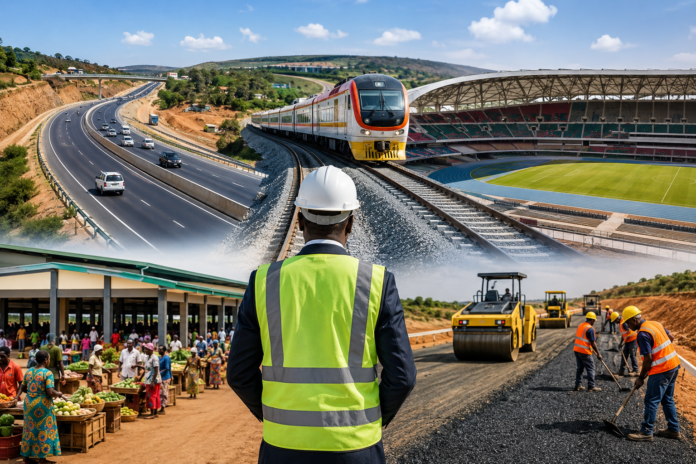
Four years into President William Ruto’s administration, Kenya is witnessing a wave of infrastructure projects spanning highways, railway lines, sports facilities and modern markets. From the Rironi–Mau Summit corridor to the SGR extension towards Kisumu and Malaba, the government is positioning infrastructure development as one of the defining pillars of its agenda ahead of the 2027 General Election.
Highlights
- The KSh200 billion Rironi–Mau Summit Road is under construction.
- The 750-kilometre Isiolo–Mandera Highway is expected to be completed by 2030.
- Construction of the Naivasha–Kisumu SGR section has resumed.
- Talanta International Stadium is nearing completion ahead of AFCON 2027.
- More than 400 modern markets are planned across the country.
Main Story
Road Network Gets Major Push
Several parts of Kenya are currently seeing large-scale road construction as the government pursues its ambitious target of delivering 28,000 kilometres of tarmacked roads over a decade.
One of the biggest projects is the Rironi–Mau Summit Road, valued at about KSh200 billion. The more than 175-kilometre highway will pass through three counties and feature additional lanes and improved interchanges designed to make movement of people and goods more efficient.
Further north, the Isiolo–Mandera Highway is expected to transform connectivity across the region. Stretching approximately 750 kilometres and linking several counties in North Eastern Kenya, the project is scheduled for completion in 2030 and is being financed through a partnership between the Kenyan government and international development partners.
The government says roughly 6,000 kilometres of the wider 28,000-kilometre road programme are already under construction.
Funding Roads Through the Maintenance Levy
The administration has also turned to alternative financing to address outstanding obligations in the roads sector.
According to the Ministry of Transport, securitising the KSh7 Road Maintenance Levy has helped mobilise more than KSh177 billion towards settling certified payments owed in the sector.
Contractors have been assured of funding for the coming year, with the government calling for faster implementation while maintaining construction standards, controlling costs and ensuring projects deliver value for taxpayers’ money.
SGR Heads West Again
Kenya’s railway expansion has also regained momentum after years of delays.
The government has restarted work on the western extension of the Standard Gauge Railway, with the 264-kilometre Narok–Kisumu section forming a major part of the project.
The wider SGR expansion is expected to strengthen links between the Rift Valley, western Kenya and the country’s regional trade routes. SPM Buzz has previously reported on the broader Naivasha–Kisumu–Malaba railway project and its potential impact on regional transport and trade.
Road and transport projects are similarly underway across regions including the Coast, Rift Valley, Nyanza and Central Kenya, creating a noticeable construction boom in different parts of the country.
Stadium Projects Gather Pace
Sports infrastructure is another major component of the government’s development agenda, particularly as Kenya prepares to co-host the 2027 Africa Cup of Nations.
The 60,000-seater Talanta International Stadium is among the flagship projects. Construction had reportedly reached 94 per cent by mid-August, with the facility expected to be officially opened in November.
Major renovation works are also being undertaken at Nyayo Stadium, Kasarani Stadium and Kipchoge Keino Stadium as the government seeks to upgrade Kenya’s sporting facilities to international standards.
Away from Nairobi, the 10,000-capacity Wajir Stadium was completed by the Kenya Defence Forces in less than three months. Work is also ongoing at more than 20 other stadium projects, including Thika Stadium in Kiambu County.
Modern Markets for Small Traders
Infrastructure development is also reaching the informal trading sector.
The government plans to establish more than 400 modern markets across the country under the Bottom-Up Economic Transformation Agenda, with small-scale traders and mama mbogas among the intended beneficiaries.
Markets in Thogoto and Gikambura are approaching completion, while facilities have already been established in Lusigetti and Kamangu.
The projects are designed to provide traders with more organised spaces while improving access to basic facilities and creating a better environment for small businesses.
A Key Test Ahead of 2027
The scale of these projects is making infrastructure one of the most visible aspects of President Ruto’s administration.
From major highways and railway expansion to stadiums and markets, the government’s infrastructure agenda is being rolled out across multiple sectors and regions.
However, the ultimate measure will not only be how many projects are launched or completed, but whether they improve everyday life, reduce transport costs, create economic opportunities and deliver value for public funds.
With the 2027 elections approaching, the infrastructure record will likely remain central to the government’s case for another term.
For millions of Kenyans, the real infrastructure story will ultimately be measured not in kilometres or billions, but in how much easier, faster and more affordable everyday life becomes.

