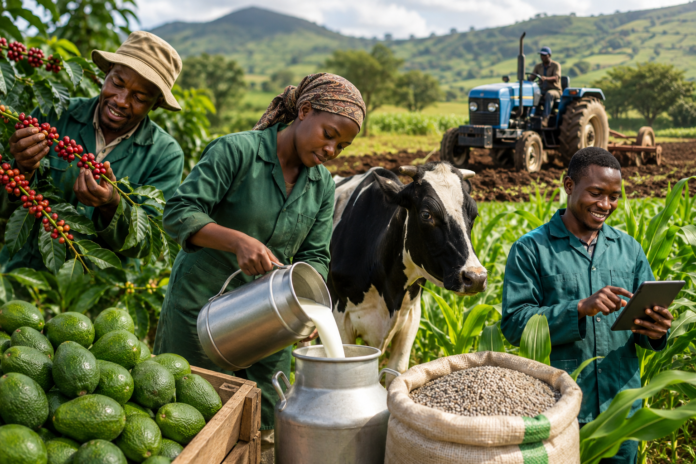
For farmers in Nyeri, agriculture is showing signs of recovery as lower fertilizer prices, improved coffee earnings and government-backed financing begin to ease some of the pressure that has weighed on farming for years. From dairy and coffee to maize and horticulture, farmers say reduced production costs are giving them fresh motivation to invest in their farms, although better infrastructure, affordable credit and stronger markets remain key priorities.
Highlights
- Fertilizer prices have fallen from about KSh6,500 to KSh2,500 for a 50kg bag.
- Coffee farmers say improved prices are helping raise their earnings.
- Young people are increasingly embracing technology and machinery in agriculture.
- Farmers want better aggregation facilities and transport infrastructure.
- Affordable credit and sector-specific subsidies remain major priorities.
Main Story
A Childhood Passion Turns Into a Farming Career
For one farmer from Karatina Ward, Nyeri County, agriculture has been part of life since childhood.
Growing up in a farming household, he was introduced to dairy farming at an early age and recalls learning how to milk cows when he was about 10 years old.
Over the years, however, farming in the region has faced its share of difficulties. Dairy and coffee farmers have struggled with production costs, low returns and changing market conditions, forcing some growers to abandon coffee for alternatives such as horticulture.
The farmer says government intervention has helped bring some stability to the sector, particularly through efforts to regulate agricultural practices and improve the quality of milk reaching consumers.
Access to Finance Gives Farmers a Lifeline
He also points to agricultural financing as an important part of the recovery.
Institutions such as the Agricultural Finance Corporation have provided farmers with access to credit, while government efforts to address historical debts have helped reduce some of the financial pressure that had been holding farmers back.
According to him, the combination of financing and government support is giving farmers more room to continue investing in their enterprises instead of constantly struggling to meet accumulated obligations.
Young People Are Returning to Agriculture
Agriculture is also attracting a younger generation.
The farmer says young people are increasingly using technology and modern equipment to make farming more efficient. Machinery, silage production and milking equipment are helping farmers improve productivity while reducing the amount of manual labour required.
Farmers in the region have also developed links to markets in Nairobi, Isiolo and Nanyuki.
However, getting produce from farms to those markets remains a challenge.
The farmer says investment in aggregation centres would make a major difference, especially for products such as milk, avocados and other perishables that require efficient collection, storage and transportation.
Cheaper Fertilizer Brings Relief to Coffee Farmers
For coffee farmer Simon Mungei, one of the biggest changes has been the reduction in fertilizer prices.
He says a 50-kilogramme bag that once cost roughly KSh6,500 can now be purchased for around KSh2,500.
The lower price means farmers can stretch their money much further, with the amount previously needed for one bag now enough to purchase two.
Simon says the cheaper fertilizer has benefited both his coffee and maize farming.
He believes further reductions would provide an even bigger boost, particularly if prices eventually fall towards KSh1,500 per bag.
Better Coffee Prices Improve Returns
Lower input costs have come alongside better coffee earnings.
Simon recalls a period when farmers received around KSh40 to KSh50 for their coffee, making it difficult to cover production expenses.
He says payments have since improved to roughly KSh100 to KSh130, allowing farmers to retain more of their earnings when combined with cheaper fertilizer.
For farmers, the difference is significant: higher income means they can reinvest in their farms instead of using most of their earnings to cover basic production costs.
Mathira Farmers Also Feeling the Difference
Coffee farmer Richard Wachira Mwangi from Mathira Constituency says the reduction in fertilizer prices has similarly changed the economics of coffee farming.
He says farmers previously paid between KSh6,000 and KSh7,000 for fertilizer, but the cost has dropped to approximately KSh2,500.
The reduction has eased pressure on farmers who also have to purchase chemicals and other inputs needed to maintain their coffee farms.
Richard says coffee prices have also improved, with farmers receiving between KSh130 and KSh160 in some cases.
However, he believes more needs to be done to ensure the gains are sustained.
He wants the government to keep fertilizer and coffee chemicals affordable while also addressing the wider issue of coffee pricing so that farmers can earn returns that match the cost and effort involved in production.
Fertilizer Reform Has Lifted Production But It Is Not the Whole Story
The broader agricultural picture shows a similar recovery.
The government’s fertilizer subsidy programme began after President William Ruto took office in 2022, when a 50-kilogramme bag was offered at a subsidised price of KSh3,500 compared with the prevailing cost of about KSh6,500.
The price was later reduced to KSh2,500, while the government expanded the number of farmers receiving subsidised inputs through registration and digital targeting.
In August 2026, the government announced another reduction, taking the price of a 50-kilogramme bag to KSh2,000, alongside a 50 per cent subsidy on maize seed.
Agricultural production has increased from the drought-hit levels recorded in 2022. Maize production, for instance, rose from about 34.25 million 90-kilogramme bags in 2022 to 47.61 million in 2023 before settling at approximately 44.76 million bags in 2024.
However, the recovery cannot be credited to fertilizer alone.
More land was brought under maize cultivation, while improved rainfall in 2023 also played a major role following the severe drought of the previous year.
The wider agricultural sector contracted by 2.3 per cent in 2022 before growing by seven per cent in 2023 and another 4.6 per cent in 2024.
Other areas of agriculture have also recorded gains, including sugar, coffee, tea and milk production.
At the same time, horticulture has faced challenges, with the value of exports declining in 2024.
What Farmers Still Need
Despite the progress, farmers say lower fertilizer prices are only part of the solution.
Affordable financing remains important, particularly for farmers looking to expand or adopt modern equipment.
Infrastructure is another major concern.
Better aggregation centres, storage facilities and transport networks could help farmers dealing with perishable products avoid losses and access markets more efficiently.
Farmers are also calling for policies tailored to individual agricultural sectors, including subsidies and cheaper credit that can reduce production costs while encouraging more young people to see farming as a viable business.
The government is meanwhile placing greater emphasis on irrigation as it seeks to reduce agriculture’s dependence on unpredictable rainfall.
The long-term challenge will be turning cheaper inputs into consistently higher productivity, stronger farmer incomes and a more resilient food system.
For farmers in Nyeri, the changes are already making a difference but they say the real test will be whether the support can last long enough to make farming a dependable business for the next generation.
For Kenya’s farmers, cheaper inputs may open the door but sustainable farming will depend on whether markets, infrastructure, financing and reliable production can keep them moving forward.

