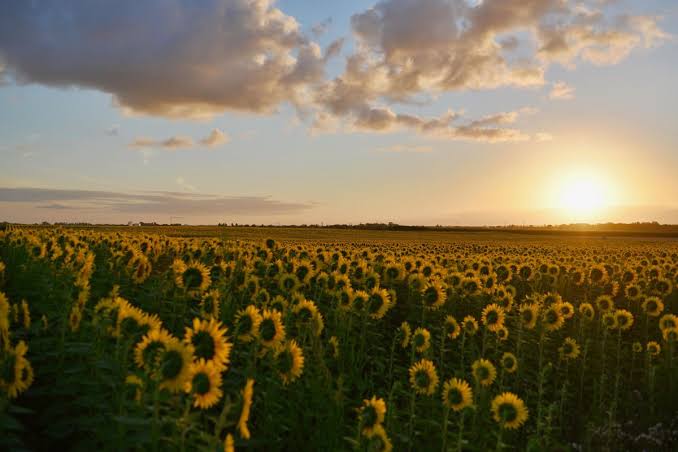
For 66-year-old Washington Gewa, farming has always been about survival but once the harvest ends, so does the income. Now, Gewa and other farmers in Ahero, Kisumu, are turning to sunflower farming in search of a more reliable source of earnings as unpredictable weather and seasonal agriculture continue to challenge smallholder farmers.
Highlights
- 100 rice farmers have received certified sunflower seeds and technical support.
- The pilot project could eventually expand sunflower cultivation to nearly 20,000 acres.
- Farmers say the crop can perform well even with limited water.
- Sunflowers could support soil health and attract pollinators.
- Increased local production could help reduce Kenya’s dependence on edible oil imports.
Main Story
A New Crop, A New Opportunity
In Ahero, farmers are beginning to look beyond rice as they search for ways to keep their farms productive and their incomes flowing throughout the year.
A government-backed pilot programme has supplied 100 rice farmers with certified sunflower seeds, extension support and guidance on improved farming methods. The initiative is expected to grow significantly, with plans to expand sunflower production to almost 20,000 acres.
For farmers who have traditionally relied on seasonal crops, the shift could offer a much-needed alternative.
Breaking the Cycle of Seasonal Income
Gewa, who has spent decades depending on his four-acre farm, knows the financial pressure that comes when a farming season comes to an end.
At 66, he has relied on his land to support himself and meet his family’s needs. But after harvesting, the money generated from the farm can quickly run out, leaving farmers to wait for the next season before another major income comes in.
Sunflower, he says, has introduced a sense of optimism that another source of earnings could be possible.
A Crop That Can Cope With Limited Water
Other farmers are also reporting encouraging results.
Hezron Oronge says sunflower has performed well on the farm despite limited water availability, making it an attractive option at a time when weather patterns are becoming increasingly unpredictable.
Farmers are being trained on important practices such as correct plant spacing and fertiliser application to help improve yields.
The programme is also placing emphasis on technology, with stakeholders arguing that better use of farming innovations can unlock more value from available land.
More Than Just an Income Crop
The benefits of sunflower may go beyond what farmers earn at harvest.
Agricultural stakeholders point to the crop’s potential contribution to soil health. Its extensive root system can help improve soil structure and aeration, while the flowers can attract pollinators that play an important role in agricultural ecosystems.
Sarah Kurui says the crop’s rooting characteristics can also contribute to healthier soils, including through processes that help manage certain elements within the soil.
John Kanye, meanwhile, argues that land should be viewed as an asset whose value can increase significantly when technology and improved farming practices are introduced.
Kenya’s Edible Oil Challenge
The push for sunflower farming comes against the backdrop of Kenya’s heavy dependence on imported edible oils.
The country is estimated to spend about KSh140 billion every year on edible oil imports while facing a supply deficit of roughly 820,000 tonnes.
Increasing domestic sunflower production could therefore provide farmers with an additional market while helping Kenya reduce its reliance on imports.
For smallholder farmers, the opportunity is particularly significant because diversification can help reduce the financial risks that come with depending on a single crop or a single harvest season.
A Potential New Chapter for Ahero Farmers
The Ahero pilot is still at an early stage, but its ambitions are much bigger than the initial group of farmers.
If the programme succeeds and production expands towards the targeted 20,000 acres, sunflower could become an increasingly important crop in the region offering farmers another way to turn their land into a more dependable source of income.
For farmers like Gewa, the hope is simple: that when one harvest ends, the opportunity to earn does not have to end with it.
For Ahero’s farmers, sunflower is more than a new crop it could be a chance to make every season count.

