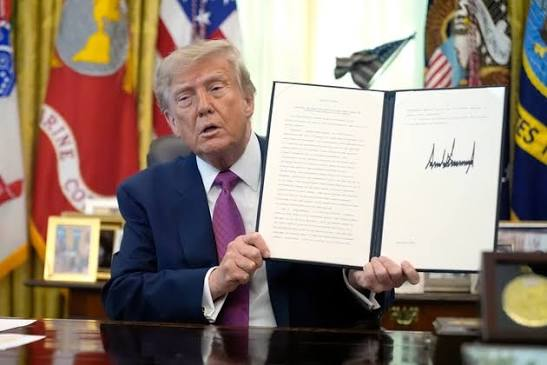
US President Donald Trump has ordered the renaming of Lake Ontario to Lake America, opening another unusual front in the growing tensions between Washington and Ottawa. Canada has rejected the move, with Prime Minister Mark Carney insisting the lake’s historic name will remain unchanged.
Highlights
- Trump signed an executive order seeking to rename Lake Ontario “Lake America”.
- Canada says the body of water will remain Lake Ontario.
- The US Interior Department has 30 days to update its geographic names database.
- The dispute comes amid escalating US-Canada trade tensions.
- New York officials say they will continue using the name Lake Ontario.
Main Story
Trump Announces Lake Ontario Name Change
US President Donald Trump has signed an executive order directing the United States to recognise Lake Ontario as Lake America.
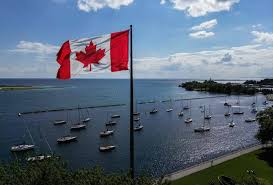
The lake is shared by the US and Canada, with the US side bordering New York State and the Canadian side forming part of Ontario.
Trump said the new name would take effect immediately, although the move only determines how the United States officially refers to the lake. Canada and other countries are not legally required to adopt the new designation.
The executive order gives the US Department of the Interior 30 days to update the Geographic Names Information Service, the country’s official database for domestic geographical names.
Canada Rejects the Move
Canadian Prime Minister Mark Carney quickly dismissed the proposed name change, pointing to the lake’s long history.
Carney said the name Lake Ontario has been used for more than four centuries and existed before both Canadian Confederation and the American Declaration of Independence.
He maintained that Canadians would continue calling it Lake Ontario.
Ontario Premier Doug Ford also rejected Trump’s decision, saying Canadians and the wider world would continue using the lake’s established name.
Other Canadian politicians have similarly criticised the move.
Another Geographic Name Dispute
Trump’s latest order mirrors his earlier decision to rename the Gulf of Mexico as the “Gulf of America” for US government purposes.
That decision was rejected by Mexico, which argued that the United States could not unilaterally rename a shared body of international water.
The issue even triggered a dispute involving Google Maps, which displays different names depending on a user’s location.
In the US, users see “Gulf of America”, while users in Mexico see “Gulf of Mexico”. In other countries, the platform has displayed both names.
The earlier dispute also resulted in a confrontation between the Trump administration and the Associated Press after the news agency declined to adopt “Gulf of America” in its reporting.
US Politicians Divided
The proposed renaming has received support from some members of Trump’s administration.
Interior Secretary Doug Burgum welcomed the move and said his department was ready to implement the president’s order.
However, Democratic lawmakers have strongly opposed it.
Michigan Representative Debbie Dingell described the decision as unnecessary and said she would introduce legislation seeking to overturn it.
She argued that the Great Lakes are a shared resource protected jointly by Americans and Canadians over generations.
New York Governor Kathy Hochul, whose state is the only US state directly bordering Lake Ontario, also said New York would continue referring to it by its traditional name.
Move Comes Amid Trade Dispute
The name-change controversy comes as relations between Washington and Ottawa remain strained.
Trade negotiations between the two countries broke down last week, followed by the United States imposing new 50% tariffs on about $20 billion worth of Canadian goods.
Canada has announced plans for matching tariffs in response.
Trump said the renaming was not specifically intended as a message to Canada, although he linked his decision to his longstanding complaints about the country’s trade relationship with the US.
Despite the escalating rhetoric, there were signs that negotiations could resume.
Canadian Trade Minister Dominic LeBlanc said Washington had backed away from some demands relating to French-language labelling, one of the issues that had contributed to tensions during the talks.
The two sides, however, continue to disagree over what caused the negotiations to collapse.
A Name With Indigenous Roots
Lake Ontario is one of North America’s five Great Lakes and is the smallest by surface area.
The names of Lake Ontario, Lake Huron, Lake Michigan and Lake Erie have Indigenous origins, while Lake Superior’s name comes from an anglicised French expression.
With the United States and Canada sharing the Great Lakes, Trump’s latest move raises another question about how geographical names should be handled when landmarks cross national boundaries.
For Canada, however, the message remains clear: Lake Ontario is not going anywhere.
A president may have the power to change how a landmark is officially recognised at home, but changing a name that has survived centuries may require more than an executive order.

