
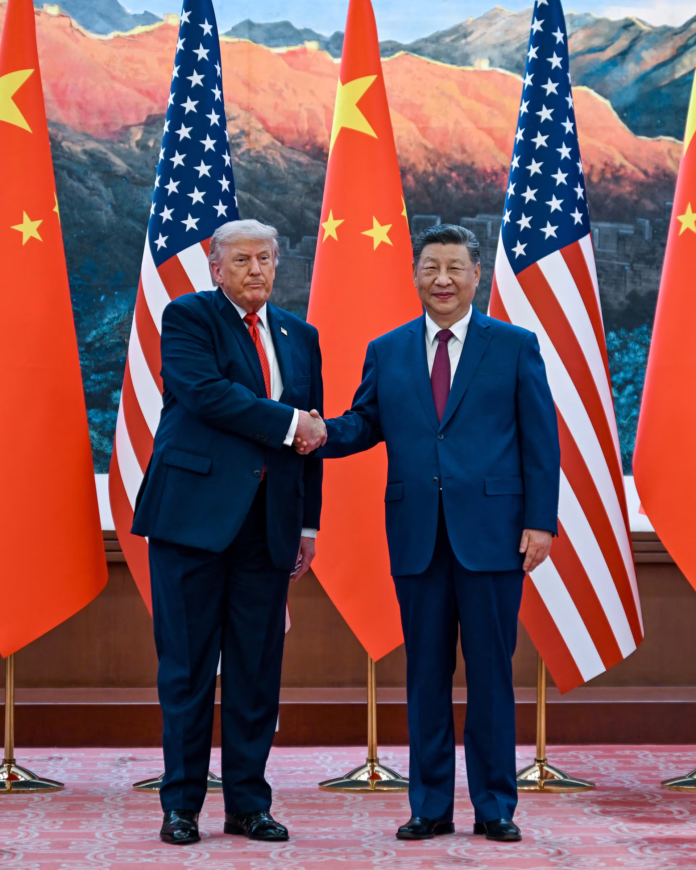
US President Donald Trump has kicked off a major diplomatic visit to China with a closely watched meeting alongside Chinese President Xi Jinping in Beijing. The high-level talks come at a tense moment for the world’s two biggest economies, with trade disagreements, Taiwan tensions, and the Iran conflict dominating discussions between the global powers.
Highlights
- Trump received a grand welcome at Beijing’s Great Hall of the People.
- Trade tensions and tech market access were key topics in the talks.
- Xi warned that Taiwan could become a major source of conflict.
- Trump also discussed Iran and broader global security concerns.
- Xi referenced the “Thucydides Trap” to stress the risks of rivalry between powerful nations.
Main Story
Trump Returns to Beijing
President Trump arrived in Beijing for his latest official visit to China, marking the first trip by a sitting American president to the country since his own earlier visit during his first administration in 2017.
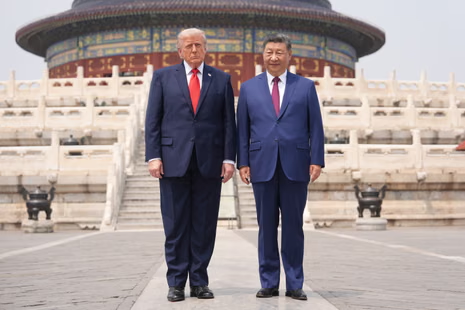
The visit began with a formal ceremony at the Great Hall of the People, where Trump and Xi walked together along a red carpet before holding private discussions.
Their bilateral meeting reportedly stretched for nearly two hours longer than many observers expected. Although Trump later described the talks as “great,” neither side immediately revealed whether concrete agreements had been reached.
The summit had originally been planned for March but was postponed following military strikes on Iran involving the United States and Israel.
Trade and Tech at the Centre
One of the biggest issues during the meeting was the strained economic relationship between Washington and Beijing.
Trump said he wanted China to give major international technology companies greater access to its market. The US has repeatedly pushed Beijing to loosen restrictions and create fairer conditions for foreign businesses operating in China.
At the same time, China is expected to seek an extension of the temporary trade truce reached last October, which paused escalating tariffs between the two nations.
Chinese state-linked commentary ahead of the visit signaled that Beijing hopes to stabilise relations with Washington and reduce uncertainty in global politics and business.
Taiwan Emerges as a Major Flashpoint
Taiwan became one of the most sensitive issues raised during the meeting.
According to Chinese state media, Xi warned Trump that Taiwan remains the most critical issue in US-China relations. He reportedly cautioned that mishandling the matter could lead to “clashes and even conflicts.”
China considers Taiwan part of its territory, while Taiwan continues to operate as a self-governed democracy with strong informal ties to the United States.
Although Washington officially recognises Beijing diplomatically, the US remains Taiwan’s largest arms supplier and one of its most powerful international partners.
Xi also reportedly urged the US to avoid encouraging what Beijing describes as “Taiwan independence.”
Iran and Global Stability
Trump confirmed before the meeting that Iran would also feature in discussions with Xi.
Even though the US president said he did not require China’s assistance to resolve the Middle East conflict, he acknowledged that Beijing’s role remains important because of its influence in the region.
He described Xi’s approach toward Iran as “relatively good” and predicted positive outcomes from the trip.
What Is the “Thucydides Trap”?
During his opening remarks, Xi referred to the “Thucydides Trap,” a term commonly used in international politics to describe the danger of conflict between an established global power and a rising rival.
The concept comes from ancient Greek historian Thucydides, who wrote about the rivalry between Athens and Sparta. Modern political analysts often use the phrase to explain growing tensions between the US and China.
Chinese leaders, including Xi, have increasingly used the term to argue that competition between the two nations should not automatically lead to confrontation.
As Washington and Beijing continue balancing rivalry with diplomacy, the world will be watching closely to see whether dialogue can truly prevent tension from turning into confrontation.

