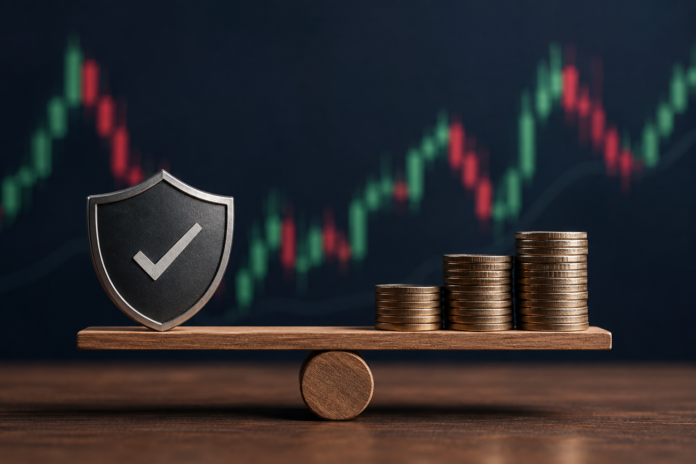
- Trading is not simply about finding opportunities and making profits. Even experienced traders face losing positions, which makes protecting your capital just as important as chasing returns. This is where risk management comes in helping traders control potential losses, make more disciplined decisions and stay in the market for the long run.
- Highlights
- Risk management helps protect your trading capital.
- Traders can use position sizing and stop-losses to control potential losses.
- Managing risk can reduce emotional and impulsive decisions.
- No trading strategy wins every time, making capital protection essential.
- Consistent risk management can support long-term trading discipline.
Main Story
What Is Risk Management in Trading?
Risk management refers to the steps a trader takes to control how much money they could lose when entering a trade.
Instead of focusing only on how much a trade could make, a disciplined trader also considers what could happen if the market moves in the opposite direction.
This approach can involve deciding how much capital to put into a position, where to exit a losing trade and how much of the overall account should be exposed to a particular opportunity.
Why Does Risk Management Matter?
Markets can be unpredictable. A trade that looks promising can quickly move against you because of price movements, economic developments, market sentiment or unexpected events.
Without proper risk controls, one bad trade or a series of them can significantly reduce a trader’s account.
Risk management is therefore designed to keep individual losses within an amount the trader can reasonably handle.
It Helps Protect Your Capital
Capital is the foundation of trading. Once a large portion of an account has been lost, recovering it requires increasingly larger returns.
For example, losing 50 per cent of an account requires a 100 per cent gain on the remaining capital just to return to the starting point.
This is why protecting your account can be more important than trying to maximise every individual trade.
Position Size Matters
Position sizing is another important part of managing risk.
Rather than placing the same amount of money on every trade, traders can adjust their position according to their account size and the level of risk involved.
A smaller position can help limit the impact of a trade that moves against the trader.
Stop-Losses Can Help Limit Losses
A stop-loss is an order or predetermined exit level that can be used to close a position when the market reaches a specified price.
While no risk-management tool can eliminate losses completely, having a clear exit plan can prevent a trader from holding onto a losing position indefinitely.
Risk Management Can Reduce Emotional Trading
Fear and greed can strongly influence trading decisions.
A trader who has not decided how much they are prepared to lose may panic when prices fall or increase their position in an attempt to recover a previous loss.
Having risk rules in place before entering a trade can encourage more consistent decision-making.
Trading Is About Survival, Not Just Winning
Even profitable traders experience losing trades. The goal of risk management is not to eliminate losses, but to prevent individual losses from becoming financially devastating.
A trader who protects their capital has a better opportunity to continue learning, improving their strategy and taking future opportunities.
Ultimately, successful trading requires more than identifying when to enter a market. Knowing when to reduce exposure, how much to risk and when to walk away can be just as important.
In trading, the biggest win may not be the trade that makes you the most money, but the discipline that keeps you in the game when things do not go according to plan.

