
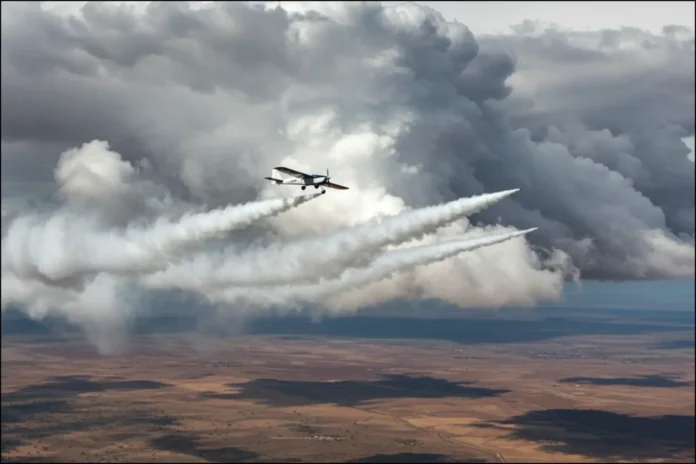
Indonesia is turning to an unusual weapon in its fight against a severe wildfire season: the sky. As vast areas of Borneo burn amid dry conditions linked to El Niño, authorities are deploying cloud-seeding aircraft in an attempt to trigger rainfall, while environmentalists warn that protecting vulnerable forests and peatlands must remain at the heart of the response.
Highlights
- More than 100,000 hectares have reportedly burned in Indonesia this year.
- Independent monitoring puts the burned area at more than 285,000 hectares through July.
- Indonesia has significantly increased its use of cloud-seeding operations.
- Experts question whether the method can work effectively during the driest months.
- Environmental groups say rainforest and peatland protection is key to preventing future fires.
Main Story
Indonesia Looks to the Clouds
Indonesia is facing another difficult wildfire season, with large parts of Borneo affected by fires and smoke.
Authorities are hoping that cloud seeding can help bring rain to areas threatened by flames. The process involves introducing substances such as silver iodide or salts into suitable clouds to encourage rainfall.
Meteorologist Safillah Anggie Wahyuni, who has taken part in hundreds of hours of cloud-seeding flights, says the method cannot manufacture clouds from nothing.
Instead, it works by taking advantage of clouds that already have the potential to produce rain.
For the technique to succeed, however, the right atmospheric conditions must be present.
Fires Have Already Burned Huge Areas
Indonesia’s government estimates that more than 100,000 hectares were affected by fires during the first six months of the year.
Nusantara Atlas, an independent deforestation monitoring platform, estimates the damage is considerably larger, placing the total at more than 285,000 hectares through July.
That area is more than four times the size of Jakarta.
The scale of the fires has revived memories of Indonesia’s devastating 2015 fire season, when millions of hectares burned during another powerful El Niño event and thick smoke spread across Southeast Asia.
Cloud Seeding Efforts Increase
Indonesia has been expanding its weather-modification programme in response to growing fire risks.
According to the country’s meteorological agency, BMKG, 252 cloud-seeding missions were carried out between 2021 and August this year. That compares with just 85 operations during the previous decade.
The missions have not all been related to wildfires. Many were conducted to encourage rainfall away from flood-prone areas, while others have focused on reducing fire risks and keeping peatlands moist.
The government has also placed aircraft and helicopters on standby across the country as weather conditions are closely monitored for potential rain-producing clouds.
Experts Question Its Effectiveness
Despite the increased investment, some scientists remain sceptical about how useful cloud seeding can be during the height of the dry season.
I Putu Santikayasa, a hydroclimatology lecturer at IPB University, argues that the technique faces a basic challenge: there may simply not be enough clouds available to work with when fires are at their worst.
Research into cloud seeding has also produced mixed conclusions about how consistently the technique increases rainfall.
There are additional questions surrounding the environmental impact of repeatedly using substances such as silver iodide, as well as the financial cost of large-scale operations.
BMKG weather modification director Budi Harsoyo maintains that there is currently no evidence showing harmful effects and describes cloud seeding as a tool for reducing immediate risks rather than a long-term answer.
Research he co-authored found that a cloud-seeding programme conducted in 2023 helped increase rainfall and was associated with the disappearance of fire hotspots.
Peatlands Remain a Major Concern
Environmental campaigners say Indonesia must address the causes of the fires rather than relying mainly on emergency measures.
The country contains extensive tropical peatlands, which store significant amounts of carbon when they remain wet. Once they dry out, however, they can become extremely vulnerable to fire.
Peat fires can also burn beneath the surface, making them difficult to extinguish and allowing them to flare up again later.
Uli Arta Siagian of environmental organisation WALHI said vulnerable forests and peatlands need stronger protection from development.
Environmentalists argue that preventing damaging land-use changes and restricting permits in fire-prone areas would help reduce the risk before fires begin.
Smoke Spreads Beyond Indonesia
The consequences of Indonesia’s fires are not limited to the areas where they start.
Smoke from major fires can create dangerous haze across neighbouring Malaysia and Singapore.
Recently, pollution levels in parts of Malaysian Borneo increased as smoke from Indonesian fires spread across the region, with some schools temporarily closed because of poor air quality.
Indonesia is responding through several measures beyond cloud seeding, including restoring moisture to peatlands, tracking hotspots using satellites and conducting patrols on the ground.
Nearly 50,000 firefighters are also involved in efforts to contain and prevent fires.
Burning Practices Under Scrutiny
Authorities have prohibited large plantations from using fire to clear land, although some small-scale farmers remain exempt under existing rules.
Environmental campaigners say burning continues to be a major contributor to wildfires.
The government has therefore urged local authorities in high-risk areas to strengthen patrols and enforcement. Officials have also called for penalties, including fines and criminal action, against those who illegally start fires.
El Niño Adds to the Risk
This year’s difficult conditions have been intensified by a strong El Niño weather pattern.
The naturally occurring climate phenomenon can disrupt rainfall and atmospheric conditions around the world. In Indonesia, it is commonly associated with hotter and drier weather, creating conditions that allow fires to spread more easily.
The scale of this year’s damage is already worrying. The land burned during the first half of the year has surpassed the total area affected by fires throughout 2023, another year influenced by El Niño.
Climate campaigners say rising global temperatures are making the situation even more challenging.
According to environmental group 350.org, El Niño is now occurring against a warmer global climate, increasing the likelihood of more extreme weather conditions.
Cloud Seeding Is Not the Whole Answer
For Indonesia, cloud seeding may provide temporary relief when suitable clouds are available, but experts and environmental groups agree that it cannot replace long-term fire prevention.
Protecting forests, maintaining healthy peatlands, enforcing restrictions on land clearing and preparing communities for increasingly severe dry conditions could prove more important in reducing future wildfire disasters.
As Borneo continues to battle flames and smoke, Indonesia’s challenge is not simply finding ways to make it rain it is preventing the landscape from becoming so vulnerable to fire in the first place.
Cloud seeding may help Indonesia buy valuable time, but the bigger question remains: what happens when the clouds disappear and the forests are still at risk?

