
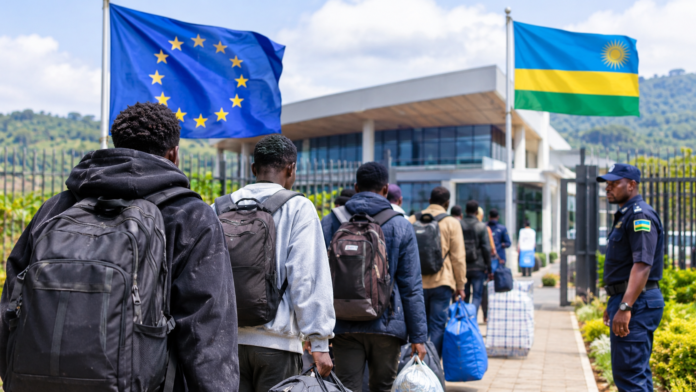
Rwanda is set to become the centre of a major European immigration policy shift after five European countries announced plans to establish a migrant deportation facility in the East African nation in 2027.
Germany, Denmark, Austria, Greece and the Netherlands are backing the proposed arrangement, which will allow certain migrants who have exhausted their legal options to remain in Europe to be transferred to Rwanda. However, the plan has already attracted criticism from human rights organisations and political leaders who question its impact on migrant protection.
Highlights
- Five European countries plan to establish a migrant return hub in Rwanda in 2027.
- The arrangement will initially focus on single men facing deportation.
- Migrants transferred to Rwanda could settle there or return to their countries of origin.
- The pilot programme could initially accommodate approximately 100 people.
- Human rights organisations have raised concerns about migrant safety and Rwanda’s human rights record.
Main Story
Five European Nations Back Rwanda Deportation Plan
Rwanda is preparing to host a migrant return facility under an agreement involving Germany, Denmark, Austria, Greece and the Netherlands.
The five governments announced the initiative as part of broader efforts to strengthen immigration enforcement and increase the number of people returned after losing their legal right to remain in Europe.
According to statements from the Dutch and Danish governments, the facility is expected to become operational in 2027.
Unlike traditional deportation arrangements, the proposed centre would offer an alternative for individuals whose countries of origin cannot receive them.
The participating nations say the programme will target people who have exhausted available legal procedures to remain in their respective countries.
How the Rwanda Return Hub Will Work
Under the proposed arrangement, migrants transferred to Rwanda will have two possible pathways.
They can either settle in Rwandan society or make arrangements to return to their countries of origin.
Those choosing to remain in Rwanda are expected to receive residence rights and access to essential services, including education, healthcare, employment opportunities and legal assistance.
The Netherlands has indicated that the first phase will exclusively involve single adult men.
It also plans to prioritise individuals originating from countries within Rwanda’s wider geographical region.
Diplomatic sources cited by AFP indicated that the programme could begin as a pilot involving approximately 100 migrants, with each participating European country potentially transferring around 20 people.
Britain Yet to Decide on Joining the Programme
The announcement has also revived comparisons with Britain’s previous attempt to establish a similar arrangement with Rwanda.
The former UK government had pursued a controversial policy that would have transferred asylum seekers to Rwanda for their claims to be processed.
However, legal challenges prevented the scheme from becoming operational before the Labour government abandoned it in 2024.
Downing Street has not completely dismissed the possibility of Britain participating in the new European initiative, saying it will monitor developments with interest.
Spain’s Prime Minister Pedro Sánchez has, however, criticised the proposal, questioning whether relocating migrants to another country offers a humane or sustainable response to migration challenges.
European Governments Defend the Initiative
The five countries argue that establishing return centres outside the European Union could help reduce pressure on their asylum systems while discouraging dangerous migration routes.
Speaking during a joint press conference in Vienna, Austrian Chancellor Christian Stocker said the countries wanted to address irregular migration and weaken the networks responsible for facilitating dangerous journeys across the Mediterranean.
The agreement follows changes to EU migration rules that have created room for member states to establish return facilities in countries outside the bloc.
Rwandan Interior Minister Vincent Biruta welcomed the cooperation, saying his country was prepared to work with European partners to develop a safe and legally structured arrangement for migrants.
He also pointed to unequal economic opportunities across the world as an important factor driving people to migrate.
Human Rights Groups Raise Concerns
Despite the support from participating governments, the proposal has triggered concerns among international human rights organisations.
Human Rights Watch researcher Clementine de Montjoye questioned the decision to select Rwanda, citing concerns over alleged political repression, arbitrary arrests, mistreatment in detention facilities and the country’s involvement in the conflict in neighbouring Democratic Republic of Congo.
The organisation warned that financing such an arrangement could expose transferred migrants to further human rights risks.
The European Union Agency for Fundamental Rights has also stressed that any country hosting a return facility must respect international human rights standards.
It further warned that individuals should never be transferred to destinations where they could face persecution or serious harm.
The Dutch government has confirmed that unaccompanied children will not be included in the programme.
Migration Pressure Continues Across Europe
The initiative comes as several European governments face growing political pressure to demonstrate stronger control over immigration.
Concerns about national security, economic difficulties and public dissatisfaction with existing migration policies have increasingly influenced political debates across the continent.
Figures from the European Border and Coast Guard Agency indicate that nearly 110,000 irregular border crossings into the EU were detected during the first 10 months of 2026.
This represented a 29 per cent decline compared with the same period in 2025.
However, October recorded approximately 18,100 crossings, 6 per cent fewer than the corresponding month in 2025 but 22 per cent higher than September 2026.
The increase was largely attributed to rising arrivals along the Western African route towards Spain’s Canary Islands.
What the Deal Means for Rwanda
For Rwanda, the proposed arrangement represents another major partnership with European governments on migration management.
The country will potentially receive migrants who can no longer legally remain in the participating European nations but cannot be returned to their countries of origin.
However, the programme’s success will depend on how the arrangement is implemented, the protections offered to migrants and whether Rwanda can guarantee their safety and access to basic rights.
With the programme expected to begin in 2027, attention will now turn to the practical arrangements and safeguards that will govern the transfers.
The bigger question remains whether sending migrants thousands of kilometres away addresses the causes of irregular migration or simply moves Europe’s immigration challenges beyond its borders.
As Rwanda prepares to take on a new role in Europe’s migration strategy, one question deserves attention: can governments control migration while ensuring that the dignity, safety and rights of migrants remain protected?

