
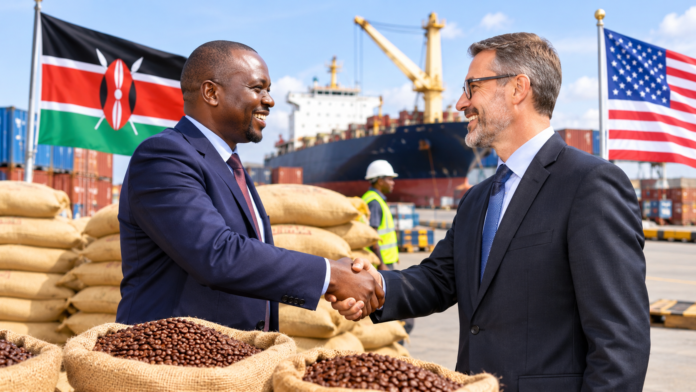
Kenyan businesses are setting their sights on the lucrative American market, with coffee, herbal products and other agricultural exports presenting significant opportunities for local entrepreneurs. However, accessing the market remains a challenge, with regulatory requirements, limited local processing capacity and gaps in export information slowing the country’s progress. Industry players believe Kenya could unlock billions of shillings in additional trade if businesses receive the right support and local agricultural products are transformed into competitive, value-added exports.
Highlights
- Kenyan manufacturers and exporters are targeting the US market, with an estimated Sh3.9 billion to Sh5.2 billion in untapped agricultural trade opportunities.
- Coffee exporter John Seroney shipped approximately 10 to 11 containers of coffee in the previous year.
- Businesses are exploring opportunities in moringa, baobab and chia seed processing.
- High product registration costs, regulatory requirements and inconsistent supply remain major obstacles.
- Kenya exported Sh79.7 billion worth of goods to the US in 2025 against imports valued at Sh135.9 billion.
Main Story
Kenyan Entrepreneurs Target the American Market
Kenyan businesses are looking to strengthen their presence in the United States, where demand for agricultural products and natural ingredients could create new opportunities for local producers.
Despite the potential, exporters continue to face challenges ranging from complicated regulatory procedures to limited access to information about American market requirements.
For entrepreneurs already operating internationally, success involves more than finding customers. Maintaining product standards, establishing reliable supply chains and earning the confidence of overseas buyers are equally important.
One such entrepreneur is John Seroney, founder and chief executive of Sumseron Coffee & Tea Limited, whose business connects Kenyan coffee farmers and cooperative societies with international buyers.
The company works with farmers in Bungoma, West Pokot, Trans Nzoia, Kericho and Kiambu counties, handling several stages of the coffee value chain, including nursery establishment, trading, processing and roasting.
The United States and Europe are among its main export destinations.
Seroney revealed that the company exported approximately 10 to 11 containers of coffee in the previous year, with each container carrying about 19.2 tonnes.
His American customers are located in states including Ohio, Michigan, California, Washington, New Jersey and New York.
Building Trust With American Buyers
Seroney explained that establishing business relationships across international markets requires patience and consistency.
Trade exhibitions and international business missions have helped him connect with potential customers, establish professional relationships and eventually secure export contracts.
However, maintaining those relationships requires exporters to demonstrate that they can consistently meet agreed quality standards and honour their commitments.
To achieve this, Sumseron works directly with farmers through producer partnership agreements. The company also employs agricultural specialists who guide farmers on practices such as pruning, crop nutrition and general farm management.
This approach helps maintain the quality of coffee supplied to international customers.
Export documentation is another important consideration. Kenyan businesses seeking to enter the American market must comply with relevant US Food and Drug Administration requirements and provide documentation such as certificates of origin, phytosanitary certificates issued by the Kenya Plant Health Inspectorate Service (KEPHIS), and other shipping and export documents.
Seroney added that international buyers increasingly want to understand the origins of the products they purchase.
They are interested in the farmers involved, the regions where crops are grown, soil conditions and the impact agricultural production has on local communities.
Issues such as women’s participation, youth involvement and improvements in household incomes are also becoming important considerations when establishing long-term business partnerships.
Healthy U Eyes Opportunities in Kenyan Agricultural Products
Beyond coffee, local entrepreneurs are exploring ways to turn Kenya’s agricultural resources into processed products that can compete internationally.
Sailesh Rach, founder and chief executive of Healthy U Limited, believes the country has considerable potential in natural ingredients such as moringa, baobab and chia seeds.
According to Rach, these products could be transformed into powders, capsules and other nutritional products for both local and international markets.
Healthy U currently imports several plant-based traditional medicine products, some of which contain additional active ingredients and are manufactured into tablets and capsules.
However, the company is exploring local manufacturing as a way of reducing reliance on imported finished products while creating new opportunities for Kenyan farmers.
Rach said the business is interested in connecting local botanical farmers with American manufacturers and suppliers who could provide access to international markets.
He believes locally processing agricultural products would allow Kenya to retain a larger share of the value generated from its natural resources.
The company is considering starting with powdered products packaged in small sachets, which could make them more accessible and affordable to consumers.
At present, only about two to three per cent of the company’s products are sourced locally, highlighting the challenges facing domestic suppliers in meeting manufacturers’ requirements consistently.
High Registration Costs Worry Local Producers
Healthy U is also exploring research and product development partnerships with Kenyatta University, the University of Nairobi and the United States International University-Africa.
The collaborations are expected to support product formulation, improve manufacturing processes and potentially lower production expenses.
However, Rach noted that expanding local production requires businesses to understand consumer demand, manufacturing capacity and the regulatory environment.
He particularly raised concerns about the proposed $500 product registration fee, arguing that the amount could discourage small manufacturers and herbal product businesses from entering the formal market.
He proposed reducing the charge to between $25 and $50 per product to make registration more accessible.
Rach also called for greater government support for small-scale farmers, particularly in identifying commercially viable crops, improving production and connecting them with international buyers through trade exhibitions and business networks.
Kenya Could Unlock Millions in Agricultural Trade
The opportunities in the American market extend beyond individual businesses.
The Kenya Association of Manufacturers (KAM) estimates that agricultural trade between Kenya and the United States has an untapped potential of between Sh3.9 billion and Sh5.2 billion.
KAM chief executive Tobias Alando identified inadequate information as one of the biggest challenges preventing Kenyan businesses from taking advantage of international trade opportunities.
He noted that exporters must understand the standards, traceability requirements, customs procedures and other conditions that apply to their specific products.
Alando also emphasised that while the government is responsible for negotiating trade arrangements, private businesses must take an active role in preparing themselves for international competition.
He urged Kenyan companies to pursue opportunities in the US market even when products are subject to some import duties, arguing that competitive pricing and quality can still make local goods attractive to American buyers.
Kenya-US Trade Negotiations and AGOA
Kenya and the United States have been working towards stronger trade relations through several initiatives.
In 2020, the two countries began negotiations for a comprehensive Free Trade Agreement during the first administration of US President Donald Trump and the presidency of Uhuru Kenyatta.
The proposed agreement aimed to reduce trade barriers, expand market access and encourage investment. It would have been the first US free trade agreement with a country in sub-Saharan Africa.
However, the negotiations stalled after Joe Biden assumed office in January 2021.
His administration instead pursued the US-Kenya Strategic Trade and Investment Partnership (STIP), which was launched in July 2022.
The partnership focused on issues including agriculture, digital commerce, labour standards, investment and regulatory barriers rather than a comprehensive tariff-reduction agreement.
Although the two countries conducted eight rounds of discussions, the process was not completed before Biden left office in January 2025.
Following Trump’s return, discussions shifted towards a reciprocal trade arrangement.
In February 2026, Kenya and the US held consultations in Washington to develop a framework covering tariffs, agricultural commodities, goods and services, digital trade and investment.
Kenya also benefits from the African Growth and Opportunity Act (AGOA), which gives eligible African countries preferential access to the American market.
The programme was extended to December 31, 2028, following legislation signed by Trump in September 2026.
However, Alando cautioned that changing trade conditions mean Kenyan exporters should not automatically expect completely duty-free access to the US.
He maintained that businesses should concentrate on making their products competitive rather than waiting for every trade barrier to disappear.
NASDA Considers Supporting Kenya’s Agricultural Extension System
Improving the ability of Kenyan farmers to produce consistently and meet international standards is another priority for industry stakeholders.
Ted McKinney, chief executive of the US-based National Association of State Departments of Agriculture (NASDA), said the organisation was considering ways to help Kenya strengthen its agricultural extension services.
The proposed initiative could involve partnerships between American and Kenyan universities, county governments and private sector organisations.
The objective would be to improve collaboration between researchers and farmers, allowing agricultural innovations, modern farming techniques and better production practices to reach farming communities.
Such support could help farmers improve productivity, adopt new technologies and become more resilient to changing agricultural conditions.
Kenya’s Trade Balance With the US
Figures from the Kenya National Bureau of Statistics (KNBS) Economic Survey 2026 show that Kenya exported goods worth Sh79.7 billion to the United States in 2025.
During the same period, imports from the American market reached Sh135.9 billion, leaving Kenya with a trade deficit of Sh56.2 billion.
Agricultural trade, however, presents a different picture.
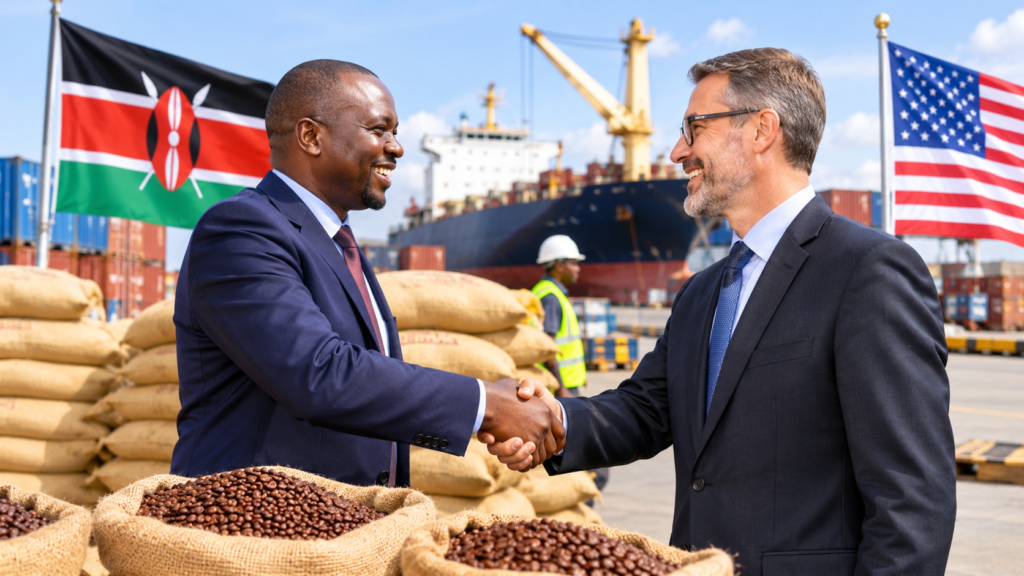
A 2025 report by the United States Department of Agriculture (USDA) estimated that Kenya exported agricultural products worth Sh15.44 billion to America in 2024, compared with US agricultural exports to Kenya valued at Sh6.01 billion.
Kenya’s agricultural exports to the US have fluctuated over the years, declining from Sh20.8 billion in 2022 to approximately Sh13.08 billion in 2023 before recovering to Sh15.44 billion in 2024.
Meanwhile, American agricultural exports to Kenya increased significantly to Sh17.82 billion in 2023 before dropping to Sh6.01 billion in 2024, partly because of reduced food aid shipments, including wheat.
The figures highlight the potential for Kenyan agricultural businesses to strengthen their position in the American market.
With improved processing capacity, reliable production and better access to export information, local entrepreneurs could capture a larger share of international demand.
For Kenya, the opportunity is not simply about exporting more raw agricultural products, but developing local industries capable of transforming those resources into higher-value goods.
Kenya’s next major economic opportunity may not lie in producing more agricultural goods, but in adding value to what it already grows. The question is whether local businesses, farmers and policymakers can work together to turn that potential into lasting international success.

