
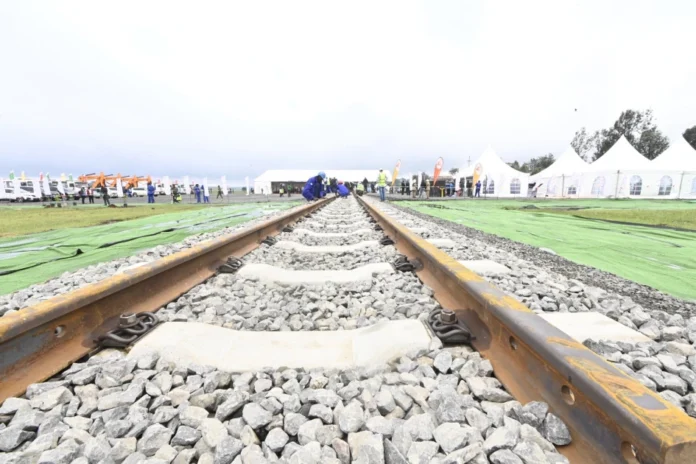
Kenya’s High Court has dealt a major setback to the government after declaring the KSh12 billion Ngong–Riruta railway project unconstitutional, citing multiple legal violations in its planning and execution.
Highlights
- Court rules project violated constitutional and procurement laws
- Lack of parliamentary approval and public participation cited
- Project currently about 40% complete
- Construction halted pending compliance
- Government given 90 days to regularize the process
Main Story
Court Finds Major Legal Violations
In a ruling delivered by Gregory Mutai, the High Court found that the Ngong–Riruta metre gauge railway project was initiated and implemented unlawfully.
The court cited several breaches, including:
- Absence of parliamentary approval
- Failure to conduct a competitive procurement process
- Lack of a feasibility study
- Inadequate public participation
Justice Mutai emphasized that these are not optional steps but constitutional requirements for public projects.
Project Can Proceed, But With Conditions
Despite the ruling, the court did not permanently cancel the project.
Instead, it allowed the government to proceed only after fully complying with the law, including:
- Securing parliamentary approval
- Conducting a fresh and transparent procurement process
- Completing a proper feasibility study
- Undertaking meaningful public participation
Funding Declared Unconstitutional
The court also ruled that the use of the Railway Development Levy Fund before March 27, 2026, was unconstitutional.
It further stated that later legal amendments could not be applied retroactively to justify earlier violations.
Petition by Omtatah and Residents
The case was filed by Okiya Omtatah alongside the Karen Langata District Association.
They argued that:
- Residents were not consulted
- Funding mechanisms were irregular
- Transparency requirements were ignored
The court agreed, noting that any consultations held after construction had already begun were insufficient.
Transparency Failures Highlighted
The judge faulted Kenya Railways Corporation and other government agencies for failing to disclose key project documents, even after court orders.
This lack of transparency further weakened the government’s case.
Strict Orders Issued
The court directed the government to act within 90 days by either:
- Initiating a new, competitive tender process, or
- Proving existing contracts meet constitutional standards
Additionally, authorities must:
- Disclose feasibility studies and financing details
- Engage affected communities and stakeholders
- Ensure full legal compliance moving forward
Construction Remains Suspended
Conservatory orders halting the project, initially issued earlier in 2026, will remain in force for up to one year or until all court conditions are met.

