
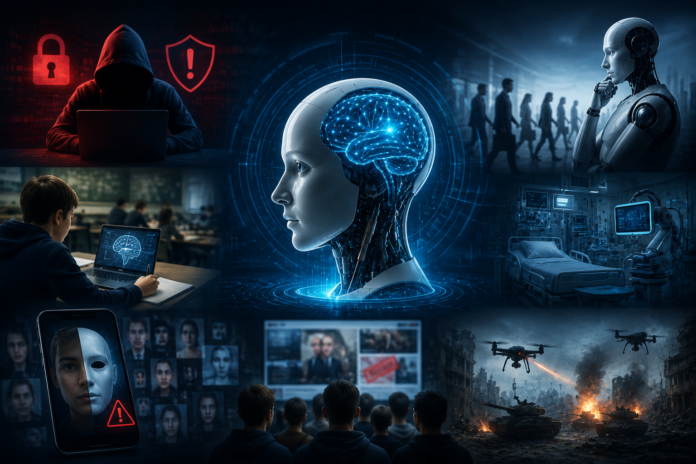
Artificial Intelligence (AI) is no longer a futuristic concept it has become part of everyday life. From helping students learn and assisting doctors in hospitals to powering chatbots and self-driving technology, AI is transforming the way people live and work. While many fear robots taking over the world, experts say the real risks lie in how AI is used by humans.
Highlights
- AI is revolutionising education, healthcare and workplaces.
- Automation is changing the job market across many industries.
- Cybercriminals are using AI to create sophisticated online scams.
- Deepfake videos and fake news are becoming harder to detect.
- Experts are calling for stronger regulations to ensure AI is used responsibly.
Main Story
AI Is Everywhere
Artificial Intelligence has rapidly become one of the world’s fastest-growing technologies. It is helping businesses improve efficiency, supporting doctors in diagnosing illnesses, assisting teachers in classrooms and making everyday tasks easier for millions of people.
However, as AI continues to evolve, experts warn that society must also prepare for the challenges it brings.
Schools Face New Challenges
AI-powered learning tools are making education more accessible by helping students understand complex subjects and allowing teachers to automate tasks such as grading and lesson preparation.
At the same time, educators are increasingly concerned that students may rely too heavily on AI to complete assignments, reducing critical thinking and creativity. AI-generated essays and homework have also made academic dishonesty more difficult to detect.
There are also growing concerns about how student information is collected and stored by AI-powered educational platforms.
AI Is Reshaping the Workplace
Across industries, businesses are adopting AI to improve productivity and reduce costs.
Routine jobs in manufacturing, customer service, data entry and administration are increasingly being automated. While this may reduce demand for certain roles, experts say AI is also creating new opportunities in software development, cybersecurity, robotics, data science and digital innovation.
Workers are being encouraged to develop new digital skills to remain competitive in the changing job market.
AI Is Transforming Healthcare
Hospitals around the world are using AI to analyse medical scans, detect diseases earlier and support doctors in making treatment decisions.
Although the technology has improved healthcare in many ways, specialists caution that AI should never replace professional medical judgment. Errors can occur if systems are trained using incomplete or biased data.
Protecting patients’ confidential medical information also remains a major concern as hospitals adopt more digital technologies.
Cybercrime Is Becoming More Sophisticated
One of the biggest concerns surrounding AI is its growing use by cybercriminals.
Fraudsters can now generate convincing phishing emails, fake customer support chats and even clone people’s voices to trick victims into sending money or revealing sensitive information.
Security experts are urging individuals and businesses to remain vigilant as AI-powered scams become increasingly difficult to identify.
The Rise of Deepfakes and Fake News
AI has made it easier than ever to create realistic images, videos and audio recordings that appear genuine.
Known as deepfakes, these digital creations can spread misinformation, manipulate public opinion and damage reputations by making people appear to say or do things they never actually did.
As election periods and major global events continue to rely heavily on digital media, experts believe media literacy has become more important than ever.
Privacy Remains a Growing Concern
Many AI-powered platforms collect large amounts of personal information to improve their services.
Without proper safeguards, this data could be misused, stolen or shared without users fully understanding how their information is being handled.
Governments around the world are now working to strengthen data protection laws as AI adoption continues to grow.
Military organisations are also investing heavily in artificial intelligence.
Some experts fear that autonomous weapons capable of identifying and attacking targets with limited human involvement could create serious ethical and humanitarian concerns if not properly regulated.
Calls for international rules governing military AI continue to grow.
The Future Depends on Responsible Use
Despite the risks, experts agree that artificial intelligence itself is not the enemy.
Like any powerful technology, its impact depends on how people choose to develop, regulate and use it. With responsible innovation, strong cybersecurity and ethical oversight, AI has the potential to improve lives across education, healthcare, business and many other sectors.

