
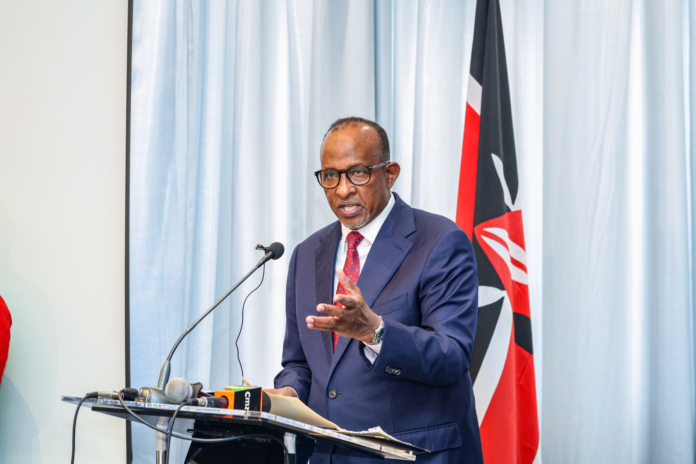
The Kenyan government has strengthened its fight against counterfeit and substandard medicines following the inauguration of a new multi-agency steering committee tasked with overseeing the implementation of the National Action Plan on Substandard and Falsified (SF) Medical Products. Health Cabinet Secretary Aden Duale said the initiative is aimed at protecting patients, improving healthcare standards, and safeguarding the country’s pharmaceutical supply chain.
Highlights
- Health CS Aden Duale has launched the Interministerial Steering Committee on fake medicines.
- The committee will oversee the implementation of Kenya’s National Action Plan on substandard and falsified medical products.
- More than 200 non-compliant pharmaceutical outlets have been shut down.
- The Pharmacy and Poisons Board has coordinated dozens of product recalls and public safety alerts.
- The government will work with the World Health Organization and other partners to strengthen regulation and enforcement.
Main Story
Government Strengthens Fight Against Fake Medicines
Health Cabinet Secretary Aden Duale has officially inaugurated the Interministerial Steering Committee (ISC), a high-level body that will coordinate Kenya’s efforts to eliminate substandard and falsified medical products.
The committee will provide strategic leadership, guide policy implementation, and improve coordination among government agencies responsible for regulating, investigating, and preventing the circulation of unsafe medicines.
Protecting Patients and Public Health
Speaking during the launch, Duale warned that counterfeit and substandard medicines continue to pose a serious threat to patient safety and the country’s healthcare system.
He noted that fake medical products contribute to treatment failure, antimicrobial resistance, preventable deaths, and reduced public confidence in healthcare services.

According to the CS, addressing the challenge is also critical to the successful implementation of Taifa Care and the government’s Universal Health Coverage (UHC) agenda.
Whole-of-Government Approach
Duale emphasized that combating fake medicines requires collaboration across multiple sectors.
The new committee brings together regulatory agencies, law enforcement officers, border control authorities, county governments, healthcare professionals, pharmaceutical manufacturers, distributors, development partners, and other stakeholders.
The goal is to improve prevention, surveillance, investigations, enforcement, and public awareness while addressing legal and operational gaps within the pharmaceutical sector.
Stronger Regulatory Action
Kenya has significantly stepped up efforts to strengthen medicine safety in recent years.
Between 2021 and 2025, the Pharmacy and Poisons Board (PPB) handled 1,413 product quality complaints, coordinated 99 product recalls, received 32,833 adverse drug reaction reports, and issued 18 public alerts concerning suspected falsified medicines.
Since January 2025 alone, the regulator has carried out 58 product recalls and released 14 rapid alerts involving counterfeit medical products.
Crackdown on Illegal Pharmacies
Authorities have also intensified enforcement operations targeting illegal pharmaceutical businesses.
More than 200 non-compliant pharmaceutical premises have been closed, while several individuals have been arrested and prosecuted for offences related to the distribution of unsafe medicines.
The government says these actions are part of wider efforts to ensure only safe, effective, and quality-assured medical products reach Kenyan consumers.
Partnership With Global Health Agencies
Duale reaffirmed Kenya’s commitment to working closely with the World Health Organization (WHO) and other international partners to strengthen pharmaceutical regulation.
Key focus areas include enhancing surveillance systems, improving intelligence sharing, introducing digital medicine traceability, and boosting enforcement capacity in line with international best practices.
He said these measures will help ensure every Kenyan has access to safe, affordable, and effective medicines.
As Kenya strengthens oversight of its pharmaceutical sector, the success of the new strategy will depend on collaboration between government agencies, healthcare providers, manufacturers, and the public in keeping counterfeit medicines out of circulation.

