
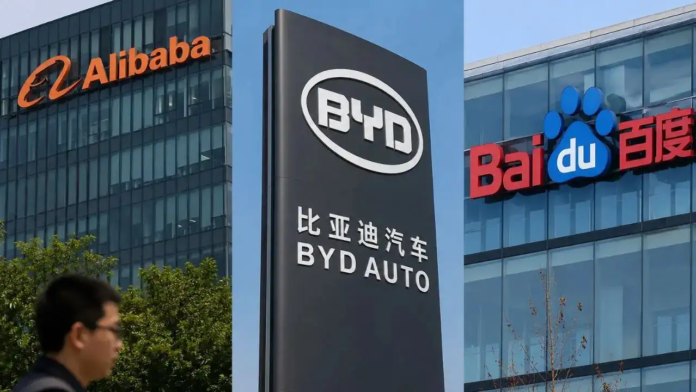
The rivalry between the United States and China has taken another sharp turn after Washington added some of China’s biggest corporate names including Alibaba, BYD and Baidu to a list of companies allegedly linked to the Chinese military. While the move does not immediately impose sanctions, it raises fresh concerns for investors and signals a tougher stance on China’s growing influence in technology, manufacturing and artificial intelligence.
Highlights
- Alibaba, BYD and Baidu have been added to a Pentagon watchlist.
- The US says the firms may have links to China’s military ecosystem.
- China has condemned the designation as unfair and discriminatory.
- The companies deny any military involvement and plan to challenge the decision.
- Analysts warn the move could deepen tensions between Washington and Beijing.
Main Story
US Expands Military-Linked Companies List
The United States Department of Defense has updated its list of Chinese companies believed to have connections to China’s military sector, adding several high-profile corporations to the roster.
Among the latest additions are e-commerce giant Alibaba, electric vehicle leader BYD and internet search company Baidu. The updated register now includes more than 80 Chinese entities operating directly or indirectly within the US market.
Although the designation does not automatically trigger penalties or restrictions, it serves as a cautionary signal to American investors, businesses and government agencies when dealing with the listed firms.
China Pushes Back
Beijing reacted strongly to the announcement, accusing Washington of unfairly targeting Chinese businesses.
Chinese officials argued that companies operating internationally follow the laws and regulations of the countries where they conduct business and should not be subjected to political pressure.
The latest dispute comes as relations between the world’s two largest economies remain strained over trade, technology and national security concerns.
Alibaba and Baidu Reject Allegations
Both Alibaba and Baidu have publicly challenged the Pentagon’s decision.
Alibaba said there is no evidence supporting claims that it has ties to the Chinese military and maintained that its operations are purely commercial. The company indicated it would pursue legal options to contest the designation.
Baidu also disputed its inclusion, describing the decision as lacking a credible basis and promising to seek removal from the list.
Growing Focus on Strategic Industries
The move highlights Washington’s increasing scrutiny of Chinese companies involved in sectors considered strategically important.
Areas such as artificial intelligence, advanced manufacturing, semiconductors and electric vehicles have become major battlegrounds in the ongoing competition between the US and China.
American officials have repeatedly expressed concerns about China’s military-civil fusion policy, which encourages cooperation between commercial businesses and defence-related institutions.
Why BYD’s Inclusion Matters
One of the most notable additions is BYD, the Chinese electric vehicle manufacturer that recently surpassed Tesla in global EV sales.
Although BYD does not currently sell passenger vehicles in the United States, its rapid international expansion has positioned it as one of China’s most influential industrial success stories.
Its appearance on the Pentagon list underscores growing US concerns about China’s rising dominance in future-focused industries.
Potential Impact on Business
Experts believe the designation could create reputational challenges for the affected companies even without formal sanctions.
Investors may become more cautious, while businesses could face increased regulatory scrutiny when operating in the US market.
Analysts also warn that Beijing could respond with countermeasures, ranging from diplomatic protests to restrictions targeting American companies operating in China.
Other firms newly added to the list include EV maker Nio and aircraft manufacturer Comac. They join previously designated Chinese giants such as Huawei, Tencent, DJI and CATL.
As competition between Washington and Beijing intensifies, technology and economic influence continue to sit at the centre of one of the world’s most important geopolitical rivalries.
As the US and China continue competing for technological and economic dominance, global companies may increasingly find themselves caught in the middle of a battle that extends far beyond business.

