
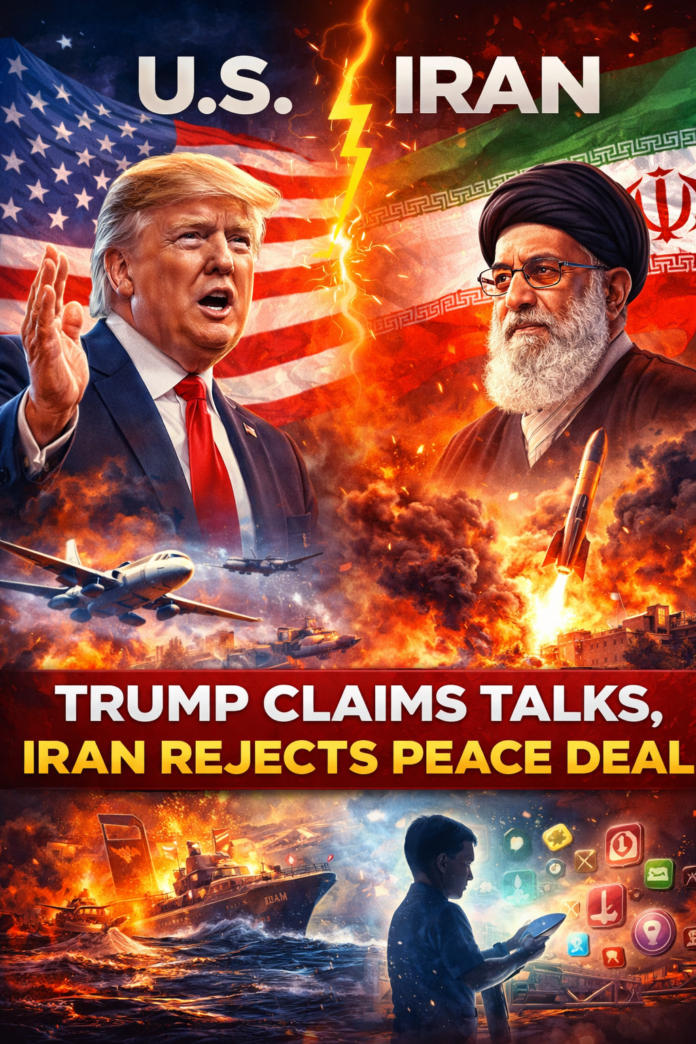
A tense geopolitical standoff between the United States and Iran is taking a new twist, with former U.S. President Donald Trump hinting at a possible exit strategy while Iran firmly rejects any suggestion of ongoing negotiations. Mixed signals from both sides are fueling uncertainty about whether peace talks are quietly progressing or completely stalled.
Highlights
- Trump claims Iran is secretly open to talks but afraid to admit it
- Iran publicly denies negotiations and rejects U.S. proposals
- Reports suggest indirect communication channels may exist
- Disagreement persists over terms of a potential deal
- No confirmed agreement despite growing global attention
Main Story
Trump Hints at a Way Out
Donald Trump has suggested that there could be progress toward easing tensions with Iran, pointing to what he described as “major points of agreement.” His remarks signal a possible attempt to shape an exit strategy from the ongoing conflict, combining diplomatic signals with continued pressure.

He has also implied that Iran may be more willing to negotiate than it publicly admits, framing the situation as one where Tehran is cautious about appearing weak.
Iran Pushes Back Publicly
Despite these claims, Iran has taken a firm stance, dismissing reports of direct negotiations with the United States. Officials have rejected a proposed peace framework, instead putting forward their own conditions for any potential agreement.
These demands reportedly go beyond simple ceasefire terms, touching on broader issues such as compensation and strategic control highlighting just how far apart both sides remain.
Even as public statements remain sharply opposed, there are indications that indirect communication channels could be in play. Diplomatic intermediaries are believed to be facilitating quiet exchanges, suggesting that dialogue may still be happening just not openly.
This kind of backchannel engagement is common in high-stakes conflicts, where both sides test possibilities without committing publicly.
Conflicting Narratives
The situation is defined by two very different narratives. On one hand, Trump presents a picture of progress and potential agreement. On the other, Iran maintains that it has not accepted any U.S. proposal and is not engaged in direct talks.
This contrast reflects a broader strategy often seen in international diplomacy where public messaging and private negotiations do not always align.
What Happens Next?
For now, there is no clear resolution in sight. While the idea of an exit strategy is being floated, the gap between both sides remains significant. Any breakthrough would likely require compromises that neither side has yet shown willingness to make publicly.
As both sides hold their ground, the world is left watching wondering whether these mixed signals are the start of peace talks or just another chapter in a long-running standoff.

