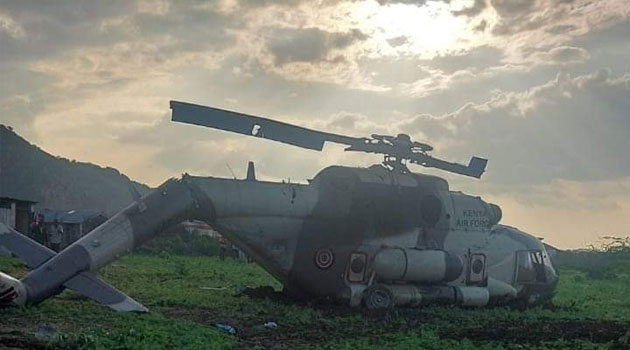
Families of fallen Kenya Defence Forces (KDF) personnel are at a standoff with the Ministry of Defence following the release of an Sh8 million compensation package per household. The settlement, intended to provide closure for families of officers killed in a recent helicopter disaster, has instead ignited a firestorm of controversy.
Legal representatives for the families and military welfare analysts have branded the figure “grossly inadequate.” They argue the payout fails to account for the current economic reality, the rank of the officers, or the risk profile associated with military aviation.
—
## A ‘Standard’ Payout or an Insult?
The Kenya Defence Forces has long maintained a strict, often opaque, protocol regarding death in the line of duty. However, the tragedy of the recent chopper crash has brought these internal policies under unprecedented public scrutiny.
Under the current framework, the Sh8 million payment is reportedly a flat-rate settlement derived from the military’s internal insurance schemes. Families argue that this “one-size-fits-all” approach ignores the years of service and the potential earnings lost by the sudden deaths of high-ranking officers and specialized technicians.
> “To offer Sh8 million for a life given in service to this country is not just a policy failure; it is a moral one,” says a legal representative for three of the affected families, speaking on condition of anonymity. “When you factor in the cost of living and the education of the children left behind, this amount is exhausted in less than three years.”
—
## Discrepancies in International Benchmarks
The core of the dispute lies in the vast gulf between KDF’s compensation and international standards for military and aviation fatalities. Investigative data suggests that in similar jurisdictions, compensation for soldiers killed in aviation accidents ranges between Sh25 million and Sh50 million.
Analysts point to several factors that make the Kenyan payout appear “insulting”:
– **Insurance Premiums:** Questions are being raised about the specifics of the KDF group life insurance policy and whether the premiums paid by taxpayers are commensurate with the benefits being dispersed.
– **Aviation Standards:** Under the Montreal Convention—which governs civil aviation—payouts for air disasters are significantly higher. While military flights are exempt from these treaties, families argue the risk and value of life remain identical.
– **Inflationary Pressure:** The Sh8 million figure has remained largely static for years, failing to adjust for the double-digit inflation affecting the Kenyan economy.
“The military is operating on 20th-century actuarial tables in a 21st-century economy,” says Samuel Kiptoo, an independent defense analyst. “If you compare this to the compensation paid to families of UN peacekeepers, the discrepancy is staggering. It creates a hierarchy of death that the soldiers’ families find impossible to swallow.”
—
## The Transparency Gap
The Ministry of Defence (MoD) has remained tight-lipped about the breakdown of the Sh8 million. Families are demanding a forensic audit of the compensation math. They want to know how much is coming from the government exchequer, how much from private insurers, and what happened to the ‘benevolent fund’ contributions deducted from the officers’ salaries.
Sources within the Department of Defence (DoD) suggest that the Sh8 million is the ceiling for “accidental death” during non-combat operations. However, the families counter that a helicopter falling from the sky due to suspected mechanical failure or pilot fatigue—while under the command of the State—should be treated with a higher degree of liability.
### Key Points of Contention:
– **Lack of Independent Assessment:** Compensation is determined internally by the military board without input from independent loss adjusters.
– **Delayed Gratuities:** Many families claim that while the Sh8 million is being offered, other statutory benefits like pension gratuities are being mired in bureaucratic red tape.
– **No Liability Admission:** By accepting the Sh8 million, families fear they are being coerced into signing indemnity forms that waive their right to sue the State for negligence.
—
## Impact on Morale and Recruitment
This is not just a financial dispute; it is a crisis of confidence. The KDF has historically relied on the “esprit de corps”—the feeling of pride and mutual loyalty. When the State is perceived as “low-balling” the families of its fallen, the ripple effects hit the frontline.
Current serving members of the Air Wing, who spoke to SPM BUZZ off the record, expressed deep anxiety. There is a growing sentiment that the risks they take daily are not valued by the top brass sitting in Hurlingham.
> “We fly birds that are decades old,” one technician noted. “Knowing that my family will have to fight for crumbs if the engine fails today makes it very hard to focus on the mission.”
—
## What Happens Next?
The families have signaled their intent to petition the National Assembly’s Committee on Defence and Foreign Relations. They seek an overhaul of the KDF Act to include a more robust, transparent, and indexed compensation framework.
Legal experts suggest that a class-action lawsuit against the Ministry of Defence is also on the table. If the courts are asked to intervene, it could lead to a landmark ruling that forces the military to open its books on insurance procurement.
Until then, the Sh8 million remains in limbo. Some families have refused to collect the cheques, viewing the acceptance of the money as a betrayal of their loved ones’ sacrifice. The ball is now in the court of the Defence Council to decide if they will stick to their “flat rate” or realize that the price of service in the modern era has gone up.
The State’s silence on the matter is becoming increasingly untenable. In any democracy, the value of a soldier’s life must be more than a line item in a budget. For the families of the crash victims, the current offer is not a settlement—it is a provocation.
Related Stories
- Kenyans Trapped In Tehran: Foreign Affairs Silence As US-Israel Strikes Intensify
- The ‘Congo Air’ Effect: Why Your Neighborhood is Flooding Despite No Clouds
- Inside the Chinese Firms Lining Up Sh10B to Invest in Kenya: What’s the Catch for Local Workers?
- UDA Internal Frictions: Why Dismissing the ‘United Opposition’ Could Backfire on Ruto

