
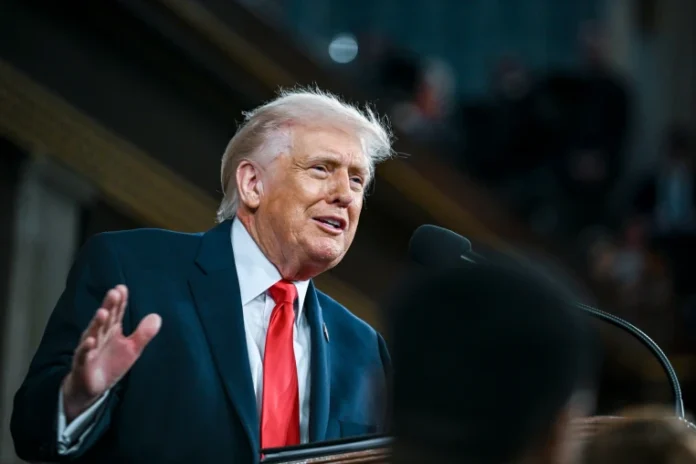
## The Facade of American Economic Strength and its Global Repercussions
The facade of a “stronger than ever” American economy, vocalized during the latest State of the Union address, is facing immediate scrutiny as global energy markets react to shifting U.S. domestic policy. While the rhetoric from the podium painted a picture of domestic prosperity, the tremors are being felt thousands of miles away in Nairobi, where the Kenyan Shilling continues to battle a domineering U.S. Dollar.
The disconnect lies in the math of energy independence versus global market reality. As the U.S. administrative shift maneuvers toward aggressive oil protectionism and erratic trade tariffs, the cost of **Brent Crude** remains stubbornly volatile, putting emerging markets like Kenya in a precarious fiscal position.
## The Rhetoric vs. The Pump
During the address, claims were made regarding the unprecedented strength of the U.S. consumer and the decline of energy costs. However, data from the **International Energy Agency (IEA)** suggests a different trajectory. Crude oil futures have seen a 4.2% uptick in the last quarter, driven largely by **U.S. policy uncertainty** and **geopolitical friction** in production zones.
For Kenya, this is not a theoretical debate. The **Energy and Petroleum Regulatory Authority (EPRA)** remains at the mercy of the landed cost of refined petroleum. When Washington enacts policies that prioritize U.S. stock market indices over global price stability, the “**Mwananchi**” pays the ultimate price at the pump.
> “The claim of a ‘strong economy’ in the West often ignores the export of inflation to the Global South,” says Dr. Silas Mwangi, a regional economist. “When the U.S. economy ‘strengthens’ through high interest rates and aggressive energy hoarding, the Kenyan Shilling weakens, making every liter of petrol more expensive to import.”
## The Dollar Weapon: A Crisis for the Shilling
A central pillar of the “Strong America” narrative is the aggressive stance of the **Federal Reserve** and the strength of the **Greenback**. While this bolsters U.S. purchasing power, it acts as a direct tax on Kenyan importers. The **Dollar-to-Shilling exchange rate** remains a primary driver of Kenya’s internal inflation.
Current analysis indicates that for every 1% gain in the **U.S. Dollar Index (DXY)**, the Kenyan cost of living rises by approximately 0.5% due to the heavy reliance on **USD-denominated imports**. The “strong economy” touted in the State of the Union is, in effect, a siphon of liquidity from frontier markets.
### Impacts on Kenya:
– **Debt Servicing**: As the Dollar strengthens on the back of U.S. fiscal policy, Kenya’s **external debt**—largely denominated in USD—balloons in local currency terms.
– **Import Costs**: Essential commodities, including **fertilizer and machinery**, have seen a 12% price hike attributed directly to currency fluctuations.
– **Fuel Subsidy Pressures**: The Kenyan government faces renewed pressure to reinstate subsidies it cannot afford, simply to cushion the blow of a “strong” U.S. economy.
## The Energy Policy Paradox
The U.S. administration’s insistence on “**Energy Dominance**” has traditionally centered on increasing domestic drilling. However, analysts point out that **U.S. shale production** is no longer the silver bullet for global prices. Logistic bottlenecks and a focus on shareholder returns over production volume mean that global supply remains tight.
Kenyan lawmakers have begun to question the sustainability of tethering the national economy so closely to U.S. monetary whims. In recent parliamentary committee sessions, members of the **Budget and Appropriations Committee** expressed concern that “State of the Union” optimism rarely accounts for the collateral damage in East Africa.
> “We are watching a closed-loop system,” a source within the Ministry of Energy stated on condition of anonymity. “The U.S. claims victory on inflation, but they are merely exporting it to us. When they tighten their belt, we are the ones who stop breathing.”
## Impact: What Happens Next?
The geopolitical fallout of this economic divergence is twofold. First, Kenya is likely to accelerate its search for **alternative trade settlements**. The discourse surrounding **de-dollarization**, once a fringe topic, is gaining traction within the **African Union** as a defensive measure against U.S. fiscal volatility.
Second, the volatility in global oil prices will force the **Central Bank of Kenya (CBK)** to maintain high interest rates to protect the Shilling. This translates to more expensive loans for small businesses in Nairobi and Mombasa, further stifling local growth to compensate for American “strength.”
As the U.S. moves into a high-stakes election cycle, the rhetoric is expected to sharpen. However, for the Kenyan observer, the State of the Union was less a report on global stability and more a warning of coming economic turbulence. The “strong economy” claimed in Washington may be the very force that destabilizes the Kenyan recovery in the fiscal year ahead.
The bottom line is clear: A stronger Dollar and fluctuating energy policies in the U.S. are not signs of global health. They are indicators of a deepening divide where the prosperity of the North is bought at the expense of the South’s stability.

