
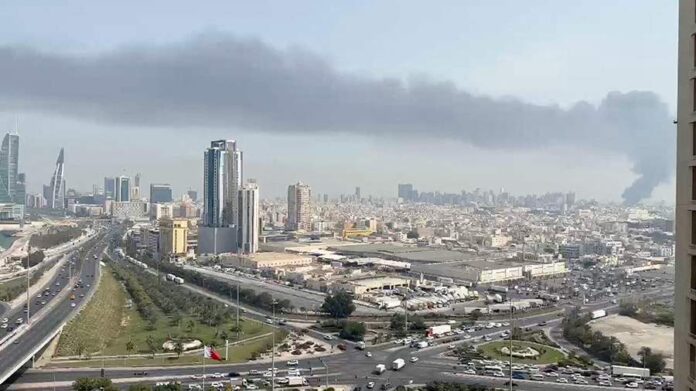
MANAMA, Bahrain — A catastrophic failure in regional missile defense systems has left the United States Navy reeling after a targeted strike on the Naval Support Activity (NSA) Bahrain. The attack, which occurred in the early hours of Thursday, resulted in confirmed American casualties and has effectively dismantled the myth of Western air superiority in the Persian Gulf.
For decades, the base—home to the U.S. Naval Forces Central Command (NAVCENT) and the 5th Fleet—was considered an untouchable fortress. That illusion evaporated at 02:14 local time when a coordinated volley of precision-guided munitions bypassed high-altitude interceptors and struck the heart of the technical operations center.
## The Breach: A Failure of Technology
Initial assessments from the Pentagon suggest the strike was not a primitive insurgent effort. The projectiles exhibited advanced low-observable characteristics, likely utilizing terrain-hugging flight paths that exploited “blind spots” in the localized radar net.
Despite the deployment of multi-billion dollar Aegis and Patriot defense systems, the saturation of the airspace overwhelmed automated response protocols. Military analysts argue that the failure was not just mechanical but systemic.
> “We are looking at a fundamental collapse of the deterrence architecture,” says retired Admiral Marcus Thorne, a naval strategy analyst. “If a state or non-state actor can put ordnance on a target as high-value as NSA Bahrain, no Western asset in the Middle East is safe. This wasn’t a lucky shot; it was a demonstration of peer-level capability.”
Early casualty reports indicate at least four sailors are deceased, with over a dozen more being airlifted to Landstuhl Regional Medical Center in Germany. The names are being withheld pending family notification, but the impact on morale at the headquarters of U.S. maritime operations in the region is catastrophic.
—
## The Intelligence Leak: An Inside Job?
The precision of the strike has triggered an immediate, high-stakes investigation into a potential security breach. The munitions struck high-value targets with a margin of error of less than three meters—accuracy that suggests access to real-time, ground-level intelligence.
Investigators from the Naval Criminal Investigative Service (NCIS) and the DIA are currently focused on how the strike bypassed the base’s electronic warfare (EW) suite, which is designed to jam incoming GPS-guided signals.
– **Internal Compromise:** Sources within CENTCOM suggest that the specific coordinates for the command center’s server rooms—which are not public knowledge—were programmed into the missiles.
– **SigInt Sabotage:** There are growing fears that local contractors or diverted diplomatic signals may have provided the “digital handshake” required to spoof the base’s identification-friend-or-foe (IFF) systems.
– **Surveillance Gaps:** Despite high-altitude drone patrols, the launch site remains unidentified, suggesting the use of a mobile platform or a hidden vertical-launch silo within the region.
“You don’t hit a target this specific with satellite imagery alone,” a former intelligence officer told SPM BUZZ on the condition of anonymity. “Someone on the inside, or someone with access to the base’s fiber-optic layout, provided the blueprint.”
—
## Geopolitical Fallout: The End of Deterrence
The attack on Bahrain is more than a tactical loss; it is a strategic earthquake. Bahrain serves as the crown jewel of U.S. power projection in the Middle East. By striking the 5th Fleet’s nerve center, the perpetrators have sent a clear message: the U.S. security umbrella is leaking.
Regional powers are already recalibrating. For years, Gulf nations have relied on the promise of American protection in exchange for basing rights. If the U.S. cannot protect its own personnel in its most fortified regional hub, the value of that alliance comes into immediate question.
The failure also highlights the growing obsolescence of traditional missile defense against a new generation of “asymmetric” threats. While the U.S. has focused on intercepting ICBMs and high-altitude ballistic missiles, this strike utilized decentralized, low-cost technologies that rendered billion-dollar sensors useless.
## The Response: Escalation or Retreat?
Washington is now faced with a “lose-lose” scenario. A disproportionate kinetic response risks a full-scale regional war that the current administration is desperate to avoid. Conversely, a muted response confirms the perception of American weakness, likely inviting further attacks on assets in Qatar, the UAE, and Djibouti.
Secretary of Defense Lloyd Austin has reportedly convened an emergency session of the Joint Chiefs of Staff. While no group has officially claimed responsibility, the sophistication of the electronics points toward a state actor or a highly funded proxy with state-level equipment.
### Immediate Implications:
– **Naval Gridlock:** Operations in the Strait of Hormuz have been temporarily suspended as the 5th Fleet assesses the safety of its remaining inland infrastructure.
– **Defense Review:** An immediate audit of all Patriot and THAAD batteries across the Middle East is underway to determine if the software was hacked or simply outmatched.
– **Diplomatic Tension:** Bahraini officials are under intense pressure to explain how their domestic security forces failed to detect the movement of such high-grade hardware within or near their borders.
The smoke still rising from the Manama waterfront serves as a grim monument to a shifting world order. The era of unchallenged American hegemony in the Gulf has ended, punctuated by the sound of incoming fire that no one saw coming until it was too late.
The investigation continues, but for the families of the fallen and the commanders in the field, the damage is already absolute. The “unsinkable” base has been hit, and the deterrence that held the region together for thirty years is in tatters.
[Trump’s Iranian Offensive: Why Your Kerosene and Petrol Bills Are About To Explode](/article/trump-s-iranian-offensive-why-your-kerosene-and-petrol-bills-are-about-to-explod-1772284602887)
[Khamenei Reported Killed: The Power Vacuum and Who Controls Iran’s Nuclear Arsenal Now](/article/khamenei-reported-killed-the-power-vacuum-and-who-controls-iran-s-nuclear-arsena-1772314795878)
[Trump’s Iranian Offensive: Why Your Kerosene and Petrol Bills Are About To Explode](/article/trump-s-iranian-offensive-why-your-kerosene-and-petrol-bills-are-about-to-explod-1772284602887)
[Explosions Rock Middle East as Iran Retaliates UAE, Bahrain, Qatar, Kuwait, Jordan, Israel Hit](/article/explosions-rock-middle-east-as-iran-retaliates-uae-bahrain-qatar-kuwait-jordan-israel-hit)
[War Profiteers: Which Defense Stocks Are Quilling As Iran Burns?](/article/war-profiteers-which-defense-stocks-are-quilling-as-iran-burns-1772277057299)

