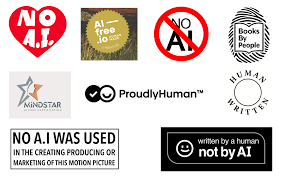
A growing global movement is taking shape as creators and organizations push back against artificial intelligence, racing to introduce labels that certify products as “human-made” but with no universal standard yet, the effort risks leaving consumers more confused than informed.
Highlights:
- Multiple groups are developing “AI-free” or “human-made” certification labels
- The trend is driven by fears of AI replacing human jobs and creativity
- Lack of a universal standard is causing confusion among consumers
- Some systems require strict audits, while others allow easy self-certification
- Creative industries like publishing, film, and music are leading the push
Main Story:
The Rise of ‘Human-Made’ Labels
Across industries, new labels like “AI-free,” “No AI,” and “Human-made” are becoming more common as creators try to distinguish their work from AI-generated content. The push comes amid growing concern that artificial intelligence is rapidly reshaping and in some cases replacing human roles in creative and professional fields.
Inspired by trusted certifications like Fair Trade, several organisations are now attempting to create a globally recognised standard for human-created work. However, at least eight different initiatives are currently competing to define what “AI-free” actually means.
A Growing Problem of Definition
Experts warn that without a single, agreed-upon definition, these labels may end up doing more harm than good. The challenge lies in the fact that AI tools are now deeply embedded in everyday workflows, making it difficult to draw a clear line between human and machine input.
Some specialists argue that the issue is not black and white. Instead of a simple “AI vs no AI” classification, they suggest a spectrum approach that reflects varying levels of AI involvement.
How Certification Systems Differ
Not all “AI-free” labels are created equal. Some platforms allow creators to download and display badges with little to no verification. Others, however, offer more rigorous systems that involve audits, questionnaires, and even AI-detection tools to verify authenticity.
In publishing, companies like Faber and Faber have started adding “Human Written” stamps to selected books. But questions remain about how such claims are verified.
Meanwhile, newer players are introducing stricter processes, requiring ongoing checks and detailed disclosures from creators to ensure minimal or zero use of AI tools.
Creative Industries Lead the Charge
The push for human-made certification is particularly strong in the arts. From films to books and music, creators are seeking ways to prove authenticity in a landscape increasingly shaped by generative AI.
For instance, the 2024 film Heretic included a disclaimer stating that no generative AI was used in its production, a move that reflects growing demand for transparency.
At the same time, AI-first studios like Itelliflicks are openly embracing the technology, highlighting a widening divide within the creative world.
Trust, Transparency, and the Future
As AI tools continue to evolve, the question of authenticity is becoming more urgent. Consumers are increasingly asking whether what they are watching, reading, or listening to reflects genuine human experience or machine-generated output.
While certification systems aim to build trust, their effectiveness will depend on whether industries can come together to create a clear, credible, and widely accepted standard.
Read Also:
- Trump Delays China Visit Amid Iran War Concerns
- 10 Things Tourists Must Know Before Visiting Japan
- Chelsea Hit With Sh1.8 Billion Fine Over Secret Payments Scandal

