
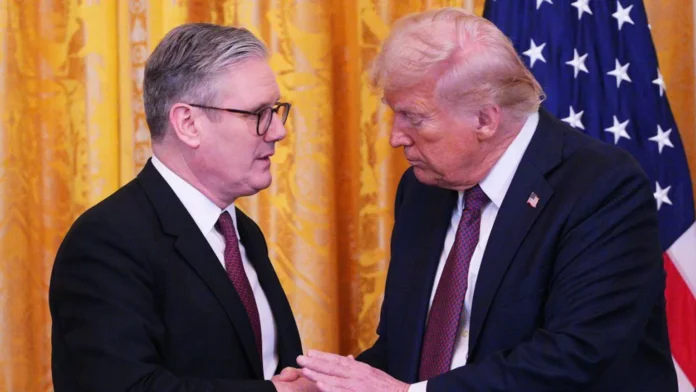
Former U.S. President Donald Trump has stirred fresh debate on international trade after stating that any future trade deal between the United States and the United Kingdom would not be permanent. His remarks, made during a campaign-style address, suggest that such agreements could be revised or renegotiated depending on shifting national priorities.
Highlights
- Trump says trade agreements with allies like the UK are “not permanent”
- He insists deals should remain flexible to serve U.S. interests
- Comments come amid ongoing uncertainty over a post-Brexit trade deal
- UK officials have not issued an immediate response
- Experts warn the remarks could add uncertainty to trade negotiations
Main Story
Trump’s Position on Trade Deals
Former U.S. President Donald Trump has reiterated his long-standing view that international trade agreements should not be treated as fixed arrangements. Speaking at a recent campaign-style event, he argued that such deals must remain adaptable to changing political and economic realities.
He specifically pointed to potential agreements between the United States and the United Kingdom, noting that they should be reviewed and adjusted whenever they no longer serve American interests.
Context: US–UK Trade Discussions
The United States and United Kingdom have been exploring a comprehensive trade deal in the years following Brexit, aiming to strengthen economic ties between the two long-time allies.
However, negotiations have faced delays due to disagreements on key issues such as agricultural standards, digital taxation policies, and regulatory alignment between the two economies.
Trump’s comments have now added a new layer of uncertainty to these already complex discussions.
Mixed Reactions and Uncertainty
Although there was no immediate official response from the UK government, trade analysts suggest that such remarks could influence how future negotiations are approached.
Concerns include:
- Potential instability in long-term trade planning
- Pressure to include stronger safeguards in agreements
- Uncertainty over how future U.S. administrations might handle signed deals
Why the Statement Matters
Trade relations between major economies often rely on predictability and long-term trust. Trump’s position highlights a broader shift in global trade thinking, where agreements are increasingly viewed through the lens of changing political leadership.
For investors and policymakers, such uncertainty can complicate decision-making and long-term economic planning.
Bigger Global Picture
The remarks reflect a wider global trend where international agreements are becoming more fluid, shaped heavily by domestic politics and leadership changes. This continues to affect how countries negotiate and maintain economic partnerships in an increasingly unpredictable global economy.
Read Also
- Horror at Sea: Hundreds of Rohingya and Bangladeshi Migrants Missing After Boat Sinks
- Nairobi Commuters Feel Pressure After Sharp Increase in Fuel Costs
- Britney Spears Seeks Help One Month After DUI Incident

