
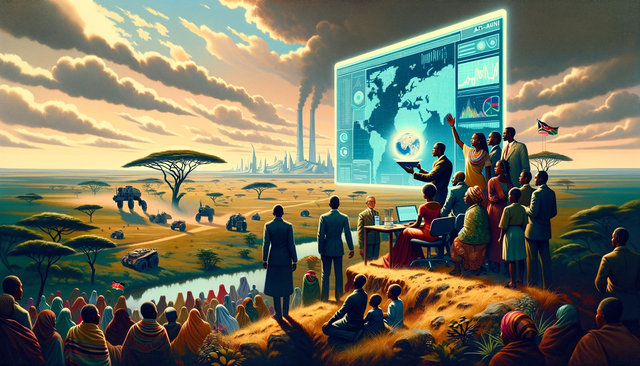
In the glass-walled offices of Nairobi’s high-growth tech corridor, the future of **Artificial Intelligence** is being built. But behind the sleek marketing of Silicon Valley giants like **OpenAI** and **Anthropic** lies a grim reality of psychological trauma and wage suppression that the Kenyan Ministry of Labor has largely ignored.
Fresh investigations reveal that thousands of Kenyan digital laborers are currently being paid as little as **$1.10 to $1.50 per hour** to “cleanse” large language models (LLMs). Their task is to filter out the most horrific content the internet has to offer—including live-streamed violence, child exploitation, and graphic war footage—to ensure AI chatbots remain “safe” for Western consumers.
## The Digital Assembly Line
Nairobi has emerged as a global hub for data labeling, or “**reinforcement learning from human feedback**” (RLHF). While the tech world celebrates the “safety guardrails” of modern AI, those guardrails are manual. They are built by human beings in Kenya sitting in cramped rooms, staring at screens for eight hours a day.
These workers are tasked with reading, watching, and labeling thousands of snippets of “toxic” data. They must categorize violence, hate speech, and sexual deviancy so that the AI learns to reject these prompts.
> “The industry treats us like the exhaust pipes of the AI engine,” says a former supervisor at an outsourcing firm who requested anonymity for fear of blacklisting. “The tech firms brag about their multi-billion dollar valuations while paying the people who make the product ‘safe’ less than the price of a cup of coffee per hour.”
## The Psychological Price of ‘War Data’
The most harrowing aspect of the trade involves “**War Data**.” With ongoing conflicts globally, Kenyan workers are increasingly being fed raw, unedited footage from active war zones to train AI on identifying combat, weaponry, and human rights violations.
Unlike content moderators at major social media firms who have, in some jurisdictions, won settlements for **PTSD**, the Kenyan AI workforce operates in a legal vacuum.
### Key Data Points:
– **Average Hourly Wage:** $1.20 – $1.65 (KES 155 – KES 215)
– **Daily Quotas:** Up to 1,500 “labels” or “annotations” per shift.
– **Mental Health Support:** Often non-existent or limited to “wellness” videos.
– **Turnover Rate:** Estimated at 45% every six months due to burnout and trauma.
> “I spent six months watching videos of torture to teach an AI what ‘suffering’ looks like,” a 23-year-old university graduate told SPM BUZZ. “I cannot sleep without medication now. I was paid 20,000 Shillings a month to destroy my mind.”
## Arbitraging African Poverty
Economic analysts argue that tech giants are utilizing “**geographic arbitrage**.” By outsourcing to Nairobi, they avoid the minimum wage laws and the stringent mental health regulations of the United States and the European Union.
This isn’t just about low wages; it’s about the lack of benefits. Most of these workers are hired as **independent contractors** through third-party agencies. This structure shields the Silicon Valley parent companies from any direct liability regarding the workers’ welfare.
> “Nairobi is being sold as the ‘Silicon Savannah,’ but for the average youth, it’s becoming a digital sweatshop,” says Dr. Silas Mwangi, a regional labor economist. “We are seeing a new form of digital colonialism where the raw material is human psychology, and it is being extracted at the lowest possible cost.”
### The Outsourcing Chain:
1. **The Client:** US-based AI giants (OpenAI, Anthropic, Google, Meta).
2. **The Middleman:** Content outsourcing firms (often US or European based with local offices).
3. **The Worker:** Kenyan graduates facing a 35% underemployment rate.
## Regulatory Silence and The Path Forward
Despite the growing evidence of exploitation, the Kenyan government has remained largely silent. The allure of foreign direct investment and the “digital jobs” narrative has overshadowed the need for protective legislation.
Current labor laws in Kenya do not account for “**psychological injury**” via digital content. There are no mandates for mandatory therapy, maximum exposure limits to graphic content, or hazard pay for those dealing with “War Data.”
International labor advocates are now calling for a “**Global Digital Minimum Wage**” and mandatory transparency in the AI supply chain. They argue that companies capable of raising billions in venture capital have no excuse for paying sub-subsistence wages in the Global South.
## The Impact: A Generation Scarred
The long-term impact on Nairobi’s tech workforce could be devastating. As AI becomes more sophisticated, the “easy” labeling jobs are being automated, leaving only the most disturbing, complex, and traumatic content for human review.
If the status quo holds, Nairobi will continue to produce the “safety” that allows Silicon Valley to thrive, while its own youth are left with the mental scars of a war they didn’t fight, documented for an AI they will likely never be able to afford.
The question for the Ministry of ICT and the Ministry of Labor is simple: Is the title of ‘Silicon Savannah’ worth the psychological destruction of a generation?
> “They call it ‘Artificial’ Intelligence,” the former supervisor noted. “There is nothing artificial about the trauma these young Kenyans are carrying home every night.”

