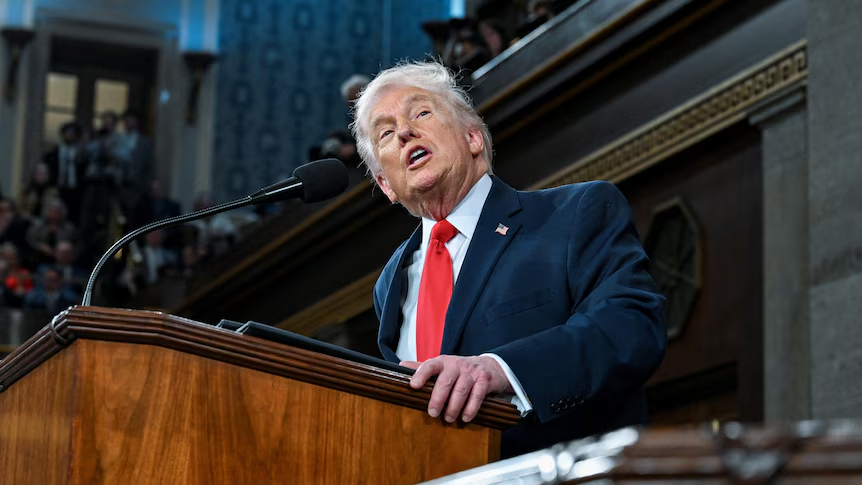
The global security architecture, already strained by three years of attrition in Ukraine and Gaza, just suffered a catastrophic breach. President Donald Trump’s formal declaration of “major combat operations” following a targeted daylight strike on Iranian command assets has liquidated the status quo.
This is no longer a shadow war. By authorizing a kinetic strike of this magnitude, the Trump administration has moved past the failed policy of “maximum pressure” and entered a phase of direct confrontation. The world is now staring at a kinetic escalation that many analysts believe mirrors the pre-conditions of a global conflagration.
—
## The Daylight Strike: A Departure from Protocol
The catalyst for this crisis was a precision-guided strike targeting a high-level coordination meeting between Iranian Revolutionary Guard Corps (IRGC) officials and regional militia leaders. Unlike previous covert operations, this was a daylight execution, designed to be seen and impossible to ignore.
Military analysts view the timing as a deliberate provocation. By striking in the middle of a metropolitan hub during business hours, the Trump Doctrine has signaled that the safety of “sovereign immunity” is dead. The administration’s subsequent declaration of combat status provides the legal framework for sustained, unilateral military action without traditional congressional oversight.
> “The restraint that characterized the previous four years is gone,” says Dr. Aris Thorne, a senior defense analyst at the Global Security Institute. “By declaring ‘major combat operations,’ Trump has functionally bypassed the diplomatic off-ramps. We are in a state of open hostility with a regional nuclear-threshold power.”
—
## The Axis of Resistance: Mapping the Counter-Strike
The immediate concern for global intelligence agencies is not just Iran’s response, but the activation of its “Axis of Resistance.” Tehran’s proxy network is a sophisticated, multi-front military machine capable of paralyzing global trade and overwhelming regional missile defenses.
The threat landscape now includes:
– **Hezbollah (Lebanon):** Carrying an arsenal of over 150,000 rockets and precision-guided missiles, capable of leveling infrastructure across the Levant.
– **Houthi Rebels (Yemen):** Already battle-hardened, they possess the capability to shut down the Bab el-Mandeb Strait, a chokepoint for roughly 10% of global seaborne oil.
– **PMF Militias (Iraq/Syria):** Thousands of ground troops positioned within striking distance of U.S. installations and diplomatic outposts.
The math for the Pentagon is grim. A simultaneous activation of these fronts would require a carrier strike group presence in the Mediterranean, the Red Sea, and the Persian Gulf simultaneously—stretching U.S. naval assets to a breaking point not seen since 1945.
—
## The Economic Weaponization of Conflict
Beyond the kinetic battlefield, the “Trump Doctrine” is triggering an immediate economic shockwave. Within hours of the declaration, Brent Crude spiked 12%, with traders pricing in a total closure of the Strait of Hormuz.
For African markets and emerging economies, this is a death knell for recovery. The cost of shipping, insurance, and fuel will skyrocket, sparking inflationary pressures that could lead to widespread civil unrest in non-combatant nations.
The administration’s gamble relies on “shock and awe” to force a negotiation. However, historical data suggests that high-intensity strikes on sovereign leadership often achieve the opposite, galvanizing nationalist sentiment and forcing even moderate factions within the targeted regime to support total war.
—
## The Red Line in the Sand
What makes this moment feel like the precipice of World War III is the shifting stance of the superpowers. Close observers note that Moscow and Beijing have moved from “concerned bystanders” to “active stakeholders.”
If Iran’s domestic stability is threatened, Russia—already integrated with Iranian drone technology—may feel compelled to open a second front. Meanwhile, China’s dependence on Iranian oil means any blockade of the Gulf is a direct attack on Chinese energy security.
The “Trump Doctrine” assumes that the U.S. can act unilaterally and that the world will adjust. But the world of 2024 is multipolar, armed to the teeth, and deeply interconnected.
### Key Factors Destabilizing the Region:
– **Nuclear Threshold Status:** Iran is reportedly days, not months, away from weapons-grade enrichment.
– **Satellite Warfare:** Reports suggest both sides have move kinetic interceptors into orbit, threatening global communication networks.
– **Cyber Total War:** The threat of state-sponsored hacking of power grids and financial systems is no longer a drill; it is a live contingency.
—
## The Impact: What Happens Next?
The next 72 hours are critical. If Tehran opts for a “proportionate” response, there may be a slim margin for backchannel diplomacy. However, Trump’s declaration includes a warning that any retaliation will be met with “exponential force.”
The legal and military infrastructure for a global conflict is now live. We are no longer discussing “if” a major war could break out in the Middle East; we are discussing how many continents it will eventually consume.
For the first time since the Cold War, the threat of a multi-theater conflict involving nuclear powers is not a theoretical exercise—it is the morning news. The “Trump Doctrine” has been unleashed; the only question left is who will be standing when the smoke clears.

