
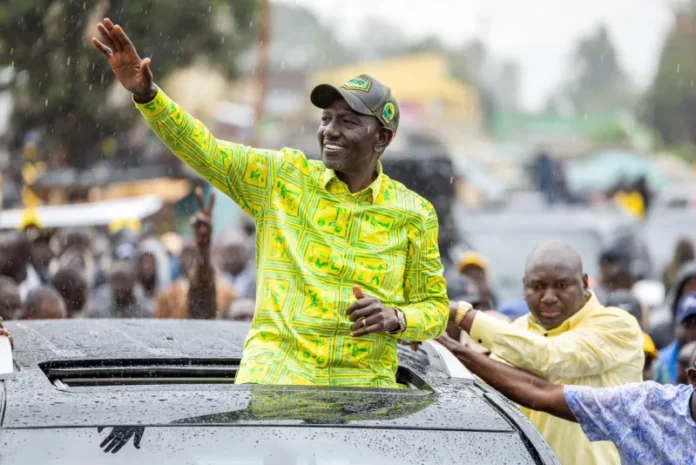
President William Ruto has intensified his political messaging by taking aim at his opponents, defending contributions to the Social Health Authority (SHA) and outlining his administration’s next phase of development. In separate remarks, the President criticised a rival’s political party and fundraising efforts, argued that higher earners should contribute more towards equitable healthcare financing, and promised expanded employment and infrastructure programmes under the Bottom-Up Economic Transformation Agenda.
Highlights
- Ruto mocked a political rival over his new party and alleged fundraising activities.
- The President defended higher healthcare contributions for better-paid Kenyans as a matter of equity.
- He described shared financial responsibility as a key principle of the bottom-up economic model.
- Ruto said his administration would be judged on its development agenda and delivery of results.
- His proposed next phase includes expanding affordable housing employment, digital work, foreign job opportunities and infrastructure projects.
Main Story
Ruto Mocks Political Rival Over New Party
President William Ruto has launched a fresh attack on a political rival, questioning the seriousness of his new party and criticising what he described as attempts to solicit money from Kenyans.
In remarks delivered during a political address, Ruto used the nickname “Mr. Empty” to ridicule the rival, whom he accused of focusing on political theatrics rather than presenting a convincing agenda to voters.
The President also referred to an occasion involving Congolese musician Koffi Olomide, claiming the rival had been seen at a gathering where alcohol was present. He questioned whether the new political outfit had a clear direction and dismissed its appeal to voters.
The comments reflect the continuing political exchanges ahead of the 2027 General Election, as leaders seek to distinguish their campaigns and challenge their opponents’ credibility.
Ruto maintained that Kenyans would not be persuaded by political messaging that lacks substance, although his remarks were framed as criticism of his rival rather than an independent assessment of the party’s platform.
Ruto Defends SHA Contributions and Healthcare Equity
The President has also defended the principle of asking higher-income earners to contribute more towards healthcare financing under the Social Health Authority (SHA).
Ruto argued that access to medical care should not depend on an individual’s financial circumstances, insisting that ordinary Kenyans should not have to sell livestock or land to meet hospital bills.
He criticised wealthy individuals who oppose higher contributions on the grounds that they pay more, arguing that their economic success is also supported by the labour and contributions of ordinary citizens.
According to the President, a fair healthcare financing system should ensure that people with greater financial means contribute more, helping extend medical coverage to those with limited or irregular incomes.
His position places income-based contributions at the centre of his administration’s healthcare equity argument.
However, questions surrounding SHA contributions, affordability, service delivery and accountability remain important to the wider public debate about the new healthcare system.
Ruto Explains the Bottom-Up Economic Model
Ruto reiterated that his administration’s bottom-up economic model is built around redistributing opportunities and supporting citizens at the lower end of the economic ladder.
He argued that people with greater resources should help support those who face financial difficulties, describing the approach as an important component of his government’s vision for a more equitable society.
The President presented healthcare financing as one example of how the model is intended to work, with contributions from better-paid citizens helping support access to services for people with fewer resources.
The model has been a central feature of Ruto’s political platform since the 2022 General Election, with the administration promising to prioritise ordinary workers, small businesses and low-income households.
Ruto Outlines Next Phase of Development Agenda
The President also defended his administration’s development record, saying Kenyans voted for a specific programme in 2022 through the Bottom-Up Economic Transformation Agenda.
He pointed to road construction, agricultural support, education under the Competency-Based Curriculum (CBC) and healthcare through SHA as areas where his government says it is pursuing change.
Ruto argued that leadership should be assessed according to its policies and delivery rather than political anger, tribal divisions or personal attacks.
He also signalled a second phase of development, outlining several areas his administration intends to prioritise.
These include:
- Affordable housing: Expanding employment opportunities linked to housing projects, with a target of two million jobs for young people.
- Digital employment: Creating more opportunities for young Kenyans to earn through digital work.
- Foreign employment: Expanding access to jobs outside the country.
- Water and energy: Developing additional dams and energy projects.
- Transport infrastructure: Upgrading the country’s transport network through the proposed National Infrastructure Fund.
The employment figures and development plans represent the President’s stated ambitions. Their eventual impact will depend on implementation, funding, job creation and the extent to which the promised opportunities reach Kenyans.
Political Debate Intensifies Ahead of 2027
Ruto’s remarks bring together three major themes likely to feature prominently in Kenya’s political debate: the credibility of opposition leaders, the affordability of healthcare and the government’s economic development record.
While the President has urged voters to focus on policy and tangible results, his criticism of political rivals shows that personal exchanges remain part of the contest.
At the same time, his defence of SHA financing places renewed attention on how Kenya can fund healthcare while balancing the financial demands placed on households.
As the country approaches the next General Election, voters will have an opportunity to scrutinise competing political promises, assess the government’s record and consider whether announced programmes deliver measurable improvements in their daily lives.
With 2027 approaching, the central question for Kenyans is whether political promises on healthcare, employment and development will translate into tangible improvements in household incomes, access to services and opportunities for young people.

