
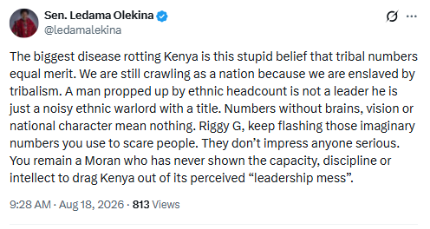
Narok Senator Ledama Olekina has launched a sharp criticism of former Deputy President Rigathi Gachagua, questioning his growing emphasis on the political strength of the Mount Kenya region as he prepares for the 2027 General Election. Olekina argues that Kenya’s leadership should be judged by competence and national vision rather than the size of an ethnic voting bloc.
Highlights
- Olekina accused Gachagua of placing too much emphasis on ethnic voting numbers.
- The senator said tribalism continues to hold Kenya back.
- He challenged politicians to prioritise competence and national character.
- Gachagua has been mobilising support for his Democracy for the Citizens Party.
- The debate over Mount Kenya’s political influence is intensifying ahead of 2027.
Main Story
Olekina Challenges Gachagua’s Political Strategy
Senator Ledama Olekina has criticised Rigathi Gachagua over what he sees as an excessive focus on ethnic numbers in Kenyan politics.
In a statement shared on X on Tuesday, August 18, 2026, Olekina argued that political support from a particular community should not automatically be treated as proof of leadership ability.
The Narok senator said Kenya continues to struggle because political conversations are often centred on ethnic mobilisation instead of the qualities needed to govern effectively.
‘Tribalism’ Remains a Major Problem
Olekina described tribalism as one of the country’s biggest barriers to progress.
He argued that reducing politics to community numbers prevents Kenyans from properly evaluating leaders based on their ideas, competence and ability to address national challenges.
According to the senator, a large voting bloc may create political influence, but it does not necessarily translate into effective leadership.
Direct Message to ‘Riggy G’
Olekina’s remarks were particularly directed at Gachagua, who has been highlighting the political significance of the Mount Kenya region while building his support base ahead of the 2027 election.
The former deputy president is also seeking to strengthen his Democracy for the Citizens Party as he positions himself for the next political contest.
Olekina dismissed the importance of projected ethnic voting numbers, arguing that political leaders should instead demonstrate clear ideas, sound judgement and a broader national outlook.
He also challenged Gachagua to show that he possesses the intellectual and leadership capacity needed to tackle Kenya’s problems.
Debate Over Mount Kenya Votes Intensifies
The exchange comes as political figures increasingly debate the influence of the Mount Kenya voting bloc ahead of 2027.
The region has traditionally been viewed as one of Kenya’s most important electoral constituencies because of its sizeable voting population.
Gachagua has increasingly sought to consolidate support from the region, while other politicians have questioned whether ethnic voting patterns should continue to dominate national politics.
Olekina’s latest remarks add to that growing debate, with the senator insisting that political numbers should not be confused with leadership credentials.
As the 2027 election approaches, discussions around ethnicity, regional voting blocs and national alliances are likely to remain central to Kenya’s political landscape.
As Kenya heads towards another fiercely contested election, the bigger question may be whether voters will choose leaders based on ethnic arithmetic or the strength of their ideas and record.

