
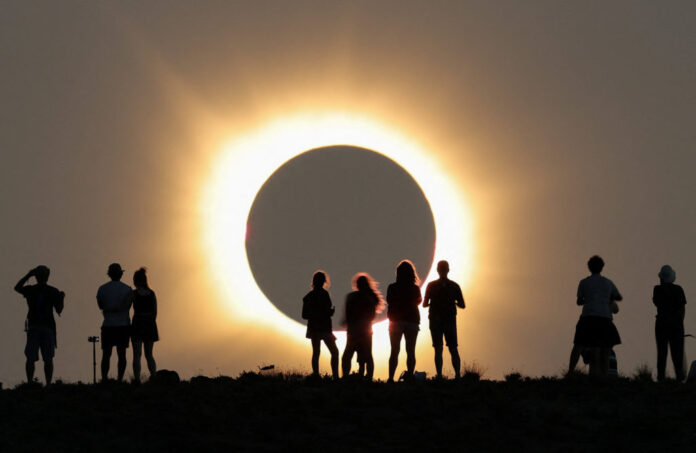
For a few unforgettable moments, parts of Europe appeared to lose daylight as the Moon moved directly in front of the Sun, creating a rare total solar eclipse. Crowds gathered across Spain and other parts of Europe to witness the dramatic event, with cheers erupting as the sky darkened and the Sun disappeared.
Highlights
- Parts of Spain experienced a rare total solar eclipse.
- Millions across Europe witnessed either a total or partial eclipse.
- The darkest phase lasted less than two minutes in many locations.
- Spectators observed phenomena including Baily’s beads and the Sun’s corona.
- Special viewing areas were established in parts of Spain for the event.
Main Story
Spain Watches Daylight Disappear
The eclipse turned parts of Spain into a major viewing destination, with crowds gathering in rural areas and other locations offering clear views of the sky.
In Buitrago de Lozoya, north of Madrid, spectators applauded and celebrated as daylight gradually faded. As the Moon moved across the Sun, the final flashes of sunlight appeared around its edge before the sky became dramatically darker.
The brief appearance of these flashes, known as Baily’s beads, added another striking moment to the spectacle.
Authorities in Spain had prepared for large crowds, particularly in areas expected to experience the strongest effects of the eclipse.
What Is a Solar Eclipse?
A solar eclipse happens when the Moon passes between the Sun and Earth, blocking sunlight from reaching part of the Earth’s surface.
Because the Moon is much closer to Earth than the Sun, it can appear large enough in the sky to temporarily cover the Sun despite being significantly smaller.
The experience depends on where a person is standing.
Someone directly inside the Moon’s darkest shadow can experience a total solar eclipse, while people outside that narrow zone may see only part of the Sun covered.
How Does a Total Solar Eclipse Happen?
A total eclipse requires an almost perfect alignment of the Sun, Moon and Earth.
As the Moon moves around Earth, its shadow is normally cast into space without reaching our planet. Occasionally, however, the alignment is just right for the Moon’s shadow to fall across Earth’s surface.
The darkest section of that shadow is called the umbra. People within it can see the Sun completely covered.
A wider, lighter shadow called the penumbra extends beyond the umbra. People in this area experience a partial eclipse.
This explains why one location can become almost completely dark while another nearby location sees only a portion of the Sun covered.
Why Does It Become Dark?
The Sun is the main source of daylight on Earth. When the Moon moves directly between us and the Sun, it temporarily blocks most or all of that sunlight.
During totality, the sudden loss of direct sunlight can make the surroundings resemble twilight even though it is still daytime.
The temperature can also fall, shadows can change dramatically and some animals may briefly behave as though night has arrived.
One of the most remarkable sights is the solar corona, the Sun’s extremely hot outer atmosphere. It is normally difficult to see because the Sun’s bright surface overwhelms it.
During totality, however, the Moon blocks the bright solar surface, allowing the faint corona to become visible around the dark Moon.
What Are Baily’s Beads?
Just before the Sun disappears completely, small points of sunlight can briefly shine around the Moon’s edge.
These are known as Baily’s beads.
They are created by the uneven surface of the Moon. Lunar mountains and valleys allow sunlight to squeeze through small gaps, producing the appearance of bright beads.
They can also be seen again as totality comes to an end and sunlight begins returning.
Where Could People See the Eclipse?
The path of totality passed through parts of Greenland, Iceland, northern Russia, Spain and a small section of Portugal.
A much larger area experienced a partial eclipse, meaning people could still see the Moon covering a significant portion of the Sun without experiencing complete darkness.
Parts of the United Kingdom, for example, experienced substantial solar coverage, although most locations did not fall within the path of totality.
Why Are Total Solar Eclipses Rare?
Solar eclipses happen because of the unique relationship between the Sun, Moon and Earth.
The Moon is roughly 400 times smaller than the Sun, but it is also roughly 400 times closer to Earth. This coincidence means the two objects can appear almost the same size in our sky.
However, the Moon’s orbit around Earth is tilted slightly compared with Earth’s orbit around the Sun. Because of this, the Sun, Moon and Earth do not line up perfectly during every new moon.
A total solar eclipse therefore requires a very specific alignment.
Even when a total eclipse occurs, its darkest shadow covers only a relatively narrow section of Earth. That is why a particular city may wait many years or even centuries for another total eclipse.
How Long Does Totality Last?
The period when the Sun is completely hidden is known as totality.
It is usually short, often lasting only a few minutes or less. During this eclipse, many locations along the path experienced totality for under two minutes.
That brief window is what makes the experience so dramatic. The sky can change from daylight to darkness and then return to daylight within a matter of minutes.
Is It Safe to Watch a Solar Eclipse?
Looking directly at the Sun without proper protection can seriously damage the eyes, even during an eclipse.
During the partial phases, viewers should use certified solar-viewing glasses or an appropriate solar filter. Ordinary sunglasses are not strong enough to protect the eyes.
Cameras, telescopes and binoculars also require specially designed solar filters. Looking at the Sun through these devices without proper protection can cause severe eye injury.
The only stage of a total solar eclipse when direct viewing is safe is the brief period of complete totality, when the Sun’s bright surface is entirely covered by the Moon. Eye protection must be used again immediately when sunlight begins to return.
What Happens After the Eclipse?
The Moon continues along its orbit, gradually moving away from directly in front of the Sun.
As it does, sunlight returns and the sky slowly brightens. The partial phase continues until the Moon completely moves away from the Sun’s apparent position.
For spectators, the entire process can last much longer than totality, but the moments of complete darkness remain the highlight.
Another Eclipse Is Coming
For anyone who missed the spectacle, another major total solar eclipse is expected on August 2, 2027.
That eclipse will be visible along a path stretching through parts of southern Europe, North Africa and the Middle East, giving another large audience an opportunity to experience totality.
For millions who looked up, the eclipse was a powerful reminder that some of nature’s most breathtaking moments can last only a few minutes but stay with us for a lifetime.

