
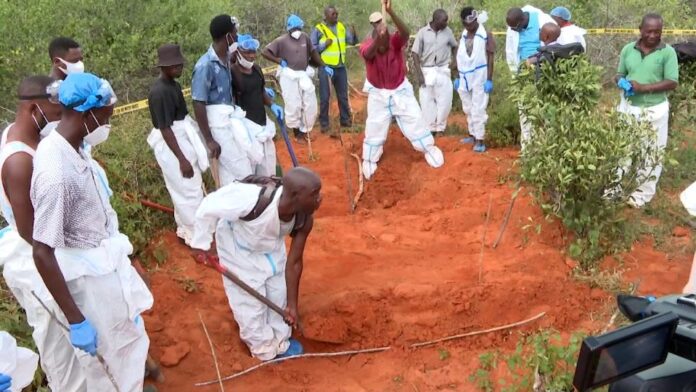
A shocking revelation has surfaced in the ongoing Shakahola trial, where a witness recounted how members of the controversial religious group referred to death as a “wedding.” The testimony has shed new light on the group’s disturbing belief system and the psychological grip it held over its followers.
Highlights:
- Witness admits to digging graves and burying bodies in Shakahola forest
- Cult members used “weddings” as a coded term for death
- Group believed death was a spiritual transition, not an end
- Followers were discouraged from seeking medical care or formal education
- Prolonged fasting played a central role in the group’s practices
Main Story:
A chilling courtroom account
The Shakahola trial continues to unravel unsettling details about life inside the forest settlement. During a recent court session in Mombasa, a defence witness who is also among the accused shared that he participated in burying victims within the area.
In his testimony, he revealed that members of the group avoided referring to death directly. Instead, they used the word “weddings,” a term that masked the grim reality of what was happening.
A belief system built on control
According to the witness, this language was rooted in the group’s teachings. Followers were led to believe that death marked a spiritual union or transition to a higher realm, rather than a tragic end.
The doctrine enforced strict rules that cut members off from mainstream life. Education, healthcare, and engagement with the outside world were discouraged, deepening dependence on the group’s leadership.
Fasting and suffering
Fasting was a central practice, often taken to dangerous extremes. The witness disclosed that some members became critically weak due to lack of food and water. He himself required medical attention after enduring prolonged fasting.
The meaning behind “weddings”
The use of coded language like “weddings” served multiple purposes. It reframed death as something positive, reinforcing loyalty and belief among followers. At the same time, it helped conceal the severity of the situation within the group.
A national tragedy
The Shakahola case remains one of Kenya’s most devastating cult-related incidents. Investigations have uncovered hundreds of bodies, with many deaths linked to starvation and extreme religious practices.
As the trial progresses, more testimonies continue to expose the methods used to manipulate followers, highlighting how belief and language were twisted to justify unimaginable loss.
Read Also:
- Can Aspirin Really Lower Cancer Risk? Here’s What Science Says
- Murkomen Reveals 14 Suspects in Osotsi Attack Escaped Across Border
- Apple Names John Ternus as New CEO After Tim Cook Steps Down

