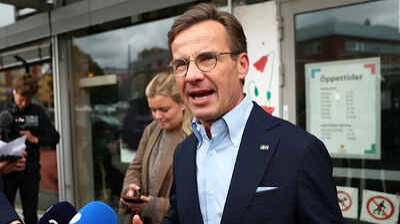
Swedish Prime Minister Ulf Kristersson has announced his resignation after his right-wing bloc narrowly lost the country’s parliamentary election to the centre-left opposition led by former Prime Minister Magdalena Andersson. The final count gave the opposition 176 seats in the 349-member Riksdag, compared with 173 for Kristersson’s bloc, setting the stage for negotiations over Sweden’s next government.
Highlights
- Ulf Kristersson has requested to step down as Sweden’s Prime Minister.
- The centre-left bloc won 176 seats against 173 for the right-wing bloc.
- Magdalena Andersson is preparing to negotiate the formation of a new government.
- The Sweden Democrats lost support compared with the 2022 election.
- Formal certification of the election result is still expected.
Main Story
Kristersson Announces Resignation
Sweden’s Prime Minister Ulf Kristersson is stepping down after the final count of Sunday’s parliamentary election confirmed a narrow victory for the centre-left opposition.
Kristersson announced his decision on Thursday, saying he had asked the Speaker of Parliament to relieve him of his duties so that the process of forming a new government could begin.
The final results showed the centre-left parties winning 176 seats in the Riksdag, while the four-party right-wing bloc secured 173 seats.
The Riksdag has 349 seats, meaning the difference between the two blocs was only three seats.
Andersson Begins Government Talks
The result puts Social Democratic leader Magdalena Andersson in a position to seek a return to the Prime Minister’s office after four years in opposition.
However, winning the election does not automatically guarantee the formation of a new government.
Andersson’s Social Democrats will need to work with the Left Party, Centre Party and Green Party, which together make up the centre-left bloc.
The parties have differences on several policy areas, including taxation, meaning negotiations could take time.
Sweden has a history of coalition and minority governments, and previous elections have shown that forming an administration can take weeks or even months.
Sweden Democrats Lose Ground
Kristersson’s governing bloc included his Moderate Party, the Sweden Democrats, Christian Democrats and Liberals.
The Sweden Democrats had supported Kristersson’s government from outside cabinet, helping the administration pursue tighter migration policies.
During the campaign, Kristersson had indicated that he would bring the Sweden Democrats into government if the right-wing bloc retained power.
However, the party lost around three percentage points compared with its 2022 performance, marking its first decline since entering Parliament in 2010.
A Closely Contested Election
The election was decided by a relatively small margin.
Earlier in the counting process, the two blocs were separated by only tens of thousands of votes, with late-arriving ballots and votes from overseas still being processed.
The final count ultimately confirmed the three-seat difference between the opposing blocs. The result remains subject to formal certification by Swedish authorities.
What Happens Next?
With Kristersson preparing to leave office, attention now turns to the Swedish Parliament and the negotiations over the next government.
Andersson will need to secure enough parliamentary support to form an administration, while the parties involved will have to bridge their differences on issues including taxes and other economic policies.
The process could take some time. Following the 2022 election, Sweden took 37 days to form a government, while the 2018 election resulted in a much longer 134-day process.
For now, Kristersson’s resignation marks the beginning of Sweden’s transition to a new political administration following one of the country’s closest recent parliamentary contests.
Sweden’s election has changed the balance of power in Parliament, but the next chapter will depend on whether the winning bloc can turn its narrow parliamentary advantage into a functioning government.
More on this topic: Russia Threatens UK Over Ukraine Support as NATO Attack Fears Grow. Official information: Government of Sweden.

