
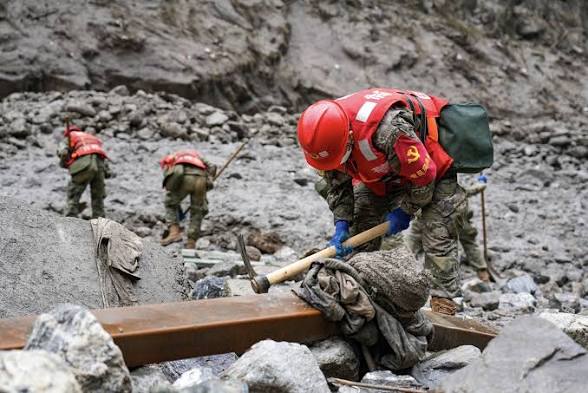
A painstaking rescue operation deep beneath Nepal’s flood-ravaged mountains has delivered a major breakthrough after rescuers pulled two men alive from a blocked hydropower tunnel. Tunnelling expert Arnold Dix has revealed how teams located the buried entrance, navigated huge rocks and mud, drained floodwater and eventually heard faint voices from inside.
Highlights
- Two men were rescued alive from the blocked hydropower tunnel.
- Rescuers used maps, satellite images and helicopter footage to locate the buried entrance.
- Explosives were carefully deployed to clear sections blocked by massive rocks.
- Teams created drainage channels to remove water from the tunnel.
- Rescuers are continuing towards areas where more survivors could be trapped.
Main Story
A Buried Tunnel Becomes the Starting Point
The rescue operation at Nepal’s Trishuli 3A Hydropower Station began with a challenge that was unlike most tunnel rescues.
The entrance to the facility had effectively disappeared beneath debris following a devastating flash flood near the Nepal-Tibet border.
According to tunnelling expert Arnold Dix, rescuers had to work out where the entrance had originally been before they could even begin searching for those trapped inside.
Dix, president of the International Tunnelling and Underground Space Association, has been advising Nepalese authorities throughout the operation.
Piecing Together the Location
With the surrounding landscape dramatically altered by the disaster, the rescue team turned to every available source of information.
Old topographical maps were compared with satellite images taken after the floods. Helicopter footage and visible landmarks, including power infrastructure, also helped the engineers establish where the tunnel entrance was likely to be.
Once they had identified the area, excavation began.
Finding the entrance, however, was only the beginning.
Digging Through Rocks and Mud
The tunnel was heavily obstructed by mud, debris and enormous rocks, with some reportedly comparable in size to vehicles.
Rescuers had to gradually clear a path while trying to determine where the trapped workers might be.
Because the survivors’ exact position was unknown, teams relied partly on listening for signs of life as they moved deeper into the mountain.
In a particularly risky move, explosives were used to break through sections of the blockage.
Dix said this carried significant danger because an uncontrolled blast could injure people still inside or compromise the rescuers’ own position.
He praised the Nepalese Army for carrying out the controlled explosions with great precision.
Floodwater Creates Another Threat
The operation became even more complicated when rescuers discovered that water remained inside the tunnel.
Instead of simply pumping it out, workers excavated drainage channels connecting the tunnel to the river outside.
Excavators and pumps were then used to help move the water away, reducing the danger for both rescuers and anyone trapped underground.
The team also constructed a narrow passage through the debris above the main tunnel.
The small route provided a safer approach because the existing tunnel roof could effectively serve as protection for the newly created passage.
A Faint Voice Brings Hope
The breakthrough came in the early hours of Friday.
Rescuers believed they could hear voices somewhere beyond the rubble. They called towards the trapped workers and received a faint response.
That moment confirmed that there were people alive deeper inside.
Soon afterwards, Sanjaya Shah and Kabir Maharjan were brought out alive.
Their rescue provided a huge boost to the operation, but teams still believe other people could be trapped further inside the hydropower facility.
More Than 150 Metres Still to Go
Dix estimates that rescuers have already advanced roughly 60 metres from the original entrance.
However, another 150 metres or so could still separate them from the hydropower station itself.
The biggest concern is what awaits them ahead.
If flood debris reached the station, those inside could have been struck by rocks and mud or trapped by rising water.
Rescuers are also worried about the possibility of water entering from either direction, creating a potentially deadly situation for workers operating underground.
Searching for the ‘Goldilocks Zone’
Despite the dangers, the successful rescue has strengthened the team’s determination.
Dix described the next target area as a “Goldilocks zone” a section of the hydropower station that could offer more favourable conditions for human survival because of the available space.
For the rescue teams, finding two people alive has demonstrated that their strategy can work.
Rather than stopping after the first breakthrough, Dix says the team is continuing with the search.
With more people feared trapped inside, the mission remains a race against time.
Two men have already emerged from the darkness alive and for the rescuers still digging, that is reason enough to keep going.

