
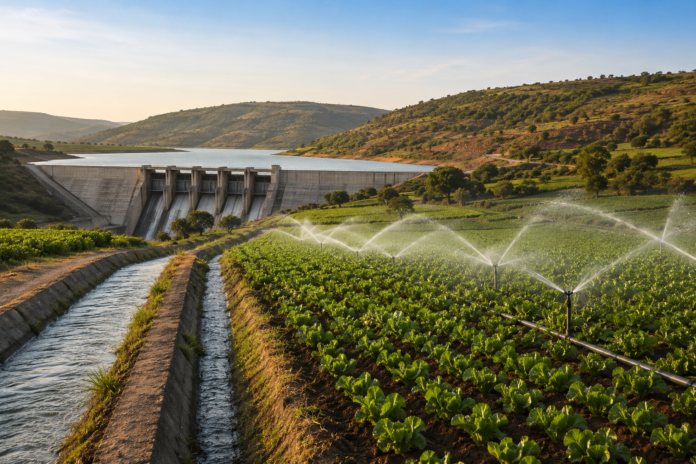
Kenya is expanding irrigation and water-storage projects as President William Ruto’s administration seeks to reduce the country’s dependence on unpredictable rainfall and boost food production. From the expanded Mwea Irrigation Scheme to proposed mega-dams in northern and coastal Kenya, the government is pursuing an ambitious plan to put millions of additional acres under reliable water supply.
Highlights
- Irrigated land increased from about 664,000 acres in 2022 to 744,340 acres by December 2024.
- Mwea’s irrigated area has grown to about 30,600 acres following the completion of Thiba Dam.
- The government is targeting an additional 2.5 million irrigated acres.
- Proposed mega-dams could support hundreds of thousands of new agricultural acres.
- Funding shortages and project delays remain major challenges.
Main Story
Kenya Pushes Beyond Rain-Fed Farming
For decades, Kenya’s agricultural fortunes have been closely tied to the weather. A good rainy season can mean bumper harvests, while poor rainfall can quickly translate into food shortages and financial pressure for farmers.
The government is now trying to change that equation by expanding irrigation and investing in water-storage infrastructure.
Official figures show that Kenya’s irrigated area had grown by more than 80,000 acres by December 2024, rising from approximately 664,000 acres in 2022 to 744,340 acres.
However, the government figures need some context. The National Irrigation Authority’s cumulative figures cover programmes dating back to 2011, meaning the entire increase cannot be credited to President Ruto’s administration.
Government progress reports indicate that 91,499 additional acres were developed between the 2021/22 and 2023/24 financial years, targeting crops such as rice, maize and horticultural produce.
Mwea Shows What Reliable Water Can Do
The Mwea Irrigation Scheme provides one of the clearest examples of the potential of irrigation.
Following the completion of Thiba Dam, the scheme’s irrigated area has expanded from about 25,000 acres to approximately 30,600 acres. The government ultimately wants to reach 35,000 acres during a single season.
The National Irrigation Authority says the scheme could eventually support double cropping, potentially translating into as much as 70,000 irrigated acres of production each year.
The expansion has coincided with a significant increase in rice production.
Government figures show rice output rising from 192,299 tonnes in 2022 to 303,724 tonnes in 2025. Over the same period, acreage under public irrigation schemes increased from 48,324 acres to 71,624 acres.
The government estimates that Thiba Dam has helped raise the annual value of rice production at Mwea from KSh10 billion to KSh14 billion while creating approximately 28,000 additional jobs.
More Schemes Being Expanded
Irrigation expansion is not limited to Mwea.
During the 2024/25 financial year, the State Department for Irrigation reported developing an additional 3,150 acres through expansion of existing schemes.
The work included 2,000 acres at Bura, 450 acres at Tana, 200 acres at Bunyala and 500 acres at Ahero.
Large-scale projects also contributed another 11,050 acres, with work taking place at schemes including Lower Kuja, Lower Nzoia, Galana and Turkana.
A further 100 acres were added through the Farmer-Led Irrigation Development programme.
The National Irrigation Authority currently reports irrigation development across 44 counties, with smallholder and community projects accounting for 147,131 acres and the rehabilitation or expansion of gazetted schemes contributing another 80,600 acres.
There are also 88 ongoing projects that are expected to create another 67,225 irrigated acres once completed.
Mega-Dams at the Centre of the Bigger Plan
The government’s long-term ambition goes far beyond the acreage already under irrigation.
President Ruto has announced plans to use 50 mega-dams to support irrigation covering approximately 1.5 million acres in northern and coastal Kenya.
This forms part of a wider national target of adding 2.5 million irrigated acres.
One of the most ambitious proposals is the High Grand Falls Dam on the Tana River. Once developed, the project is expected to support irrigation covering between 300,000 and 400,000 acres.
The government is also seeking to revive the Galana-Kulalu irrigation project, which previously stalled.
The long-term plan includes constructing the Galana Dam to provide water for up to 300,000 acres. Under a wider 250,000-acre development plan, Selu Limited has been allocated 20,000 acres, Nyumbani Foundation 50,000 acres and UAE-based Al Dahra 180,000 acres.
Thwake and Mwache Face Different Realities
Other major water projects are also expected to expand agricultural production.
Thwake Multipurpose Dam, serving Kitui and Makueni counties, has a storage capacity of 688 million cubic metres and is expected to support about 100,000 acres of irrigation once fully operational.
The project, however, has encountered delays.
An Auditor General’s report raised concerns about stalled works, rising costs and financial losses, highlighting the difficulties that can accompany large infrastructure projects.
At the Coast, Mwache Dam is also expected to provide water for irrigation. President Ruto has previously said the project could support at least 7,000 acres.
In 2026, the government was conducting a feasibility study for an irrigation scheme covering approximately 4,942 acres around the dam.
Small Projects Also Making a Difference
While mega-dams attract most of the attention, smaller water projects are also helping communities access water for agriculture.
During the 2025/26 financial year, the National Water Harvesting and Storage Authority reported completing 76 projects involving structures such as weirs, small earth dams, boreholes and water-supply systems.
Together, the projects created approximately 1.196 million cubic metres of additional water storage capacity, benefiting more than 115,000 people and supporting irrigation on more than 12,000 acres.
The authority also rehabilitated existing water pans, dams, boreholes and weirs, restoring approximately 300 million litres of storage capacity.
The Money Challenge
The irrigation push comes with a major financial hurdle.
Kenya’s National Irrigation Sector Investment Plan targets an increase in irrigated land from 664,000 acres in 2021/22 to 1,289,142 acres by 2027/28.
It also seeks to dramatically increase water available for irrigation, from 55.4 million cubic metres to 2,379.2 million cubic metres over the same period.
But achieving those targets will require significant and consistent financing.
In 2025, the Ministry of Water warned Parliament that budget cuts could delay major irrigation projects.
The Bura scheme faced a potential KSh250 million reduction that threatened its planned 18,500-acre expansion. Mwea was facing a KSh200 million reduction that could put another 5,000 acres at risk, while the National Expanded Irrigation Programme faced an KSh850 million cut.
These funding pressures could determine how quickly some of the government’s most ambitious agricultural projects move from plans to productive farms.
Can Irrigation Change Kenya’s Food Story?
The government’s irrigation strategy represents a shift from simply hoping for sufficient rainfall to creating more predictable conditions for farming.
Mwea’s growing rice production demonstrates what can happen when farmers have access to dependable water, while the proposed mega-dams could open up vast areas of northern and coastal Kenya to commercial agriculture.
But the success of the wider plan will depend on more than building dams and canals.
Projects will need reliable financing, proper maintenance, effective water management and farmers who can access markets and afford the inputs required to produce at scale.
If those pieces come together, irrigation could become one of the biggest drivers of Kenya’s food-security strategy and rural economic growth.
Kenya may never control the rain, but with the right investment in water, farmers could have far more control over what happens when the skies stay dry.

