
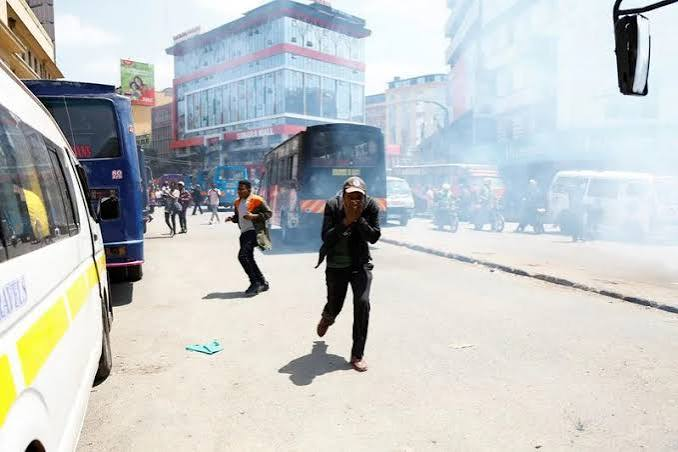
Nairobi’s Central Business District was disrupted on Friday, August 28, 2026, as hundreds of small-scale traders took to the streets to oppose new Kenya Revenue Authority (KRA) customs valuation rules. Traders from Kamukunji, Gikomba and Nyamakima say the changes could wipe out already narrow profits and push up prices for consumers.
Highlights
- Traders marched from the National Archives towards Times Tower.
- The minimum valuation for a 40-foot consolidated cargo container rose to Ksh3.2 million.
- Traders say the Ksh700,000 increase threatens small businesses.
- Several CBD shops remained closed amid the demonstrations.
- KRA says the figure is a minimum reference point, not a flat tax charge.
Main Story
Traders Take to Nairobi Streets
Hundreds of small-scale traders brought parts of Nairobi’s CBD to a standstill on Friday as they protested changes to the way consolidated imports are valued for customs purposes.
The demonstrators gathered near the Kenya National Archives along Tom Mboya Street before heading towards Times Tower, where KRA is headquartered.
Carrying Kenyan flags, banners and vuvuzelas, the traders demanded a review of the new valuation system, arguing that it places an unfair financial burden on businesses that operate with limited capital.
Why Traders Are Angry
At the centre of the dispute is a revised minimum valuation benchmark for a 40-foot container carrying consolidated general cargo.
The benchmark has reportedly increased from Ksh2.5 million to Ksh3.2 million. That represents an additional Ksh700,000, or roughly 28 per cent, for every container at the minimum reference level.
The change has particularly affected traders who combine their goods in shared containers, a common arrangement among small importers bringing products such as clothes, electronics and household items from China.
For businesses working with small profit margins, traders say the additional cost could make importing increasingly difficult.
Fear of Higher Prices
Traders argue that absorbing the extra cost would leave them with little or no profit.
Some also fear they will have no choice but to increase retail prices, meaning consumers could eventually feel the impact through more expensive goods.
Small businesses in commercial areas such as Kamukunji, Gikomba and Nyamakima are particularly concerned because many rely on relatively small consignments rather than importing entire containers themselves.
CBD Businesses Feel the Impact
The demonstrations affected normal activity in parts of the capital.
Although public transport and major roads continued operating in some areas, a number of shops and retail outlets in the CBD stayed closed during the morning.
Some business owners reportedly opted to keep their premises shut as a precaution, while others backed the traders’ demands.
The situation adds to a series of recent demonstrations and disruptions that have affected commercial activity in Nairobi’s city centre.
KRA has sought to clarify the meaning of the Ksh3.2 million figure, saying it should not be interpreted as a standard tax charged on every 40-foot container.
According to the authority, the amount functions as a minimum reference point used in simplified customs clearance and risk management.
KRA also says importers have another option: they can de-consolidate their shipments and have individual goods assessed using detailed declarations.
Traders Question Practicality
For many small-scale importers, however, that alternative may not be straightforward.
Traders say preparing individual declarations for numerous small consignments can be difficult for businesses with limited working capital and resources.
This has left traders calling for direct discussions with KRA and other government agencies before the new system causes further disruption.
Business leaders and trade groups have similarly urged both sides to return to the negotiating table, warning that prolonged uncertainty could hurt traders, consumers and Nairobi’s wider retail economy.
Calls for Dialogue
The dispute now places the government and thousands of small traders at a crossroads.
While KRA maintains that the valuation benchmark is part of its customs risk-management framework, traders want a system that takes into account the realities of micro-importers who depend on shared cargo arrangements.
As the standoff continues, dialogue could be key to finding a solution that protects government revenue without pushing small businesses and consumers into an even tighter financial corner.
For Nairobi’s small traders, the question is simple: how can Kenya raise revenue without making it harder for the people at the heart of its everyday economy to survive?

