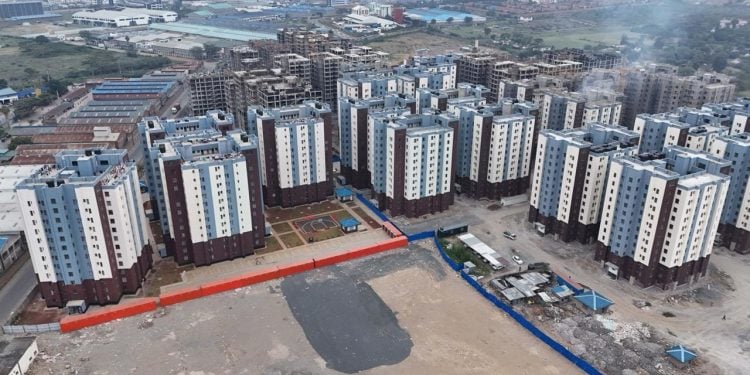
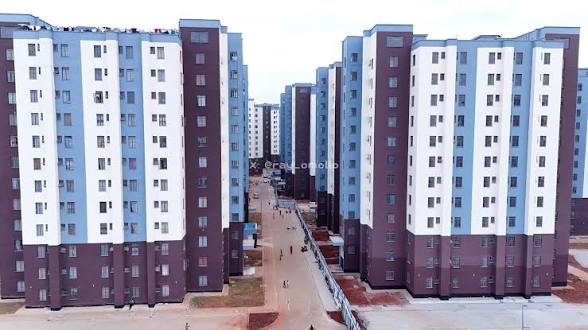
Four years into President William Ruto’s administration, his Affordable Housing Programme has moved from a campaign promise to one of the government’s biggest ongoing projects but the numbers reveal both notable progress and a significant gap between the original ambition and what has been delivered.
Highlights
- About 8,800 affordable homes have been completed and handed over to buyers.
- Housing levy collections reached Sh73.2 billion in the 2024/25 financial year.
- More than 1.3 million Kenyans have registered interest through Boma Yangu.
- The government says the programme has generated over 1.1 million direct and indirect jobs.
- The original target of 250,000 homes annually remains unmet.
Main Story
A flagship promise takes shape
Affordable housing was among President William Ruto’s most prominent pledges during the 2022 presidential campaign. The administration positioned the initiative not only as a way of helping Kenyans own homes, but also as a tool for job creation and economic growth.
The programme has since become a major component of the government’s development agenda, with construction projects being rolled out in counties across the country.
But alongside the construction has come a heated debate over how the programme is funded, who benefits from it and whether its results justify the financial burden placed on workers.
The housing levy
The main funding mechanism is the Affordable Housing Levy. Employees contribute 1.5 per cent of their gross salaries, while employers provide a matching contribution.
The Kenya Revenue Authority collected Sh73.2 billion through the levy during the 2024/25 financial year. That was above the Sh63.2 billion target and represented a 35 per cent increase from the Sh54.2 billion collected during the levy’s first year.
The government has used the growing revenue to create a dedicated financing stream for housing rather than relying entirely on allocations from the national budget.
It has also considered using expected future levy collections to secure additional financing of up to Sh100 billion, with the aim of expanding construction and addressing funding gaps.
How many homes have been delivered?
Around 8,800 affordable housing units have so far been completed and handed over to buyers.
The pace of delivery has accelerated considerably. Approximately 1,655 units were completed in 2024, compared with more than 6,700 in 2025.
Despite that growth, the figures are still a long way from Ruto’s initial ambition of producing 250,000 housing units every year.
The government says the bigger picture is found in projects currently under construction. Between 214,000 and 277,000 additional units are reported to be at various stages of development across all 47 counties.
The pipeline includes social housing, affordable homes and more than 73,000 beds for university students.
Jobs beyond the houses
The State has also presented the housing programme as an employment engine.
According to the Presidency, more than 1.1 million direct and indirect jobs have been generated through the initiative.
Construction workers are among the beneficiaries, but the programme also creates opportunities for engineers, plumbers, mechanics and other skilled workers.
Businesses supplying cement, steel, transport, equipment and other construction-related services also stand to benefit from the increased activity.
This has allowed the government to argue that the housing programme is designed to stimulate a much wider section of the economy rather than simply put up residential buildings.
High interest, fewer actual applicants
The Boma Yangu platform has attracted significant interest, with more than 1.3 million Kenyans registering for the programme.
However, registration has not translated into home applications at the same rate.
About 38,000 people have formally applied for homes, with roughly 11,000 receiving allocations. Approximately 5,300 families have already moved into their new houses.
To make the programme more accessible, the government reduced the minimum deposit from 10 per cent to five per cent.
It has also introduced measures allowing some buyers experiencing financial pressure to restructure their payments.
These changes are intended to address a central question facing the programme: whether the homes being constructed are genuinely within reach of the low- and middle-income Kenyans they are meant to serve.
The levy remains controversial
While the government has defended the levy as essential to financing its housing ambitions, the deduction remains one of the programme’s biggest political flashpoints.
Critics argue that workers are being required to surrender part of their earnings without a guarantee that they will eventually own one of the houses being constructed.
Opposition politicians have repeatedly pledged to abolish the levy if they take power, saying Kenyans should not be compelled to finance a programme from which many may never benefit.
Ruto has rejected that position, arguing that scrapping the levy would weaken his administration’s broader development plans.
The dispute has turned the housing levy into more than an economic policy issue. With the 2027 General Election approaching, it is increasingly becoming a political dividing line.
Questions over implementation and accountability
The programme has also faced scrutiny over procurement, project delays, stalled construction sites and the capacity of contractors to handle projects on such a large scale.
Questions about oversight have become particularly important given the billions of shillings being collected through the levy.
For supporters, the growing number of construction sites, jobs and completed homes point to a programme gaining momentum.
For critics, the relatively small number of completed and occupied units compared with the scale of levy collections raises questions about efficiency, affordability and value for money.
What the next phase could look like
The government’s challenge now is to convert the large pipeline of ongoing projects into completed homes while ensuring that potential homeowners can actually afford them.
The success of the programme will ultimately be judged not just by the number of units under construction, but by how many families move into affordable homes and whether the economic benefits promised by the government are sustained.
With the 2027 election drawing closer, those figures could become some of the clearest indicators of how Kenyans assess Ruto’s first-term record.
A housing programme is ultimately measured not by the number of projects announced, but by how many families can realistically call the finished houses home.