
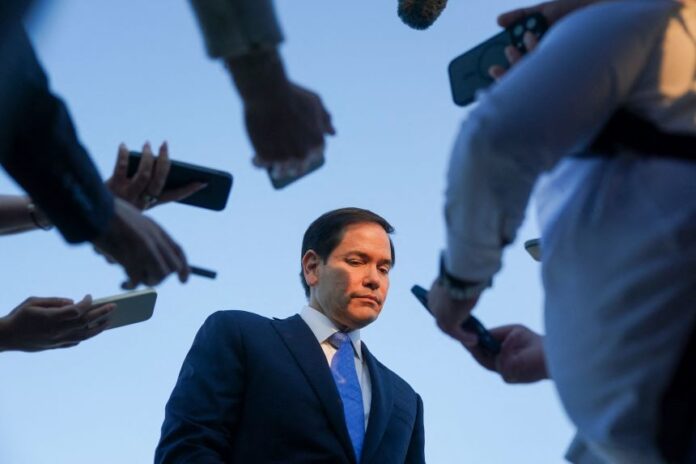
The United States has introduced new visa restrictions against certain South African nationals accused by Washington of supporting racial discrimination, violence or uncompensated land seizures. The move, announced by Secretary of State Marco Rubio, marks another escalation in the increasingly strained relationship between Washington and Pretoria, particularly over South Africa’s land reform policies and the treatment of its white Afrikaner minority.
Highlights
- Washington has announced targeted visa restrictions involving South African nationals.
- US officials cited alleged racial discrimination, violence and land seizures without compensation.
- South Africa has repeatedly rejected allegations of persecution against white citizens.
- The dispute centres partly on South Africa’s land reform programme.
- The latest visa measures could be followed by additional US actions, according to the US embassy in Pretoria.
Main Story
US Introduces New Visa Restrictions
The United States has announced new visa restrictions targeting individuals it says are involved in policies that discriminate on racial grounds in South Africa.
US Secretary of State Marco Rubio announced the measures on Tuesday, saying Washington had concluded that South Africa had not adequately addressed concerns previously raised by the Trump administration.
The restrictions target people accused of promoting what the US describes as race-based discrimination, inciting violence or supporting the confiscation of land without compensation. No specific individuals were named when the policy was announced.
The measures do not amount to a blanket suspension of visas for South Africans.
Dispute Over Afrikaners
The latest move is closely linked to the Trump administration’s claims that Afrikaners predominantly descendants of European settlers face discrimination in South Africa.
South Africa has consistently rejected those allegations, arguing that claims of systematic persecution or a “white genocide” are not supported by credible evidence.
The dispute has particularly focused on land ownership, which remains one of South Africa’s most politically sensitive issues more than 30 years after the end of apartheid.
Why Land Reform Is at the Centre of the Dispute
South Africa’s government argues that land reform is necessary to address inequalities created during apartheid, when the country’s black majority was subjected to extensive land dispossession.
The country’s land expropriation law allows the state to acquire property in the public interest and, under specific circumstances, compensation can be set at zero.
However, the legislation does not provide for unrestricted seizure of private property. In most cases, authorities are expected to first attempt to reach an agreement with property owners, while disputes can be challenged through the courts.
The government maintains that the law is intended to address historic inequality rather than enable arbitrary confiscation.
Trump Administration’s Previous Actions
The latest visa restrictions follow several measures taken by the Trump administration against South Africa.
Washington previously reduced aid to the country, expelled South Africa’s ambassador and offered refugee opportunities to Afrikaners whom President Donald Trump said were facing persecution.
South African authorities have rejected the claims and maintained that white South Africans are not being systematically targeted.
Relations were also strained by disagreements over South Africa’s foreign policy, including its legal action against Israel at the International Court of Justice.
Ramaphosa’s Efforts to Ease Tensions
President Cyril Ramaphosa has sought to improve relations with Washington, including through a visit to the White House with members of South Africa’s coalition government.
However, the meeting became tense after Trump raised allegations about attacks and persecution targeting white farmers.
South African officials have disputed those claims and accused critics of spreading misinformation about the country’s security and land policies.
Washington Signals Further Measures
The US embassy in Pretoria has described the latest restrictions as the beginning of a broader response.
According to the embassy, Washington believes previous diplomatic discussions have not produced sufficient progress and warned that additional measures could follow.
The latest development comes as the two countries continue to navigate disagreements over trade, land policy, race relations and foreign policy.
For South Africa, the issue touches directly on its post-apartheid efforts to address historic inequality. For Washington, the Trump administration has framed the matter around alleged discrimination against the country’s Afrikaner minority.
The two governments have yet to bridge their fundamentally different positions on the issue.
The latest visa restrictions add another layer to a relationship increasingly shaped by disagreements over race, land, trade and foreign policy leaving diplomacy between Washington and Pretoria under renewed pressure.

