
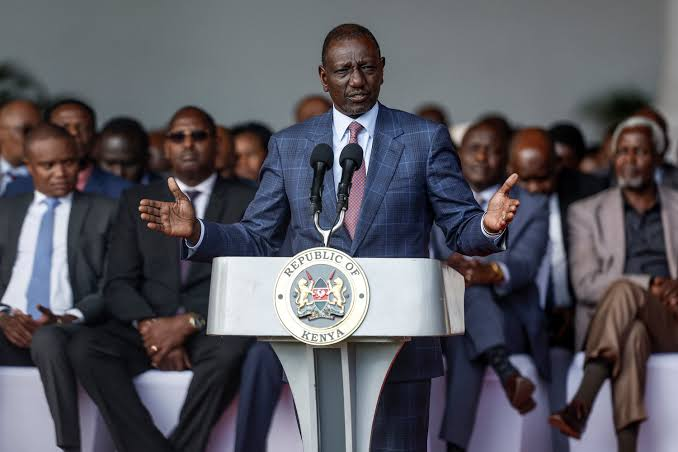
President William Ruto has defended his administration’s Bottom-Up Economic Transformation Agenda, outlining its focus on reducing the cost of living, creating jobs and expanding access to essential services. He has also acknowledged growing public pressure over taxation, unemployment and the pace of economic change, noting that winning an election does not remove the government’s responsibility to listen to citizens and deliver on its promises.
Highlights
- Ruto says the Bottom-Up Economic Transformation Agenda is designed to improve household incomes and economic opportunities.
- Agriculture, education, healthcare, infrastructure and job creation remain central to the plan.
- The President acknowledges public frustration over the cost of living, taxation and unemployment.
- He says an electoral mandate comes with a responsibility to deliver measurable results.
- Ruto recognises citizens’ right to question government decisions and demand accountability between elections.
Main Story
Ruto Outlines Vision Behind Bottom-Up Economic Agenda
President William Ruto has reiterated his administration’s commitment to transforming Kenya’s economy through the Bottom-Up Economic Transformation Agenda (BETA), a development framework intended to expand opportunities for ordinary households and businesses.
The President said meaningful economic change requires a clear plan, targeted interventions and a willingness to be judged by the public on the results achieved.
The agenda focuses on several key sectors, including agriculture, education, healthcare, infrastructure and enterprise development. The government’s stated objective is to ease pressure on household budgets while creating more opportunities for Kenyans to earn an income.
Agriculture features prominently in the strategy because of its role in supporting rural livelihoods, food production and employment. Other priorities include improving access to healthcare, modernising infrastructure and supporting local businesses.
The overall ambition is to strengthen household purchasing power and create an economy in which more citizens can participate in productive economic activity.
Cost of Living and Household Incomes Remain Central
Reducing the cost of living is one of the major objectives outlined in Ruto’s economic agenda.
For many households, expenses such as food, transport, rent, education and medical care determine how much money remains available for savings and other needs.
The government’s approach seeks to address these pressures through interventions across multiple sectors while expanding opportunities for employment and income generation.
However, the impact of the agenda depends on how effectively its programmes are implemented and whether their benefits translate into meaningful improvements in household finances.
The cost of living, employment opportunities and access to essential services therefore remain important measures through which Kenyans can assess the administration’s economic priorities.
Ruto Says Electoral Mandate Comes With Accountability
The President also addressed the responsibility that comes with winning an election, saying the government must be judged by its ability to improve lives across the country.
He argued that citizens voted for a programme of economic change and that the mandate should be understood as an obligation to deliver rather than unrestricted authority.
Ruto acknowledged that public demands for accountability have sometimes been uncomfortable for his administration.
His remarks come against a backdrop of protests, particularly those involving young Kenyans who have raised concerns about taxation, unemployment, living costs and the speed of economic reforms.
The demonstrations have underscored the importance of public participation in national affairs and the need for government decisions to respond to citizens’ concerns.
President Recognises Citizens’ Right to Question Government
In his remarks, Ruto acknowledged that an election result does not end the public’s role in holding leaders accountable.
He recognised that Kenyans retain the right to question government policies, challenge decisions and demand better services between elections.
This principle is central to democratic governance, where public participation extends beyond voting to include peaceful demonstrations, petitions, public debate and other lawful forms of civic engagement.
The President’s recognition of these rights also highlights the challenge facing his administration: balancing the implementation of its economic programme with public concerns about the costs, priorities and consequences of government policies.
For young Kenyans in particular, issues such as job access, economic security and the affordability of basic needs remain significant in assessing the country’s direction.
Turning Promises Into Measurable Progress
The Bottom-Up Economic Transformation Agenda sets out broad ambitions for economic growth and social development, but its long-term impact will depend on results that citizens can see and experience.
Progress can be assessed through indicators such as household incomes, employment opportunities, food prices, access to healthcare and the quality of education and infrastructure.
Equally important is the government’s ability to explain its decisions, respond to criticism and demonstrate how public resources are being used.
Ruto’s remarks place accountability alongside economic transformation, recognising that citizens expect more than policy announcements.
Ultimately, the success of the agenda will be judged not only by the vision it presents but also by whether it delivers tangible improvements in the daily lives of Kenyans.
An electoral mandate opens the door to leadership, but lasting public trust is built through results, transparency and a willingness to listen when citizens demand change.

