
Wiper Patriotic Front leader Kalonzo Musyoka has criticised President William Ruto’s administration following the reported arrest of Citizen TV journalist Francis Ode while covering demonstrations against rising fuel prices in Nairobi on Mashujaa Day. The incident has renewed debate over press freedom, police conduct and the constitutional right of Kenyans to protest, with questions remaining about the circumstances surrounding the journalist’s detention.
Highlights
- Kalonzo Musyoka accused the government of undermining constitutional freedoms following the reported arrest.
- Citizen TV journalist Francis Ode was reportedly detained while covering fuel price demonstrations on Kimathi Street.
- The protests brought concerns over rising petroleum prices and the cost of living into focus.
- Kalonzo cited constitutional protections for expression, media independence and peaceful assembly.
- The police explanation and the legal grounds for the reported arrests remain central unanswered questions.
Main Story
Kalonzo Criticises Government Over Journalist’s Arrest
Opposition leader Kalonzo Musyoka has accused the government of restricting democratic freedoms after Citizen TV journalist Francis Ode was reportedly arrested while covering protests against rising fuel prices in Nairobi.
In a statement dated Tuesday, October 20, 2026, Kalonzo linked the incident to wider concerns about the treatment of journalists, activists and citizens who publicly challenge government decisions.
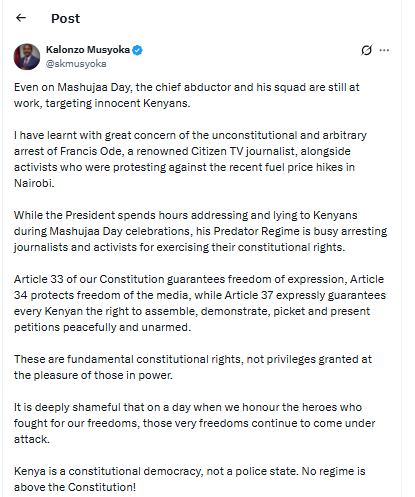
He used strongly worded language to condemn the reported arrests, arguing that Kenyans should be able to exercise their constitutional rights without intimidation.
The allegations have placed the conduct of security officers and the protection of media freedom at the centre of the latest political dispute.
Journalist Detained During Nairobi Fuel Protests
According to reports cited in the account, Ode was arrested along Kimathi Street in Nairobi’s Central Business District while covering demonstrations over the latest increase in petroleum prices.
The journalist was reportedly roughed up alongside some protesters before being bundled into a police vehicle.
The demonstrations took place as Kenyans marked Mashujaa Day, with protesters using the national holiday to draw attention to the cost of fuel and its impact on households and businesses.
Higher petroleum prices can affect transport fares, food distribution and the cost of delivering goods, making fuel pricing a significant concern for many Kenyans.
However, details surrounding the journalist’s arrest, including the specific grounds for detention and the status of those taken into custody, remain unclear from the information provided.
Kalonzo Escalates Criticism of Ruto’s Administration
Kalonzo accused the administration of presenting a message of democratic progress during national celebrations while, in his view, allowing security agencies to target people exercising their rights.
His remarks reflect the opposition’s broader concerns about accountability, the handling of public demonstrations and the treatment of journalists reporting on politically sensitive events.
However, the claims that government officials directed the arrests or that the detentions were politically motivated have not been independently established in the information available.
A statement from the National Police Service explaining the circumstances of the arrests would help clarify whether officers acted under a specific legal basis and what charges, if any, were being considered.
Constitutional Rights at the Centre of the Dispute
Kalonzo invoked Articles 33, 34 and 37 of the Constitution of Kenya to support his criticism of the reported incident.
Article 33 protects freedom of expression, including the right to seek, receive and impart information. Article 34 safeguards the freedom and independence of the media, while Article 37 protects the right to assemble, demonstrate, picket and present petitions peacefully and unarmed.
These provisions are particularly relevant when journalists cover public demonstrations and citizens gather to express concerns about government policy.
At the same time, determining whether a particular arrest violated constitutional protections requires an examination of the circumstances, the legal grounds cited by police and how the law was applied.
An arrest during a demonstration does not automatically establish a constitutional violation, just as the existence of police powers does not remove the obligation to respect protected freedoms.
Fuel Prices and the Right to Public Protest
The demonstrations also highlight the economic pressures that can drive citizens to take their concerns into the streets.
Fuel costs have implications beyond motorists, influencing public transport, agricultural production, logistics and the prices consumers pay for goods and services.
For protesters, public demonstrations provide a way to express dissatisfaction and demand accountability over decisions that affect their daily lives.
For authorities, the challenge is to maintain public order while respecting peaceful assembly and ensuring that journalists can report on unfolding events without unlawful interference.
The reported arrest has therefore brought two important public concerns together: the cost of living and the protection of constitutional freedoms.
As questions surrounding the incident continue, the police response and any further information about Ode’s detention will be important in establishing what happened and whether the actions taken complied with the law.
The strength of a democracy is measured not only by the rights written into its Constitution, but also by how those rights are protected when citizens question those in power.

