
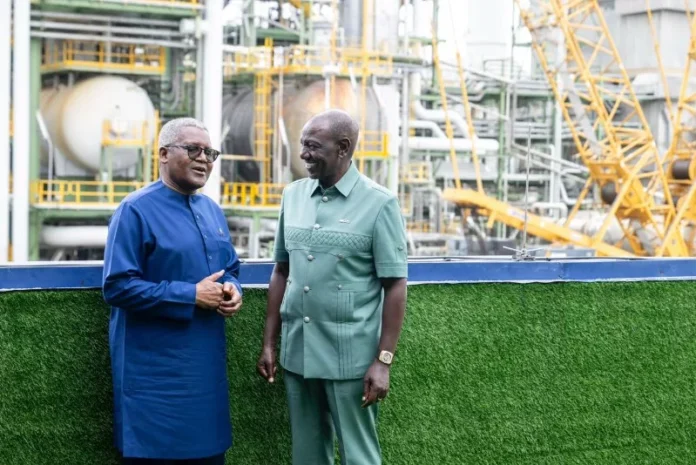
Africa’s push for industrialisation has taken centre stage in Lamu, with billionaire businessman Aliko Dangote praising the speed at which the planned refinery project has moved from concept to launch. Speaking at the groundbreaking ceremony in Mokowe, Dangote said more than 110 pieces of equipment were already on site, with hundreds more expected in the coming weeks.
Highlights
- Dangote said the Lamu project is among the fastest launches in his group’s history.
- More than 110 pieces of equipment are already on site.
- Another 400 pieces of equipment are expected within 60 days.
- The project is being positioned as part of Africa’s wider industrialisation drive.
- Dangote said the development will focus on local skills, jobs and supply chains.
Main Story
Dangote Praises Speed of Lamu Project
Dangote Group founder and President Aliko Dangote has praised the pace at which the Lamu refinery project has taken shape, describing it as the second-fastest launch in the group’s history.
Speaking during the project’s launch in Mokowe, Lamu, Dangote said the development had progressed rapidly, with more than 110 pieces of equipment already at the site.
He added that a further 400 pieces of equipment are expected to arrive within the next 60 days.
Dangote also congratulated President William Ruto for the progress made on the project, joking about the speed with which the development had moved forward.
‘Africa Must Industrialise Africa’
Beyond the refinery itself, Dangote framed the Lamu project as part of a wider push for African industrialisation and value addition.
He argued that the continent has historically exported raw materials while importing finished products, a pattern he said has limited the number of jobs and economic opportunities created locally.
According to Dangote, African countries need to process more of their own resources and build industries capable of producing goods for both domestic and regional markets.
He described the gathering in Lamu as representing more than the launch of an individual project, saying it reflected cooperation between African governments, financial institutions and private businesses.
From Lekki to Lamu
Dangote also drew comparisons between the Lamu project and the group’s refinery development in Nigeria.
He said the experience gained from building the Lekki refinery would inform the company’s approach in Kenya, while local talent, regional opportunities and international technology would be combined to develop the Lamu facility.
Rather than simply reproducing the Nigerian project, Dangote said the aim was to apply lessons learned from Lekki while developing a facility suited to the needs and opportunities of East Africa.
Responding to Doubts
Reflecting on the construction of the group’s projects, Dangote said the company had faced scepticism over the scale of its ambitions.
He said critics had questioned whether the projects could be delivered, but the group continued with its plans despite the doubts.
Dangote presented the experience as evidence of what African businesses can accomplish when they pursue large-scale industrial projects.
Jobs and Local Supply Chains
The businessman also highlighted the potential economic activity that could develop around the refinery.
He said a project of this size would generate demand across multiple sectors, including transport, food supplies, accommodation, construction and other services.
According to Dangote, the local and regional supply chain could be substantial, particularly during the construction phase when tens of thousands of workers could be involved directly and indirectly.
He also stressed the importance of developing Kenyan technical expertise rather than relying indefinitely on foreign labour.
The group, he said, intends to train and empower local workers so that future infrastructure projects can increasingly be delivered using African talent.
A Bigger Industrial Ambition
The Lamu refinery is therefore being presented not only as an energy project but also as part of a broader industrial strategy centred on skills development, local supply chains and value addition.
For Dangote, the project offers an opportunity to transfer experience from Nigeria to Kenya while building capacity within the region.
As work begins in Lamu, attention will now turn to how quickly the project moves from groundbreaking to construction and, ultimately, operations.
From Lekki to Lamu, Dangote’s message was clear: the next phase of Africa’s growth could depend not only on what the continent produces, but on how much of that value it keeps at home.

