
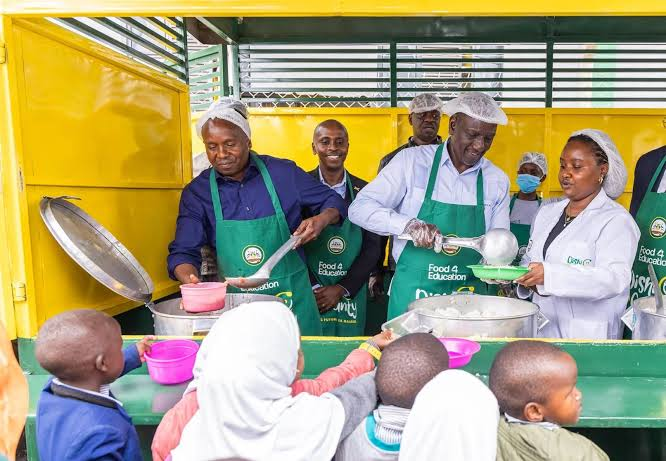
President William Ruto has announced plans to launch a national school meals programme across Kenya in the first term of 2027, potentially expanding government-supported feeding programmes to millions more learners. The plan is part of a broader push to strengthen social protection and ease the burden on vulnerable families.
Highlights
- National school meals rollout is planned for the first term of 2027.
- The programme is expected to cover learners from lower primary to junior secondary.
- Government currently provides meals to about 2.6 million learners.
- Kenya aims to expand school feeding to 10 million learners by 2030.
- Ruto also announced plans for a Social Protection Fund targeting 2.5 million households.
Main Story
National School Meals Plan Set for 2027
President William Ruto has announced that Kenya will begin rolling out a national school meals programme in the first term of 2027.
The programme is expected to cover learners in lower primary, upper primary and junior secondary schools, with the government aiming to create a more coordinated approach to school feeding across the country.
Ruto made the announcement during the Fourth Kenya Social Protection Conference at the Kenya School of Government in Kabete, Nairobi.
His remarks were delivered by Labour and Social Protection Cabinet Secretary Alfred Mutua.
The President said the current approach to school feeding has been fragmented, making it difficult for the government to achieve the scale and consistency needed.
He has now directed the Ministry of Education to work with the Labour and Social Protection Ministry, the National Treasury and other stakeholders to develop the policies, financing arrangements and implementation structure required for the national rollout.
10 Million Learners Target
The announcement comes shortly after Health Cabinet Secretary Aden Duale said the government intends to increase the number of learners benefiting from school meals from approximately 2.6 million to 10 million by 2030.
That target was first announced in 2024, but the latest announcement provides a clearer timeline for beginning a national rollout.
The existing programme largely focuses on children considered particularly vulnerable, including learners in arid and semi-arid areas and communities facing food insecurity.
However, it remains unclear whether the planned 2027 programme will cover every school in all 47 counties or whether implementation will be phased according to specific criteria.
Billions Needed for School Feeding
Expanding school meals to 10 million learners would require significant government investment.
An analysis by the Institute of Public Finance estimated that feeding 10 million children at an indicative cost of Sh20 per learner per school day, over approximately 200 school days, could cost around Sh40 billion annually.
The government has also been promoting a home-grown school feeding model.
Under the approach, schools source food from local farmers, meaning money allocated for meals can also support agricultural production and create markets for farmers.
This could make the school feeding programme more than a nutrition initiative by connecting it to livelihoods and local economic activity.
Ruto Plans Social Protection Fund
The President also announced plans to establish and capitalise a Social Protection Fund.
The proposed fund is intended to make government assistance more predictable for Kenyans facing challenges such as poverty, disability, old age and climate-related shocks.
Ruto said the country needs a system that gives families greater confidence that they will receive support when faced with serious economic difficulties.
The government also plans to increase the coverage of social protection programmes to 2.5 million households.
Inua Jamii Beneficiaries Increase
The government used the conference to highlight changes to the Inua Jamii programme, which provides financial support to vulnerable Kenyans.
Principal Secretary for Social Protection Joseph Motari said the number of beneficiaries has increased from 1.2 million to 1.7 million.
That represents an additional 500,000 people receiving support, although the government wants to reach 2.5 million beneficiaries.
Motari also said the government is now disbursing about Sh3.5 billion every month to vulnerable Kenyans.
According to the PS, payments have increasingly shifted from commercial banks to mobile money, particularly M-Pesa, with the aim of making access easier and faster.
Government Defends Payment Record
The government also addressed concerns that have previously surrounded delays in Inua Jamii payments.
CS Alfred Mutua said Ruto had directed that beneficiaries should receive their money before senior government officials receive their salaries.
He argued that the directive demonstrated the President’s commitment to prioritising vulnerable Kenyans.
The comments came as government officials, development partners and other stakeholders gathered in Nairobi for the three-day Social Protection Conference.
The conference, running from September 29 to October 1, is focusing on how Kenya can strengthen social protection amid changing economic conditions and the growing impact of climate change.
If implemented as planned, the 2027 school meals programme could become one of Kenya’s biggest social protection interventions, while also providing a major boost to nutrition, school attendance and household welfare.
For millions of Kenyan families, a reliable meal at school could mean more than food on the table it could be a practical lifeline through difficult economic times.

