
Kenya is preparing to host a major regional gathering as several African leaders are expected in Lamu for the groundbreaking of a KSh2 trillion-plus oil refinery. Backed by Nigerian billionaire Aliko Dangote, the ambitious project is expected to supply refined fuel across East Africa, create thousands of jobs and strengthen Kenya’s position as a regional energy and logistics hub.
Highlights
- The Lamu refinery is expected to cost more than KSh2 trillion.
- Several African leaders are expected to attend the groundbreaking ceremony.
- The facility is planned to process up to 700,000 barrels of crude oil daily.
- It could supply fuel to Kenya and several neighbouring countries.
- President Ruto says the project could create about 60,000 jobs.
Main Story
Lamu prepares for major refinery launch
Lamu is set to become the centre of attention as Kenya prepares to break ground on a major oil refinery expected to reshape the region’s petroleum industry.
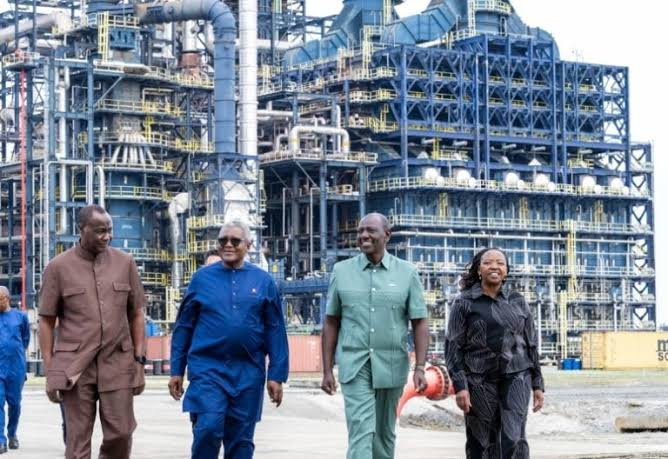
President William Ruto is expected to be joined by several African leaders for the ceremony, highlighting the regional significance of the project.
Among those expected are Rwanda’s President Paul Kagame, Uganda’s President Yoweri Museveni, Ethiopian Prime Minister Abiy Ahmed and Burundi’s President Évariste Ndayishimiye.
Togo’s President Jean-Lucien Savi de Tové is also expected, while Benin’s Romuald Wadagni has been listed among the senior African officials attending.
A refinery designed for regional markets
The proposed Dangote East Africa Refinery is expected to take roughly three years to complete.
Once operational, the facility is intended to serve both the Kenyan market and neighbouring countries, including Uganda, Tanzania, Rwanda, Burundi, Ethiopia, South Sudan and the Democratic Republic of Congo.
The project is being positioned as a way of reducing the region’s dependence on imported refined petroleum products while creating a more reliable source of fuel closer to East African consumers.
700,000 barrels a day
Dangote Group chairman Aliko Dangote has said the planned refinery will have the capacity to process up to 700,000 barrels of crude oil every day.
The facility is projected to produce more than 100 million litres of petrol, diesel and aviation fuel daily, making it one of the most significant planned investments in East Africa’s energy sector.
For Dangote Group, the Lamu project would represent its largest refining investment outside Nigeria and another major step in the company’s expansion across Africa.
Dangote sees wider investment opportunities
Dangote has described the refinery as more than simply an energy project.
He believes establishing the facility could attract additional investors to Kenya, particularly businesses looking to operate around a large industrial and energy hub.
The expectation is that supporting industries could emerge around the refinery, creating additional opportunities in manufacturing, logistics, transport, storage and other sectors.
Construction equipment arrives at Lamu Port
Preparations for the project have already moved forward, with Lamu Port receiving thousands of tonnes of equipment intended for construction activities.
The Kenya Ports Authority said the vessel MV Da Yang docked at the port on September 26 carrying 2,930 metric tonnes of construction equipment.
The arrival comes days before the planned groundbreaking ceremony.
Ruto highlights jobs and fuel security
President William Ruto has described the refinery as an important component of Kenya’s industrialisation and energy strategy.
During a visit to the existing Dangote Refinery in Lagos, Nigeria, Ruto said the Lamu project could strengthen fuel security and reliability while creating employment opportunities.
The President put the potential number of jobs at approximately 60,000, underlining the expected economic impact beyond the refinery itself.
He also highlighted the infrastructure supporting crude oil transportation to the Lagos facility, including an offshore connection extending about 120 kilometres from ships to the refinery.
Lamu’s growing economic importance
The refinery adds to a series of developments positioning Lamu as an increasingly important economic and logistics centre.
The project is expected to build on the strategic role of Lamu Port while connecting Kenya more closely to regional energy markets.
However, the project is also facing scrutiny over land issues, with a group of farmers and other occupants challenging aspects of the land acquisition process in court. The High Court recently declined to stop the planned groundbreaking but ordered parties to maintain the existing status quo on the disputed land pending further proceedings.
If construction proceeds as planned, the refinery could become a major piece of East Africa’s energy infrastructure, with its impact extending well beyond Lamu.
For Lamu, the refinery could mark the beginning of a much bigger economic story one where energy, jobs, trade and regional connectivity converge on Kenya’s coast.

