
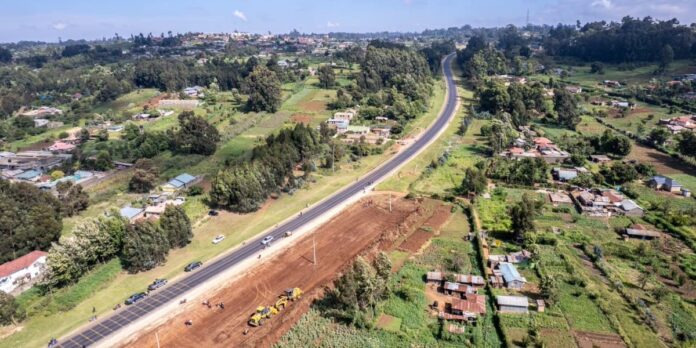
The government has set June 2027 as the target for completing and opening the Rironi–Mau Summit Road, with Transport Cabinet Secretary Davis Chirchir promising a faster construction approach aimed at transforming one of Kenya’s key transport corridors before the next General Election.
Highlights
- Rironi–Mau Summit Road is targeted for completion by June 2027.
- Tarmacking between Rironi and Naivasha is expected to begin by September 30.
- The upgraded corridor will have six lanes in total.
- Nearly 90 companies will work on different sections simultaneously.
- The road will be divided into 5-kilometre construction sections.
Main Story
Government Sets June 2027 Completion Target
Transport Cabinet Secretary Davis Chirchir has announced plans to accelerate construction of the Rironi–Mau Summit Road, with the government targeting completion and opening of the road by June 2027.
The project is expected to significantly improve movement along the busy route, which connects Nairobi and the wider Rift Valley through Naivasha.
Chirchir said the government wants construction to move at a much faster pace than the traditional approach of completing one section before starting another.
Tarmacking to Begin on Rironi–Naivasha Section
According to the CS, sections of the road between Rironi and Naivasha are expected to begin receiving tarmac by September 30, 2026.
The completed road is planned to have three lanes heading towards Naivasha and another three lanes serving traffic travelling towards Nairobi.
The expansion is expected to increase the road’s capacity and improve traffic flow along one of the country’s important transport routes.
90 Companies to Work on the Corridor
Chirchir explained that the government is adopting a different construction model to ensure work progresses across the entire corridor rather than being concentrated in one location.
Under the approach, a major contractor will coordinate close to 90 companies, with the project divided into sections of approximately five kilometres each.
Different companies will work on separate sections at the same time.
This means construction can take place simultaneously at multiple points along the corridor, potentially reducing the time required to complete the entire project.
Government Wants Faster Visible Progress
The CS said the strategy is intended to address a common challenge in major road projects, where residents in some areas may see little or no construction activity because contractors are working on distant sections.
He cited projects such as Chemusot and Kimondi, where construction has been progressing under arrangements involving individual contractors working on particular sections.
For the Rironi–Mau Summit Road, the government wants several sections to advance at once so that progress is visible across a much wider stretch.
If the plan stays on schedule, the entire corridor could be completed and opened by June 2027.
The project is expected to be closely watched as the government races to deliver major infrastructure projects ahead of the 2027 General Election.
With nearly 90 companies expected to work across the corridor at the same time, the real test now is whether the accelerated approach can turn the June 2027 deadline from a target into a completed road.

