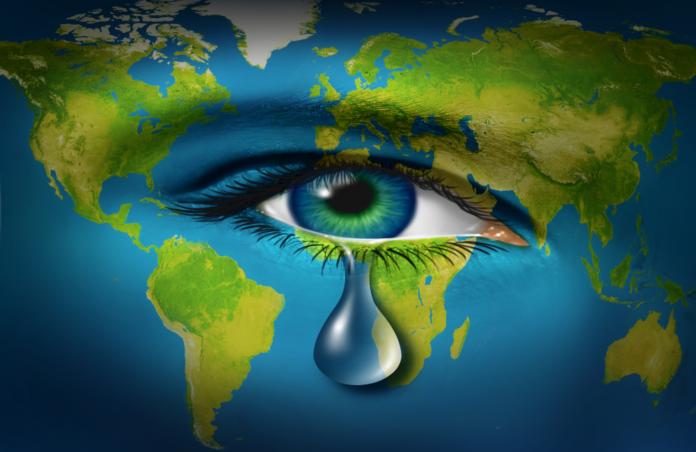
The thin veneer of global stability has officially fractured. As 2026 enters its second quarter, a synthesis of United Nations human rights data and escalating theater-wide warfare suggests the world is entering its most volatile period since the mid-20th century.
A leaked internal memorandum from the UN Human Rights Council, seen by SPM Buzz, describes the current geopolitical climate as a “**cascading collapse of deterrents**.” From the entrenched trenches of Eastern Europe to the volatile urban corridors of the Middle East and a burgeoning crisis in South Asia, the mechanisms designed to prevent total war are failing.
## A Triple-Front Crisis
The traditional “hotspots” have transitioned from localized skirmishes into systemic drains on global resources and security. In Ukraine, the conflict has entered a “**war of attrition 2.0**,” where technological parity has led to a stagnant but increasingly lethal front line that shows no signs of resolution before the year’s end.
Simultaneously, the Middle East has moved beyond the proxy stage. Analysts warn that the deterioration of diplomatic backchannels between regional powers has hit a ten-year low. “We are no longer looking at controlled escalations,” says Dr. Aris Thorne, a senior geopolitical strategist at the Global Risk Institute. “We are looking at a landscape where every actor believes they can achieve a total military solution because **international law is no longer being enforced**.”
## The South Asian Flashpoint
The newest and perhaps most dangerous variable in the 2026 landscape is the rapid destabilization of South Asia. Border disputes that remained dormant for decades are being reignited by resource scarcity and internal political pressures.
– **Resource Conflict**: Water rights along the Indus and Brahmaputra rivers are becoming primary military objectives.
– **Nuclear Posturing**: Increased mobilization along disputed territories has forced a re-evaluation of nuclear “**No First Use**” policies.
– **Economic Shockwaves**: The disruption of maritime trade routes in the Indian Ocean is projected to shave 2.4% off global GDP by December.
> “The international community has lost its ability to play the role of the honest broker. When the referees walk off the pitch, the players write their own rules—and those rules are written in blood.” — Source at the UN Human Rights Council.
## Data Points: The Human Cost of 2026
The UN Human Rights report paints a harrowing statistical picture. For the first time in documented history, the number of **forcibly displaced persons globally has crossed the 150 million mark**. This is not merely a humanitarian disaster; it is a security threat that is destabilizing neighboring non-combatant nations.
According to the SPM Buzz analysis of current conflict data, the proliferation of **low-cost loitering munitions—drones**—has increased casualty rates among civilian populations by 40% compared to 2024 levels. Precision is no longer a priority; saturation is the new doctrine.
Global defense spending is also at an all-time high. Nations that previously prioritized social infrastructure are pivoting toward “**fortress economies**.” In Western Europe and East Asia, defense budgets have swelled to an average of 3.5% of GDP, effectively cannibalizing funds previously earmarked for climate transition and healthcare.
## The Collapse of the Rules-Based Order
The core of the “**Dangerous World**” warning lies in the obsolescence of the United Nations Security Council. The **veto system**, once a tool for stability, has become a blunt instrument of obstruction. Investigative findings suggest that for every peace resolution proposed in 2026, four have been blocked by permanent members with vested interests in ongoing conflicts.
This paralysis has birthed a new era of “**Minilateralism**.” Smaller, aggressive military pacts are replacing broad international alliances. These smaller groups are more likely to take unilateral military action, further complicating the global effort to de-escalate.
## Projecting the Next Six Months
Intelligence briefings suggest that the second half of 2026 will be defined by three critical trends:
– **Sovereignty Erosion**: Non-state actors and private military companies will gain more territorial control in Africa and Latin America as central governments focus on external threats.
– **Cyber-Kinetic Integration**: Infrastructure attacks—targeting power grids and communication satellites—will become standard precursors to physical invasions.
– **Total Mobilization**: At least three more middle-tier powers are expected to announce mandatory conscription or “**national service**” requirements to bolster aging military reserves.
The impact of this shift is already being felt in the global markets. **Gold and defense stocks** are hitting record highs, while emerging market currencies are being devalued as investors flee to safe-haven assets. This economic flight is creating a self-fulfilling prophecy of instability.
## The Verdict
The world of 2026 is one where the “**long peace**” has become a historical footnote. The current trajectory suggests that the next six months will not involve a cooling of tensions, but a hardening of fronts. The UN report’s final assessment is bleak: without a fundamental restructuring of how the world manages conflict, 2026 will be remembered as the year localized crises merged into a singular, unrelenting global conflagration.
For the average citizen, the “**Dangerous World**” warning means that the **era of isolation is over**. Whether through economic inflation, digital warfare, or refugee crises, the conflicts in Donbas, Gaza, and the Himalayas are now everyone’s doorstep.

