
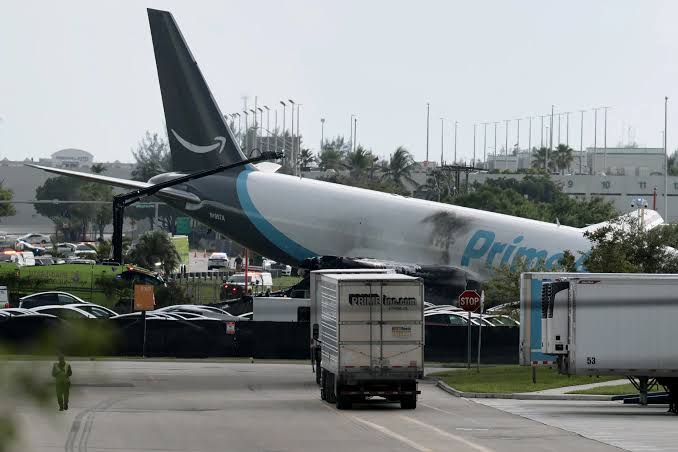
Investigators have recovered the flight recorders from a cargo plane that crashed at Miami International Airport, but the immediate focus remains on recovering the victims of the deadly accident. Five people died and five others suffered serious injuries after the Boeing 767-300 overshot the runway and struck vehicles within the airport perimeter.
Highlights
- Five people died and five others were seriously injured.
- The Boeing 767-300 was operated by 21 Air.
- Both the cockpit voice recorder and flight data recorder have been recovered.
- Investigators say it is too early to determine what caused the crash.
- The NTSB will examine the aircraft, crew, weather and runway safety systems.
Main Story
Deadly Crash at Miami Airport
A cargo aircraft has crashed at Miami International Airport, leaving five people dead and five others seriously injured.
The Boeing 767-300, operated by 21 Air, was arriving from San Juan, Puerto Rico, when it overran the runway shortly before 2pm local time on Sunday.
The aircraft had two crew members aboard and was reportedly completing its third flight of the day.
After leaving the runway, the plane struck airport navigation equipment before breaking through a perimeter fence and hitting vehicles outside the runway area.
Vehicles Hit During Crash
Among the vehicles struck was a white Ford van belonging to a contracted airport cleaning company. The van was carrying seven people at the time.
The aircraft also collided with a Toyota Corolla carrying three occupants before finally coming to rest roughly 1,300 feet beyond the runway.
The impact scattered aircraft debris, damaged vehicles and pieces of airport fencing across the crash site.
National Transportation Safety Board (NTSB) Chairwoman Jennifer Homendy described the scene as devastating, particularly for first responders working to recover those who died.
Flight Recorders Recovered
Investigators have recovered both the flight data recorder and cockpit voice recorder from the aircraft.
The devices are being transported to NTSB headquarters, where specialists will analyse them for information that could help establish what happened during the flight and landing.
However, Homendy cautioned against drawing conclusions at this stage, saying investigators are still collecting facts and evidence from the crash site.
What Investigators Will Examine
The investigation will involve several areas as authorities work to determine why the aircraft failed to stop on the runway.
Investigators are expected to review the plane’s flight history, the pilots’ experience and training, radar information and aircraft performance.
Specialists will also inspect the aircraft’s systems and engines, while meteorological experts will assess the weather conditions during the landing.
Another major area of focus will be the runway itself.
Questions Over Runway Safety
The NTSB will investigate whether the runway should have been equipped with an Engineered Materials Arresting System (EMAS).
The system is designed to help slow and stop aircraft that leave the end of a runway, potentially reducing the severity of an accident.
Homendy described the issue as an important part of the investigation.
For now, investigators say the priority is recovering victims and supporting the response at the crash site before turning their full attention to analysing the aircraft and other evidence.
As investigators begin piecing together the final moments of the flight, the recovered recorders could provide crucial answers about what went wrong but for the families of those lost, the tragedy is already irreversible.

