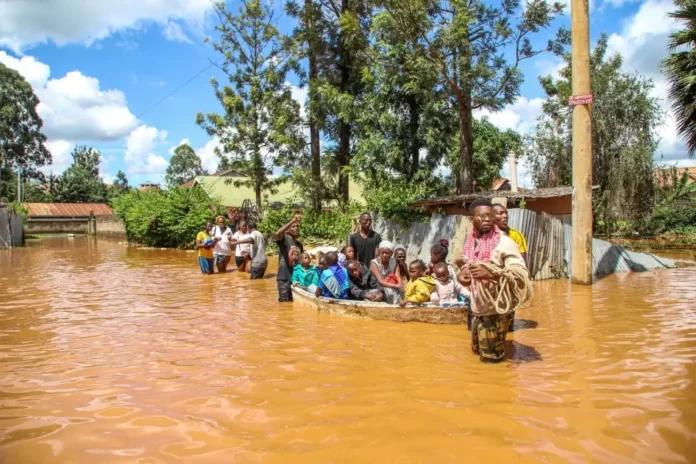
The skies over Nairobi remained a deceptive, steely grey on Tuesday morning, yet the streets of South C, Syokimau, and the luxury suburbs of Kileleshwa were already under two feet of water. This is the “**Congo Air**” effect—a meteorological phenomenon that has caught the Kenya Meteorological Department (KMD) flat-footed and left thousands of residents counting losses as their “**premium**” real estate turns into expensive swamps.
While the coast experiences the expected seasonal lashing, the inland flooding is a result of a massive moisture surge from the Congo Basin, colliding with cold air over the Kenyan highlands. The resulting “**invisible**” downpours are concentrated, heavy, and catastrophic, occurring often without the traditional thunderous warnings associated with local storms.
## The Failure of Pre-emptive Intelligence
Critique of the Kenya Meteorological Department has reached a fever pitch. Despite having access to advanced satellite imaging and regional climate models, the department’s warnings have remained vague, often released only after the first waves of destruction have already occurred.
“We are seeing a systemic failure in hyper-local forecasting,” says Dr. Silas Mwangi, a regional climate analyst. “The KMD is still using broad-stroke predictions for a landscape that has been radically altered by topography and concrete. They are telling us it will rain in ‘Nairobi,’ but they aren’t telling us that South C will be submerged by noon.”
The lack of granular data has left emergency services like the Kenya Red Cross playing a reactive game. By the time the “**heavy rain**” alerts are flashed on social media, the Mbagathi River has already burst its banks, and the Nairobi Express Way diversions have turned into impassable lagoons.
## The ‘Luxury’ Drainage Paradox
Nowhere is the crisis more visible than in the city’s high-end estates. Development in Kileleshwa, Lavington, and the outskirts of Ruaka has followed a pattern of “**build first, infrastructure later**.” Luxury apartment blocks, retailing for upwards of KES 15 million, are being erected on what were historically natural riparian discharge zones.
### Data Points of the Crisis:
– Nairobi Wetland Loss: An estimated **40%** of the city’s natural soak-away plains have been paved over since 2015.
– Surface Runoff: One hour of Congo Air rain generates **5x more runoff** today than it did a decade ago due to the “**concrete jungle**” effect.
– Maintenance Backlog: Major arterial drains in the CBD and industrial area have not seen a comprehensive desilting operation in over **24 months**.
Real estate developers have exacerbated the “**Congo Air**” effect by bypassing environmental impact assessments. In many cases, developers have diverted natural streams into narrow PVC pipes that are incapable of handling the sheer volume of water pushed by the Congo-originating moisture fronts.
> “We bought the dream of a riverside apartment, but we weren’t told the river would eventually want its bedroom back,” says one resident of a gated community in Athi River, who requested anonymity. “The water didn’t come from the sky above us; it flowed from the saturated ground and the blocked culverts two miles away.”
## The Science of ‘Congo Air’
The **Congo Air Mass** is a deep layer of moist, unstable air that moves from the Atlantic Ocean, across the Congo Basin, and into East Africa. Unlike the Indian Ocean monsoons, which are predictable and seasonal, the Congo Air pulses are erratic. When this moisture meets the cool air of the Kenyan Highlands, it triggers “**orographic lifting**,” creating intense rain cells that may only last two hours but deliver a month’s worth of water.
Journalistic investigation reveals that the KMD’s current radar infrastructure at Dagoretti is struggling with maintenance issues, limiting the ability of meteorologists to track these fast-moving moisture “**blobs**” in real-time. This creates a lethal lag between the data reaching the monitors and the message reaching the public.
## Economic Impact and Government Inertia
The economic toll of the current flooding is projected to hit **KES 2.1 billion** by the end of the month. This includes destroyed household goods, vehicle damage, and lost man-hours as the city’s transport network grinds to a halt. The insurance industry is already bracing for a surge in “**Act of God**” claims, though many policies specifically exclude flooding in areas designated as high-risk—a designation many homeowners were never made aware of.
The Nairobi County Government has responded with its characteristic “**disaster management**” rhetoric, promising to unclog drains. However, an internal source at City Hall admits that the problem is structural, not just a matter of trash in the gutters. “The city’s master plan is being ignored. We are building on **100-year floodplains**, and no amount of ‘unclogging’ will stop the water from finding its natural level,” the source stated.
## Impact: What Happens Next?
As the **Congo Air** effect continues to dominate the weather patterns for the next 72 hours, the risk of landslides in the central highlands and flash floods in the Rift Valley remains critical. Residents in low-lying areas are being advised—not by the government, but by community leaders—to move to higher ground immediately.
The long-term impact is a looming crisis in the real estate market. The “**premium**” tag on estates that flood every season is beginning to fade. We expect a shift in property values as savvy buyers begin to demand flood-risk assessments before signing deeds. For now, Nairobi remains a city at the mercy of its own concrete and a meteorological department that is watching the radar while the people drown.
The bottom line: Nature is reclaiming its territory, and the “**Congo Air**” is simply the catalyst revealing the decades of **planning failure and corruption** that have defined Kenya’s urban expansion. Until the drainage infrastructure is rebuilt to match the pace of the skyscrapers, “**luxury**” will remain a damp, expensive illusion.

