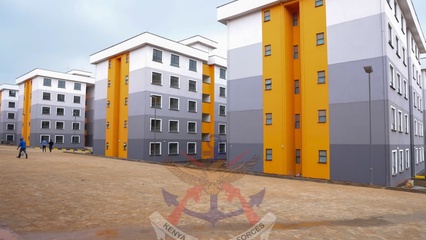
President William Ruto has issued a direct mandate for the construction of **28,000 housing units** for the **Kenya Prisons Service**, a massive infrastructural undertaking valued at an estimated **Sh20 billion**. The directive, aimed at addressing the **squalid living conditions of correctional officers**, effectively fast-tracks one of the largest single-sector housing tenders in the **Kenya Kwanza administration’s** history.
While the official narrative focuses on dignity for uniformed officers, the sheer speed of the directive has triggered alarms within procurement oversight circles. Industrial insiders and transparency watchdogs are now scrutinizing the “**Money Trail**” to determine if the tender process is a genuine **competitive bid** or a choreographed handout to **politically aligned construction giants**.
## The Urgency vs. The Process
Historically, large-scale government housing projects in Kenya have served as conduits for “**tenderpreneurship**,” where contracts are subdivided among a select clique of well-connected firms. The **Prisons Housing Project**, integrated into the broader **Affordable Housing Agenda**, bypasses traditional slow-moving departmental procurement through the use of the **Public-Private Partnership (PPP)** framework.
Analysts suggest that by framing the project as an **emergency intervention for national security organs**, the government may be utilizing “**restricted tendering**” or “**direct procurement**” clauses. This maneuver effectively narrows the field of competition, leaving smaller, independent contractors locked out of the **Sh20 billion windfall**.
> “When you see a project of this magnitude announced with such specific timelines, the technical specifications are often already sitting on the desk of a preferred bidder,” says a senior procurement consultant based in Nairobi. “The ink on the President’s directive isn’t even dry, yet the structural blueprints and financing models appear suspiciously ready for deployment.”
## The Key Players in the Frame
Multiple sources within the State Department for Housing and Urban Development point toward a shortlist of “**Tier 1**” contractors who have dominated recent government contracts. These firms, often backed by significant offshore capital and local political heavyweights, are positioned to monopolize the 28,000 units across various prison facilities including Kamiti, Kodiaga, and Shimo la Tewa.
The investigation into the beneficiaries of this Sh20 billion kitty reveals three primary categories of “winners”:
– The **Legacy Giants**: Established construction firms that have successfully pivoted to align with the current administration’s “**Bottom-Up**” rhetoric while maintaining old-guard elite connections.
– The **Strategic Newcomers**: Recently incorporated **special purpose vehicles (SPVs)** that have secured massive chunks of the Affordable Housing levy funds despite a limited track record in large-scale masonry.
– The **Financial Intermediaries**: Local banks and private equity firms that provide the “**equity**” portion of the PPP, often charging interest rates that critics argue could puff up the final cost to the taxpayer by billions.
## Data Points: The Cost of a Room
Standard industry metrics for low-to-middle income housing in Kenya place the cost of construction at approximately Sh35,000 to Sh45,000 per square meter. At a Sh20 billion valuation for 28,000 units, the math suggests a highly optimized—or dangerously lean—budget of roughly Sh714,000 per unit.
However, when factoring in the cost of bulk infrastructure (sewerage, roads, and security fencing) required for prison facilities, the per-unit cost usually spikes. If the Sh20 billion figure remains static, there are legitimate concerns regarding the quality of materials and the potential for “**variation of price**” (VoP) claims mid-construction—a classic tactic used to bleed government coffers after the initial contract is signed.
## Procurement Red Flags
The **Ethics and Anti-Corruption Commission (EACC)** has previously warned about the “**Pre-selection Syndrome**” in the housing sector. In this model, the government identifies a “strategic partner” before the tender is even advertised. This partner then helps draft the tender requirements, effectively tailoring the suit to fit themselves.
> “The core issue isn’t whether the officers need houses—they do. The issue is whether the taxpayer is getting Sh20 billion worth of value, or if Sh5 billion of that is a ‘facilitation fee’ for the political elite,” notes an investigative economist. “In the current economic climate, where the Housing Levy is being forcibly deducted from salaries, the lack of transparency in how these billions are allocated is a recipe for a national scandal.”
## Impact: The High Stakes of Delivery
For President Ruto, the **Prisons Housing Project** is a high-stakes gamble on his **legacy**. Total failure to deliver would alienate a crucial security constituency. However, a successful delivery that is later revealed to be a corruption-riddled “**cash cow**” for cronies could be even more damaging to the **Kenya Kwanza “hustler” brand**.
As the ground is broken on these 28,000 units, the focus remains on the **Registrar of Companies**. The true winners of this Sh20 billion tender will not be the prison wardens who finally get a roof over their heads, but the directors behind the firms that receive the first tranche of the multi-billion shilling mobilization fees.
**SPM BUZZ** will continue to track the specific companies awarded these contracts as the names are gazetted. In the world of Kenyan construction, the real story is rarely found in the speeches at the groundbreaking ceremony, but in the bank accounts of those who hold the shovels.

