
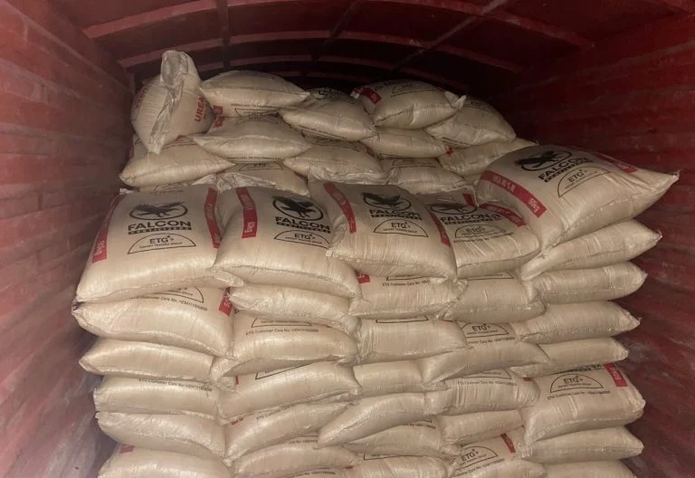
The Anti-Counterfeit Authority (ACA) has seized 323 bags of suspected counterfeit fertiliser valued at more than Sh1.6 million in Matungu, Kakamega County, following allegations that government-subsidised farm inputs were being diverted and repackaged for sale at commercial prices. The operation also resulted in the seizure of two loaded lorries and industrial packaging equipment, with two drivers arrested as investigators pursue other individuals suspected of involvement in the alleged scheme.
Highlights
- ACA seized 323 bags of suspected counterfeit fertiliser worth more than Sh1.6 million in Matungu, Kakamega County.
- Preliminary investigations suggest subsidised fertiliser was diverted and repackaged into counterfeit Falcon-branded bags.
- Two lorry drivers were arrested, while two loaded vehicles and industrial packaging equipment were seized.
- ACA warns that the alleged scheme could expose farmers to substandard products and undermine food security.
- The operation follows an earlier crackdown in Uasin Gishu, where authorities recovered more than 4,100 bags of suspected counterfeit fertiliser.
Main Story
ACA Seizes 323 Bags of Suspected Counterfeit Fertiliser in Kakamega
The Anti-Counterfeit Authority has intensified its crackdown on suspected illegal agricultural input trading after seizing 323 bags of suspected counterfeit fertiliser in Matungu, Kakamega County.
The fertiliser, estimated to be worth more than Sh1.6 million, was recovered during an operation targeting allegations of illegal diversion and repackaging of government-subsidised farm inputs.
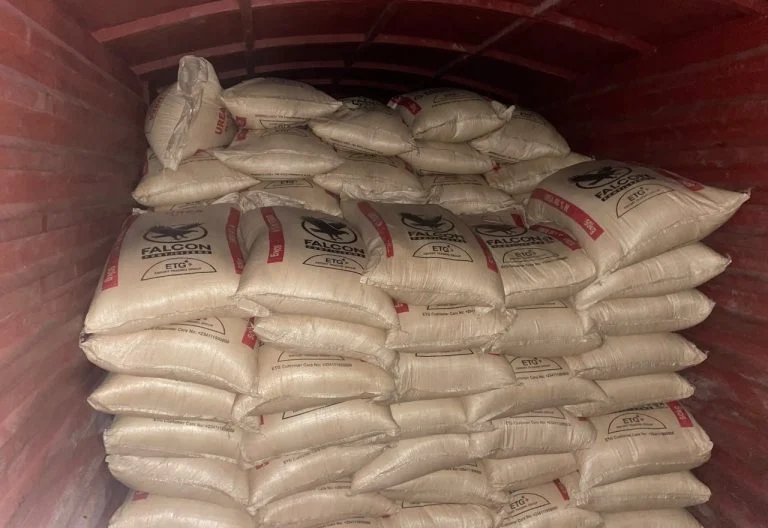
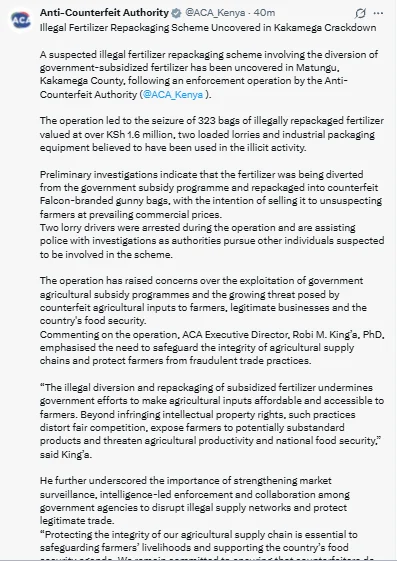
According to a statement shared by the authority on X on Friday, October 16, 2026, preliminary investigations indicate that the fertiliser may have been diverted from the government subsidy programme before being repackaged into counterfeit Falcon-branded gunny bags.
Authorities suspect the products were intended for sale to farmers at prevailing commercial prices rather than being distributed through the subsidised supply system.
The operation also led to the seizure of two loaded lorries and industrial packaging equipment believed to have been used in the suspected illegal activity.
The recovery has raised concerns about the integrity of agricultural supply chains and whether farm inputs intended to make production more affordable are reaching their designated beneficiaries.
ACA Warns of Risks to Farmers and Food Security
ACA Executive Director Robi M. King’a warned that the alleged diversion and repackaging of subsidised fertiliser could undermine efforts to improve farmers’ access to affordable agricultural inputs.
He said the suspected activities could also affect fair competition, expose farmers to products that may not meet the required standards and threaten agricultural productivity.
The concerns extend beyond the suspected infringement of brand and intellectual property rights. Fertiliser plays an important role in crop production, and farmers rely on products that meet the appropriate quality requirements for their intended use.
Where fertiliser is misrepresented or its quality cannot be verified, farmers risk spending money on inputs that may not deliver the expected results.
For small-scale farmers operating with limited resources, such losses can affect production costs, household incomes and the ability to invest in subsequent planting seasons.
King’a stressed that protecting the integrity of the agricultural supply chain was important for safeguarding farmers’ livelihoods and supporting Kenya’s food security objectives.
However, the seized products remain suspected counterfeit fertiliser, and their precise composition and quality have not been established in the information released by the authority.
Two Lorry Drivers Arrested as Investigations Continue
The ACA operation resulted in the arrest of two lorry drivers who were taken in to assist with investigations.
The authority said investigators were pursuing other individuals suspected of involvement in the alleged scheme, although their identities have not been disclosed.
The two vehicles, the fertiliser and the packaging equipment were secured as exhibits as authorities continued examining the circumstances surrounding the suspected diversion and repackaging.
The ACA has not publicly identified the other individuals being pursued or confirmed whether the two drivers have been formally charged in court.
Investigators will need to establish how the fertiliser was obtained, who was responsible for its handling and repackaging, and whether it was intended for distribution through commercial outlets.
The findings could help authorities determine the extent of the suspected operation and whether additional individuals or businesses were involved.
For now, the arrests mark an investigative step rather than a determination of criminal responsibility.
How the Alleged Scheme Could Undermine Fertiliser Subsidies
The Kenyan government operates a fertiliser subsidy programme intended to reduce the cost of agricultural inputs and improve access for farmers.
The programme is designed to support agricultural production by making fertiliser more affordable, particularly for farmers who might otherwise struggle to meet the cost of essential inputs.
The alleged diversion of subsidised supplies into commercial channels could undermine that objective by reducing the quantity available to intended beneficiaries.
Repackaging fertiliser in counterfeit branded bags could also make it harder for buyers to establish the product’s origin and authenticity.
Farmers purchasing agricultural inputs need reliable information about what they are buying, including the product’s identity, quality and suitability for their crops.
If subsidised products are diverted and sold at ordinary commercial prices, the intended beneficiaries may lose access to the lower-cost supplies, while those involved in the alleged scheme could potentially profit from the difference.
The ACA’s investigation is expected to help establish how the recovered fertiliser entered the suspected distribution chain and whether the allegations are supported by further evidence.
Earlier Crackdown Recovered More Than 4,100 Bags in Uasin Gishu
The Kakamega operation comes amid previous enforcement action targeting suspected counterfeit fertiliser in other parts of Kenya.
In July 2026, the Directorate of Criminal Investigations reported recovering approximately 3,500 bags of suspected counterfeit fertiliser in the Kabenes area of Soy Sub-County, Uasin Gishu County.
The recovery brought the total amount seized during that investigation to more than 4,100 bags, following an earlier operation in which detectives recovered 624 bags.
According to the DCI, some of the fertiliser recovered during the Uasin Gishu investigation was suspected to have originated from government-subsidised supplies.
The findings raised similar concerns about the potential diversion of agricultural inputs intended to support farmers and the risk of suspected counterfeit products entering the market.
Authorities have not, however, established a connection between the Uasin Gishu investigation and the latest operation in Kakamega.
The two cases illustrate the continuing enforcement challenge facing agencies tasked with protecting agricultural supply chains and investigating suspected illegal trading in farm inputs.
ACA Vows to Intensify Enforcement in Western Kenya
ACA Western and Nyanza Regional Manager Tom Muteti said the authority would step up enforcement operations across the region to address the illegal trade in agricultural inputs.
He highlighted the importance of surveillance, intelligence sharing and coordination between government agencies in identifying suspected illegal supply networks and disrupting their activities.
Such cooperation can help investigators trace products through the supply chain, identify suspicious repackaging operations and establish whether supplies intended for particular programmes have been diverted.
The Kakamega operation involved the recovery of fertiliser, vehicles and industrial packaging equipment, giving investigators several categories of exhibits to examine as they establish the suspected operation’s scope.
The authority’s wider objective is to protect legitimate traders and consumers while ensuring that agricultural products entering the market comply with applicable requirements.
For farmers, effective enforcement can help reduce the risk of purchasing falsely labelled products and strengthen confidence in the agricultural input market.
Farmers Urged to Remain Vigilant When Buying Farm Inputs
The ACA has urged farmers, agricultural input dealers and members of the public to remain alert when purchasing fertiliser and other agricultural products.
The authority also encouraged the public to report suspected counterfeiting, illegal repackaging and the diversion of subsidised supplies.
Farmers can reduce some purchasing risks by buying agricultural inputs from reputable suppliers, checking packaging and labelling carefully, and seeking clarification where a product’s origin or authenticity is uncertain.
Unusually presented packaging or inconsistent product information may warrant further checks, although appearance alone cannot establish that a product is counterfeit.
The latest seizure highlights the importance of protecting subsidised agricultural inputs from diversion while ensuring that farmers can access products that meet the necessary quality standards.
As investigations continue in Matungu, authorities will be looking to establish the origin of the recovered fertiliser, identify any wider network involved and determine what legal action may follow.
Ultimately, the success of the crackdown will depend not only on seizures and arrests but also on the ability to prevent illegal diversion, protect farmers and ensure that public investment in agricultural support reaches its intended beneficiaries.
As Kenya continues investing in agricultural support programmes, protecting subsidised fertiliser from suspected diversion will be essential to ensuring farmers receive the inputs intended to improve production, safeguard livelihoods and strengthen national food security.

