
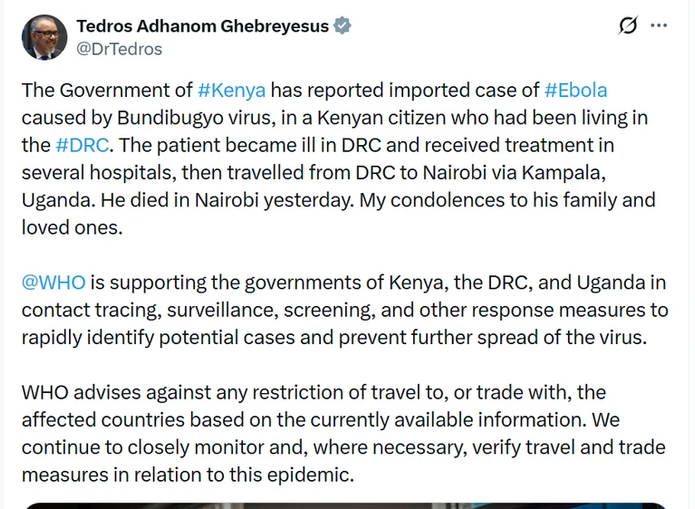
The World Health Organization (WHO) has advised against restricting travel or trade with Kenya, Uganda and the Democratic Republic of Congo (DRC) after Kenya confirmed its first imported case of Bundibugyo virus disease. The patient, a Kenyan citizen who had been living in the DRC, later died in Nairobi.
Highlights
- Kenya has confirmed its first imported case of Bundibugyo virus disease.
- The patient travelled from the DRC through Uganda before reaching Nairobi.
- WHO is supporting Kenya, Uganda and the DRC with surveillance and contact tracing.
- WHO has advised against travel and trade restrictions based on current information.
- Kenyan authorities are tracing contacts linked to the case.
Main Story
Kenya Confirms Imported Ebola Case
Kenya has confirmed its first imported case of Bundibugyo virus disease, a form of Ebola, after a Kenyan citizen who had been living in the Democratic Republic of Congo fell ill and later travelled to Nairobi.
According to WHO, the patient became sick while in the DRC and received treatment at several health facilities before travelling by road to Kampala through Beni on October 2.
The patient then flew from Uganda to Nairobi, arriving on October 3, where they were taken to hospital and isolated.
Laboratory testing at Kenya’s National Virology Reference Laboratory and the Kenya Medical Research Institute confirmed the infection. Despite receiving supportive treatment, the patient died on October 5.
WHO Supports Kenya’s Response
WHO Director-General Tedros Adhanom Ghebreyesus has expressed condolences to the patient’s family while commending Kenya for promptly reporting the case and activating its response systems.
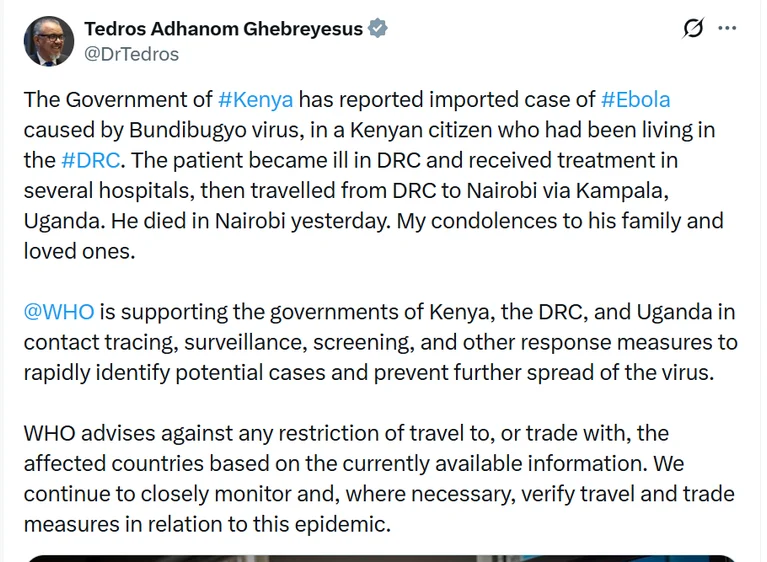
WHO is working with authorities in Kenya, Uganda and the DRC on contact tracing, surveillance, screening and other measures designed to identify possible infections early and limit further transmission.
As of October 6, Kenyan authorities had identified 28 contacts, including relatives and healthcare workers who interacted with the patient. Officials were also tracing 23 passengers and four crew members from the flight that carried the patient to Nairobi.
WHO Rejects Travel Restrictions
Despite the confirmation of the imported case, WHO is not recommending blanket restrictions on movement or trade involving Kenya, Uganda or the DRC.
The global health body says the current response should instead focus on surveillance, early detection, contact tracing and coordinated action across borders.
WHO has previously warned that broad travel restrictions can disrupt supply chains and interfere with outbreak response efforts.
Kenya Had Been Preparing for Ebola
Kenya had already stepped up its preparedness after Ebola cases were reported in the DRC and Uganda.
WHO says the country has screened more than 652,000 travellers, tested 267 suspected samples and trained about 5,000 healthcare workers in Ebola prevention and management as of October 6.
Isolation facilities in 27 high-risk counties have also been identified and assessed, while additional testing supplies and protective equipment have been distributed.
The preparedness work has included particular attention to Kenya’s borders. In September, WHO reported that health workers and border stakeholders had received training at the Busia and Malaba One-Stop Border Posts as well as Lwakhakha.
What Is Bundibugyo Virus Disease?
Bundibugyo virus disease is a severe illness caused by the Bundibugyo virus, one of the viruses responsible for Ebola disease.
It can spread through direct contact with the blood or other body fluids of an infected person, as well as contaminated materials. WHO says there are currently no approved vaccines or specific treatments for Bundibugyo virus disease, although candidate products are being evaluated in clinical trials.
The ongoing outbreak in the DRC has remained serious, with WHO previously assessing the risk as very high in the DRC and high for countries sharing its borders.
Health Authorities Urge Vigilance
WHO Africa Regional Director Dr Mohamed Janabi has praised Kenya’s preparedness and response, saying the country had important outbreak-control measures in place before the imported case was detected.
The focus now is on quickly identifying anyone who may have been exposed and ensuring that suspected cases are investigated and managed without delay.
For Kenya, the latest development underscores the importance of continued surveillance while avoiding unnecessary disruption to travel, trade and everyday life.
With Kenya’s surveillance systems now under closer scrutiny, the priority is clear: detect any further cases early, protect communities and keep the response moving faster than the virus.

