
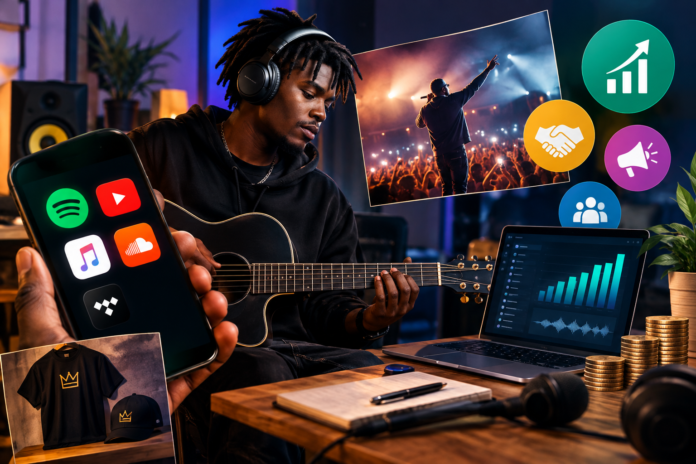
Music streaming has completely transformed the business of making music. Platforms such as Spotify, Apple Music and YouTube have made songs easier to access than ever, but they have also changed how artists earn from their work.
For musicians, success is no longer measured only by album sales. Streams, audience engagement, live performances, brand partnerships and other digital opportunities have become increasingly important sources of income.
Highlights
- Streaming has replaced much of the traditional album-buying model.
- Artists generally earn based on how their music is streamed.
- Large streaming numbers do not always translate into huge payouts.
- Touring, merchandise and brand deals remain important revenue sources.
- Social media and digital platforms have created new ways for artists to monetise their audiences.
Main Story
The End of the Album-First Era
For decades, musicians relied heavily on physical sales such as CDs, cassettes and vinyl records.
An artist could release an album and earn money each time a fan purchased a copy. Record stores and physical distribution were therefore a major part of the music business.
Streaming has changed that model.
Instead of buying an entire album, listeners can now access millions of songs through monthly subscriptions or advertising-supported platforms.
This has made music more accessible, but it has also changed how revenue reaches artists.
Streams Have Become the New Currency
Today, one of the most important numbers for a musician is the number of streams their songs receive.
Every time a song is played on a streaming service, revenue is generated and distributed through a complex system involving the platform, rights holders, record labels, publishers and artists.
However, artists do not simply receive a fixed amount directly into their accounts for every stream.
The amount ultimately reaching a musician depends on several factors, including their contract, ownership of the recording and songwriting rights, the platform involved and how the revenue is divided among rights holders.
This means two artists with similar streaming numbers can potentially take home very different amounts.
More Listeners, But Tougher Competition
One major advantage of streaming is that artists no longer need to depend entirely on traditional gatekeepers to reach listeners.
An independent musician in Kenya, for example, can release music digitally and potentially reach audiences in Africa, Europe, North America and beyond.
But the same accessibility has created intense competition.
Millions of songs are available online, making it difficult for individual artists to capture listeners’ attention. A successful release often requires consistent promotion across TikTok, Instagram, YouTube and other platforms.
Touring Has Become Even More Important
For many musicians, streaming helps build an audience, while live performances provide a more substantial opportunity to generate income.
Concerts, festivals, tours and appearances allow artists to turn online popularity into real-world revenue.
An artist who develops a large streaming audience can use that following to sell tickets, merchandise and VIP experiences.
This has made the relationship between digital popularity and live entertainment increasingly important.
Brand Deals and Social Media
Streaming has also contributed to the rise of the artist as a personal brand.
Musicians with strong online communities can attract partnerships with companies looking to reach their audiences.
Social media has created additional opportunities through sponsored content, collaborations, YouTube monetisation and other digital ventures.
For some artists, music is now just one part of a much broader entertainment business.
The Importance of Owning Your Music
The streaming era has also brought greater attention to music ownership.
Artists who control their master recordings and publishing rights can potentially retain a larger share of the money generated by their work.
Those who sign traditional record deals may receive significant support with production, marketing and distribution but could have to share revenue or surrender certain rights depending on the terms of their contracts.
As a result, more musicians are paying closer attention to contracts, royalties and intellectual-property ownership.
What This Means for Kenyan Artists
For Kenyan musicians, streaming presents both opportunities and challenges.
Digital platforms make it possible for local artists to reach audiences beyond Kenya without relying entirely on physical distribution.
However, building enough streams to generate substantial income remains difficult, particularly for independent musicians.
This has encouraged many artists to diversify their earnings through performances, endorsements, merchandise, content creation and collaborations.
Ultimately, streaming has not simply changed how people listen to music. It has changed how musicians think about their careers.
In today’s music industry, a song can be a source of streaming revenue, a marketing tool, a gateway to live performances and a platform for building a personal brand.
The streaming revolution has made music easier to discover than ever but for artists, turning those streams into a sustainable career still requires much more than simply making a hit song.

