
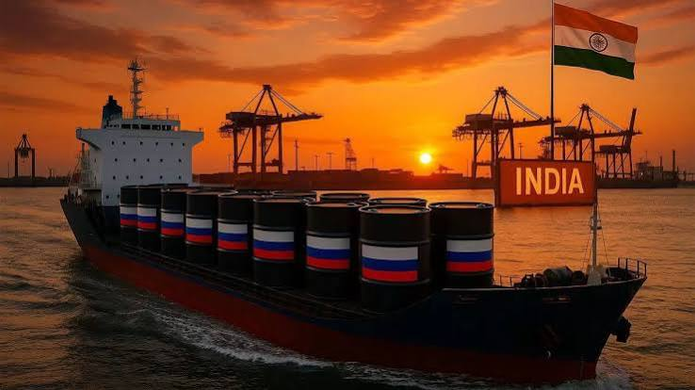
India’s strategy of buying discounted Russian crude is facing a fresh challenge after the US House of Representatives approved legislation that could expose countries purchasing Russian energy to tariffs of up to 100%. For New Delhi, the issue goes beyond diplomacy Russian crude has become a major part of its energy supply, while the United States remains a crucial market for Indian exports.
Highlights
- Russian crude accounted for 30.3% of India’s crude imports in fiscal 2026.
- India spent about $40.8 billion on Russian crude during the period.
- Proposed US measures could impose tariffs of up to 100% on Russian energy buyers.
- India says it remains focused on protecting its energy security.
- Replacing Russian oil could increase crude, shipping and insurance costs.
Main Story
From Bargain to Geopolitical Problem
For years, India has benefited from the disruption caused by Russia’s invasion of Ukraine.
Western sanctions and restrictions pushed large volumes of Russian crude away from traditional European markets. Indian refineries stepped in to absorb much of that supply, frequently purchasing the oil at discounts.
The arrangement helped India contain the cost of one of its largest import bills while giving its refiners reliable access to crude.
But what was once primarily an economic calculation is increasingly becoming a diplomatic headache.
The United States is now considering tougher measures against countries that continue purchasing Russian oil and gas.
India and China Face the Biggest Exposure
Legislation passed by the US House of Representatives would give President Donald Trump wider powers to sanction Russia and impose tariffs of as much as 100% on countries buying Russian energy.
India and China would be among the countries most exposed because of their substantial purchases of Russian crude.
Data from the Centre for Research on Energy and Clean Air shows that between December 2022 and August 2026, China accounted for about half of Russia’s crude exports, while India represented 37%.
India’s dependence has become particularly significant.
According to the Global Trade Research Initiative, Russian crude made up 30.3% of India’s crude imports in fiscal 2026, with purchases valued at approximately $40.8 billion out of a total crude import bill of $134.7 billion.
In July alone, Russia supplied more than half of India’s crude imports.
Finding Another Source Would Cost More
India can technically look elsewhere for crude, but replacing Russian supplies on a large scale would not necessarily be cheap.
S&P Global estimates that alternative supplies could come with higher crude prices as well as increased freight and insurance expenses.
Longer shipping routes could add further costs.
Kpler analyst Sumit Ritolia says the challenge is not simply finding buyers willing to take Russian barrels. The bigger question is whether enough alternative crude can enter the market without placing additional pressure on global supply.
That could make any sudden reduction in Russian imports a complicated exercise for New Delhi.
India Defends Its Energy Policy
The Indian Government says its priority remains securing affordable and reliable energy for its population.
In a statement, New Delhi said it was following developments around the proposed US measures while reaffirming its commitment to energy security.
India has also previously communicated its concerns to US officials, warning that the issue could affect both bilateral relations and the wider international oil market.
Former Indian trade official Ajay Srivastava, who heads GTRI, argues that purchasing Russian crude is primarily an energy-security decision rather than an attempt to support Moscow’s war effort.
He has also warned against allowing US tariff pressure to dictate India’s energy policy.
Washington Has Another Pressure Point
The potential impact on India would not be limited to its energy sector.
The proposed measure concerns tariffs on countries buying Russian energy, meaning Indian exporters could face consequences in the US market.
That matters because America is one of India’s most important trading partners.
The United States imported approximately $104 billion worth of goods from India in 2025, while two-way trade in goods and services was around $240 billion, according to the US Trade Representative.
Indian exports to the American market include electronics, pharmaceuticals, machinery, jewellery, chemicals, textiles and petroleum products.
Electrical and electronic equipment alone accounted for about $25.8 billion of Indian exports to the US in 2025, while pharmaceuticals contributed roughly $9.7 billion and machinery about $7.2 billion.
Delhi Faces a Difficult Calculation
The situation leaves Indian policymakers weighing two competing economic interests.
On one side is the savings generated by cheaper Russian crude.
The Council on Energy, Environment and Water estimates India has saved approximately $12.6 billion since shifting heavily towards Russian oil after 2022.
On the other side is the possibility of higher US tariffs affecting Indian exports.
Michael Kugelman of the Atlantic Council described the situation as particularly sensitive because it comes while India and the US have been engaged in trade discussions.
The potential tariff exposure could therefore affect Indian exporters, the rupee, refinery profitability and the country’s wider trade position.
Russian Oil Does Not Stop at Indian Refineries
India’s relationship with Russian crude has also created another link between the two economies.
Indian refineries process Russian crude into petroleum products, some of which are then exported.
This has become particularly significant as Ukrainian attacks on Russian refineries have affected Moscow’s ability to produce enough refined fuel.
According to CREA, Russian fuel imports reached a record 172,000 tonnes in August, more than seven times the previous monthly record.
India supplied about 120,000 tonnes, representing roughly 70% of those imports. Much of the fuel was petrol refined from Russian crude at a facility in Gujarat.
Energy Security Remains a Concern
India’s dependence on imported energy makes the issue even more complicated.
The country imports more than 88% of the crude oil it consumes.
According to the Council on Energy, Environment and Water, more than 85% of India’s crude imports come from six countries, with several suppliers located in regions exposed to geopolitical instability.
Indian refineries also vary in their ability to process different grades of crude, meaning switching suppliers may not always be straightforward.
The country’s energy vulnerability extends beyond crude oil.
India imports more than 60% of its liquefied petroleum gas, a major cooking fuel used by hundreds of millions of households.
Its strategic petroleum reserves are estimated to cover only around nine to 10 days of net oil imports, although refinery inventories provide additional coverage.
China Has More Economic Leverage
India is not the only major Asian buyer of Russian oil facing pressure from Washington.
China purchases even larger quantities, but analysts argue that Beijing has greater leverage in a potential confrontation because of its central role in global manufacturing and supply chains.
Kugelman argues that Washington may therefore view economic retaliation from China as potentially more disruptive than similar measures directed at India.
For New Delhi, the calculation is more delicate.
The country must consider whether the financial benefits of Russian crude continue to outweigh the potential consequences for its access to the American market.
What Happens Next?
The economics of Russian oil have already changed.
The discounts that initially made the crude exceptionally attractive to Indian refiners have narrowed, while shipping, insurance and sanctions-related risks have increased.
The final impact will depend on several factors, including the size of any Russian discount, international crude prices, transport costs and the tariff level ultimately applied by Washington.
Possible exemptions or a broader agreement between India and the US could also change the equation.
For now, India faces a balancing act between maintaining energy security and protecting its lucrative export relationship with the United States.
The decision could have consequences not only for India’s economy, but also for global oil markets.
For India, the Russian oil strategy has delivered billions in savings but with Washington now raising the stakes, the question is no longer simply how cheaply New Delhi can buy crude, but what price it is willing to pay for that advantage.
More on this topic: Russia Threatens UK Over Ukraine Support as NATO Attack Fears Grow. Official information: International Energy Agency.

