
Saudi Arabia’s ambitious Jeddah Tower has reached approximately 474 metres, putting the unfinished skyscraper at a height comparable to some of the world’s tallest completed buildings.
The milestone comes as construction reaches Level 118, with the project still aiming for an extraordinary final height of more than one kilometre.
Highlights
- Jeddah Tower has reached about 474 metres and Level 118.
- The structure is already around the same height as two major skyscrapers in the US and China.
- The completed tower is planned to exceed 1,000 metres.
- Jeddah Tower could overtake Dubai’s Burj Khalifa as the world’s tallest building.
- Construction is currently expected to be completed in August 2028.
Main Story
Jeddah Tower Hits Another Major Milestone
Construction of Saudi Arabia’s Jeddah Tower is continuing to climb, with the landmark structure now standing at roughly 474 metres.
Ian Norman Miller, senior executive project director at Saudi Binladin Group, announced that workers had completed the latest concrete pour, taking the tower to Level 118.
Miller praised the construction teams for safely reaching the new milestone, describing it as another step towards the project’s ultimate target of surpassing the one-kilometre mark.
Already Among the Tallest
At its current height, Jeddah Tower is already comparable to some of the world’s tallest completed skyscrapers.
New York’s Central Park Tower rises 472.4 metres, while Wuhan Greenland Center in China stands at 475.6 metres.
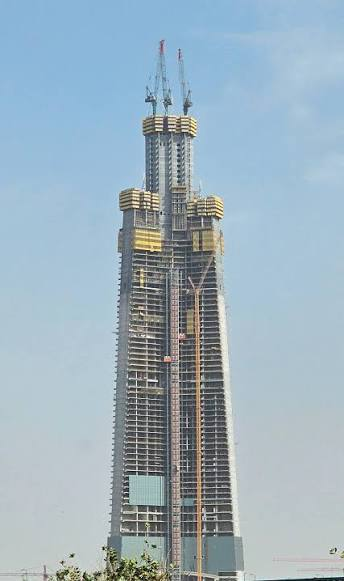
That means Jeddah Tower, despite still being under construction, is already operating in the same height range as these completed supertall buildings.
But unlike those structures, Jeddah Tower has hundreds of metres still to go.
Saudi Arabia Wants the World Record
The project is designed to rise beyond 1,000 metres, putting it on course to challenge Dubai’s Burj Khalifa, which currently stands at 828 metres.
If Jeddah Tower reaches its planned height, it would exceed the current record holder by more than 170 metres.
The project has therefore become one of the most closely watched construction developments in Saudi Arabia and could eventually redefine the global skyscraper race.
Engineering a Tower for Extreme Heights
Reaching such extraordinary heights requires more than simply stacking floors higher.
Jeddah Tower has been designed with a narrow, tapering profile and a three-winged base. Its shape changes progressively as the building rises, helping reduce the impact of strong winds on the structure.
Central Park Tower and Wuhan Greenland Center were also designed with wind and structural forces in mind.
All three projects share another connection: they were designed by Chicago-based architectural firm Adrian Smith + Gordon Gill Architecture and received wind engineering input from Canadian specialist RWDI.
What Will Be Inside Jeddah Tower?
The tower is expected to contain around 530,000 square metres of built-up space when complete.
Its planned facilities include luxury residences, offices, retail areas, hotel accommodation and an observation deck.
A major component of the development will be a Four Seasons hotel, alongside Four Seasons-branded serviced apartments, Class A office space and luxury condominiums.
The observation deck is also expected to become the highest of its kind in the world.
From Construction Setback to Major Comeback
Jeddah Tower’s latest progress comes after the project experienced a lengthy construction halt before work eventually resumed.
Saudi Binladin Group is leading the main construction, with completion currently estimated for August 2028.
The tower forms the centrepiece of the wider Jeddah Economic City development and is being positioned as a major symbol of Saudi Arabia’s ambitions for large-scale development.
Often described as the world’s first “skypiercer”, the project is built around the idea of breaking through the 1,000-metre barrier.
At 474 metres, however, the tower is only partway through that journey.
At nearly half a kilometre high and still climbing, Jeddah Tower is a reminder that the race to touch the sky is far from over.

