
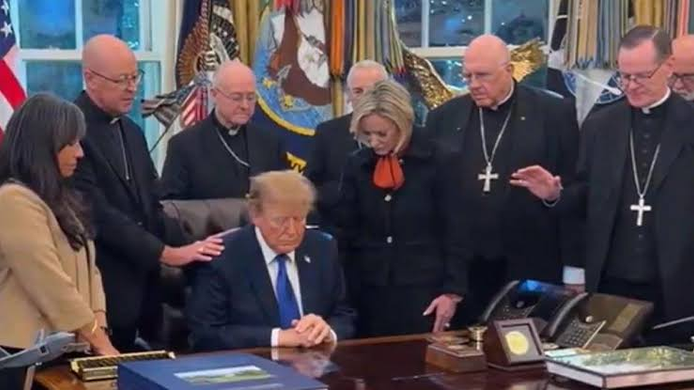
Two Catholic bishops in the United States have expressed regret over a meeting with President Donald Trump after photographs and video showing them praying with him in the Oval Office triggered criticism and raised questions about political endorsements. The religious leaders say they did not expect the encounter to become public and insist their participation was not intended to support any politician, as tensions continue over the administration’s immigration policies and its relationship with the Catholic Church.
Highlights
- Two US Catholic bishops have expressed regret after photos of them praying with Donald Trump circulated online.
- Archbishop Jeffrey Grob said he believed the meeting was private and not intended for political publicity.
- Bishop William Joensen said the discussions covered immigration, visas for international clergy and vulnerable communities.
- The controversy comes amid tensions between Trump’s administration and Catholic leaders over immigration enforcement.
- A recent survey found that approval of Trump among US Catholics had declined compared with 2025.
Main Story
Prayer Meeting Sparks Controversy
Two Catholic bishops in the United States have distanced themselves from the political attention surrounding a meeting with President Donald Trump at the White House.
Images and video from the October 22 encounter showed several bishops gathered around Trump at the Resolute Desk in the Oval Office, praying with the president.
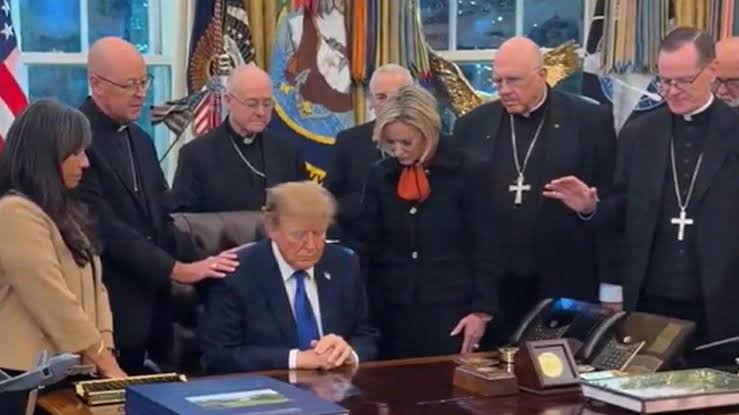
The footage prompted questions about whether the religious leaders were signalling support for the Republican president, particularly with a national election approaching.
Milwaukee Archbishop Jeffrey Grob, who was among those pictured, said he had understood the meeting to be private and did not expect it to be turned into a public political moment.
Grob later received messages from members of his congregation who were concerned about the images and what they appeared to communicate.
Bishops Say They Did Not Intend Political Endorsement
Bishop William Joensen of Des Moines, Iowa, also addressed the controversy in a public statement.
He explained that White House Faith Office officials had arranged the meeting to discuss a range of issues, including immigration, visas for international clergy and the exploitation of vulnerable people living in poverty.
Joensen said the bishops had not intended to endorse a political party or any individual seeking office.
He also expressed disappointment that the meeting had been used in a way that created the impression of political support.
Grob said the bishops had spent approximately 90 minutes meeting officials before being taken into the Oval Office to pray with Trump.
According to the archbishop, the public reaction included messages from people who feared the encounter suggested approval of the president’s policies. Others expressed pain over the effects those policies had allegedly had on them or their families.
Grob also said the participants had not given permission for photographs and video from the meeting to be publicly distributed.
White House Defends Trump
The video was shared online by Margo Martin, a special assistant to Trump and communications adviser who frequently posts footage from the president’s activities.
When approached for comment, the White House did not directly address the bishops’ concerns about how the images had been released.
Instead, spokesperson Taylor Rogers defended Trump’s record with Catholic Americans, arguing that his presidency had been particularly favourable to the community.
The response came as the bishops sought to clarify that meeting with a political leader should not automatically be interpreted as support for that leader’s political agenda.
The incident has renewed debate about the relationship between religious institutions and political power, especially when private discussions become public communications events.
Immigration Policies Deepen Tensions With Catholic Leaders
The controversy comes against a backdrop of growing disagreements between Trump’s administration and sections of the Catholic leadership over immigration enforcement.
Trump has pursued a tougher approach towards people believed to be living in the United States illegally, a policy that has attracted criticism from religious figures who emphasise compassion, family unity and the dignity of migrants.
Pope Leo XIV has also had a strained relationship with the president during his second term, reflecting broader differences over the administration’s immigration agenda.
Just over a week before the bishops’ White House meeting, Bishop Brendon Cahill and Walter Kim, president of the National Association of Evangelicals, issued a joint appeal urging compassion and wisdom in discussions about immigration.
They warned that the crackdown was contributing to fear, separating families, undermining due process and encouraging hostility towards neighbours.
The US Conference of Catholic Bishops has also criticised other administration proposals, including a plan to livestream a military execution that was subsequently abandoned.
These disagreements illustrate the challenge facing religious leaders who seek to engage with government officials while maintaining their independence on issues of public concern.
Catholic Support for Trump Under Scrutiny
The controversy also comes at a time when polling suggests Trump’s standing among Catholic voters has weakened.
According to figures cited from the Pew Research Center, 30% of American Catholics surveyed in October approved of Trump’s performance, down from 47% when he returned to the White House in 2025.
The same survey indicated that 42% of Catholic respondents preferred Democratic candidates in their local House of Representatives races, compared with 39% who favoured Republicans.
The figures could be significant ahead of the November 3 midterm elections, which will determine control of Congress.
Catholic voters represent an important constituency in American politics, making the relationship between the administration and influential religious leaders particularly consequential.
Catholic Figures Maintain Links With the Administration
Despite disagreements over immigration and other policies, several prominent Catholic figures have maintained connections with Trump’s administration.
Vice-President JD Vance and Secretary of State Marco Rubio are both Catholics who have visited the Vatican during Trump’s second term.
Bishop Robert Barron of Minnesota also agreed to serve on the president’s Religious Liberty Commission, alongside former New York Archbishop Timothy Dolan.
The differing responses among Catholic leaders demonstrate that engagement with the administration does not necessarily mean uniform agreement with its policies.
For Grob and Joensen, however, the immediate concern has been the public interpretation of their meeting with Trump and the impression that their presence might be taken as a political endorsement.
Their response highlights the delicate balance religious leaders must navigate when meeting political figures, particularly during a heated election period.
When faith leaders meet political leaders, where should the line be drawn between dialogue and the appearance of political endorsement?

