
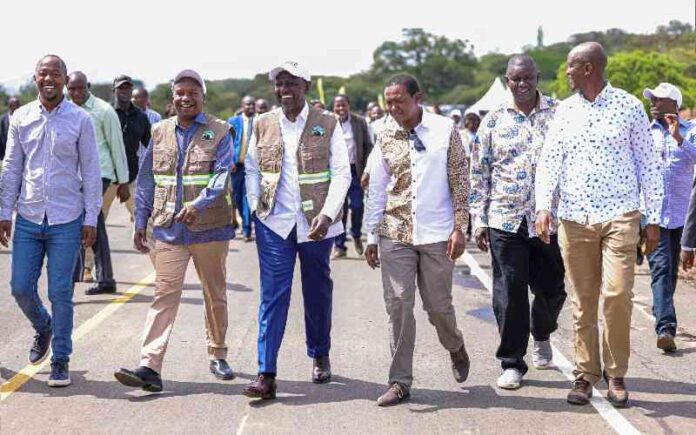
President William Ruto has defended his government’s development agenda while taking a swipe at opposition leaders, promising residents of Makueni County greater access to roads, electricity and public services. During his address, the President also defended Wiper leader Kalonzo Musyoka over his comments linking the Head of State to God’s role in road construction, insisting that the remarks were not wrong. Ruto further pledged to address regional development gaps, announcing a KSh 2.3 billion allocation aimed at connecting 22,000 additional households in Makueni to the national electricity grid by May 2027.
Highlights
- Ruto accused opposition leaders of focusing on political slogans instead of presenting clear policies on healthcare, education and infrastructure.
- The President defended Kalonzo Musyoka over comments suggesting that God was using Ruto to construct roads.
- Ruto promised that Ukambani would receive greater attention in the distribution of national development resources.
- The government plans to spend KSh 2.3 billion connecting 22,000 households in Makueni to electricity by May 2027.
- The President called for national unity, saying every Kenyan deserves equal treatment and access to public services.
Main Story
Ruto Accuses Opposition of Lacking a Clear Development Plan
President William Ruto has criticised opposition leaders, accusing them of prioritising political attacks over practical solutions to the challenges facing Kenyans.
Speaking in Makueni County, the Head of State argued that political leaders should focus on presenting workable policies covering infrastructure, education and healthcare instead of relying on campaign slogans.
Ruto maintained that his administration was committed to delivering development across the country, regardless of residents’ political affiliations.
He insisted that every Kenyan should benefit from government projects and services, adding that political differences should not determine which communities receive development.
The President also took issue with opposition leaders whom he accused of failing to present a convincing alternative to his administration’s development agenda.
His remarks come as political activity gradually intensifies ahead of the 2027 General Election, with leaders increasingly debating their records, policies and plans for the country.
Ruto Defends Kalonzo Musyoka Over God and Road Construction Remarks
The President also came to the defence of Wiper leader Kalonzo Musyoka following questions surrounding the opposition leader’s comments about Ruto’s role in constructing roads.
Kalonzo had reportedly described the President as someone being used by God to build roads, a statement that subsequently attracted attention and prompted questions during an interview.
Responding to the controversy, Ruto questioned why the remarks had become a subject of criticism.
He argued that there was nothing wrong with suggesting that a person could be serving God’s purpose through development projects.
The President further maintained that Kalonzo had simply acknowledged the construction work being undertaken by his administration.
Ruto’s response added another dimension to the political conversation between the two leaders, particularly as their respective camps continue positioning themselves ahead of the next election.
Although the exchange has attracted attention because of its religious undertones, the wider discussion centres on how political leaders communicate about government achievements and public infrastructure.
Ruto Promises Fair Development for Ukambani
Beyond the political exchanges, Ruto used his address to promise residents of Ukambani a greater share of national development initiatives.
The President said Kenya needed to move away from approaches that leave some communities feeling excluded from government programmes.
He maintained that public resources should be distributed fairly and that every citizen should have confidence that the government represents their interests.
Addressing residents of Makueni, Ruto urged them not to allow political differences to become a source of division or discrimination.
He pledged that his administration would continue pursuing development projects across Ukambani, with roads among the key priorities.
The President framed his promise around the principle of Usawa ni Sawa, emphasising equal treatment and access to public services regardless of where Kenyans live.
For residents of the region, the significance of these assurances will ultimately depend on the projects delivered, the services improved and the extent to which communities experience tangible changes in their daily lives.
KSh 2.3 Billion Set Aside for Electricity Connections in Makueni
Rural electrification was another major issue highlighted during the President’s remarks, with the government outlining plans to connect thousands of additional households in Makueni County to the national electricity grid.
According to the announcement, KSh 2.3 billion has been allocated towards connecting 22,000 households, with the programme targeting completion by May 2027.
The initiative is intended to extend electricity access to communities that have continued to experience limited connectivity, particularly in rural areas.
Access to electricity can have a significant impact on household welfare and economic activity. Families can benefit from improved lighting and greater convenience, while traders and small businesses can use power to extend their operations and adopt electrical equipment.
Electricity connections can also support learning by giving students better access to lighting and digital resources, while helping communities improve their access to modern technology.
However, the impact of the programme will depend on the pace of implementation, the reliability of the connections and whether the announced target is achieved.
The KSh 2.3 billion allocation therefore represents a commitment that residents will be watching closely as the government works towards its stated deadline.
Government Emphasises Equal Access to Public Services
Ruto’s message in Makueni also focused on the broader question of fairness in the distribution of public resources.
The President argued that residents in every part of Kenya contribute to the country’s economy through taxes and should therefore benefit from essential services.
Under this approach, rural electrification and road construction are presented as important tools for addressing development gaps between different regions.
For communities that have experienced limited access to infrastructure, improved connectivity can make it easier to reach schools, hospitals, markets and other essential facilities.
Better roads can reduce travel difficulties and improve the movement of goods, while electricity can support businesses and create opportunities for economic growth.
Nevertheless, equitable development requires more than announcements and budget allocations. The progress of projects, the quality of completed infrastructure and the accessibility of public services remain important measures of whether government commitments are being fulfilled.
As the 2027 General Election approaches, development is likely to remain a major subject of political debate, with leaders facing increasing pressure to demonstrate what their policies mean for ordinary Kenyans.
For Makueni residents, the immediate focus will be on whether the promised electricity connections, roads and other investments translate into lasting improvements.
As political leaders make promises ahead of 2027, the question for residents of Makueni and the rest of Kenya remains the same: Will the development commitments made today deliver meaningful change in the lives of ordinary citizens tomorrow?

